By Nukanah Kollie / kollienukanah94@gmail.com
In Liberia, where poverty, entrenched gender disparities, and cultural barriers hinder access to education for girls, the Center for Justice and Peace Studies (CJPS) is spearheading a transformative initiative aimed at empowering adolescent girls and young women.
With financial backing from the international development organization Bread for the World, CJPS is actively working in 21 schools across Bong, Margibi, and rural Montserrado Counties. The program directly engages 315 girls through organized advocacy clubs, mentorship, parental involvement, and material support.
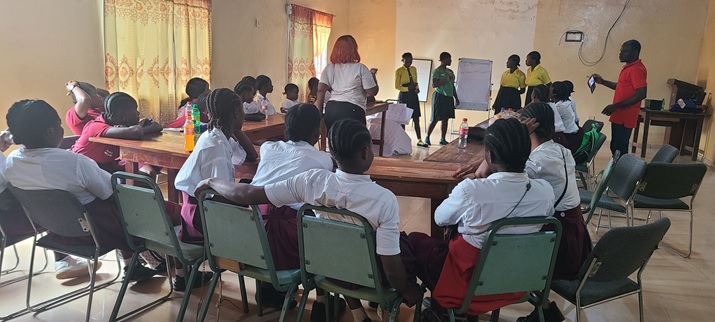
“Each school hosts a Girl Advocacy Club with 15 members,” shared Francis Konyon, Acting Executive Director and Program Manager of CJPS. “These clubs are platforms for developing leadership and life skills, enabling the girls to become peer advocates and agents of change within their schools and communities.”
Launched in July 2024 and set to continue through 2026, the initiative promotes school enrollment and retention for girls, challenges harmful societal norms, and provides essential assistance like tuition, learning materials, and sanitary items. For Konyon, the deeper objective lies in building confidence and fostering leadership. “We’re not just keeping girls in school; we’re equipping them to lead and realize their potential. We encourage discipline, advocacy, and ownership of their voices.”
CJPS also targets male involvement through its “Father Schools” — a gender-awareness initiative engaging 180 fathers in structured dialogues around parenting, shared responsibilities, and gender equality. “We address toxic masculinity head-on,” Konyon said. “We help men become supportive figures within their families.”
Mentorship is another critical layer. In each of the three counties, three respected women act as mentors for out-of-school girls, helping them regain self-esteem and chart a course back into education or vocational programs.
Girls Share Their Journeys: Stories from the Clubs
At schools such as Yanquobei in Palala, G.W. Gibson in Suakoko, and N.V. Massaquoi in Gbarnga, the initiative is creating tangible impact. During a recent CJPS media tour, several girls expressed how the program has touched their lives.
Yassah, a club member, called the project life-changing: “CJPS is supporting our education. Even if it’s not everything, they’re doing what most groups won’t. It’s a big deal to take responsibility for students like us.”
She highlighted how the club has empowered her and others to advocate for their rights. “We teach our classmates about living responsibly in society. Without this club, many of us wouldn’t understand our worth or our rights.”
CJPS also tackles taboo issues like teacher misconduct. “If a teacher approaches you wrongly — what we call ‘loving business’ — we know now to report it. Teachers should protect, not harm us,” she added.
Mary, a 20-year-old in 11th grade, thanked the program for easing the burden on her family: “Our parents are doing their best, but fees are hard to manage. I’m just grateful — and I hope this support continues so more girls can benefit.”
She also encouraged teenage mothers not to give up. “Making a mistake doesn’t mean it’s over. You can raise your child and still finish school.”
Another student, Agata, emphasized the importance of menstrual health education. “Some of us didn’t even know how to properly use sanitary pads. CJPS taught us how to care for our bodies, and I’m proud of that.” She promised to share this knowledge: “I’ll teach my younger friends about hygiene and self-respect.”
Hannah and Jamama, also participants, voiced appreciation for the financial and emotional support the program offers. “If you’re a girl who can’t read or write,” Hannah noted, “you’re left behind in your community.”
Leadership Endorsement: A Principal’s Viewpoint
At St. Mark’s Lutheran High School in Bong County, Principal James K. Barkolleh has witnessed the program’s benefits firsthand. “You don’t often see such meaningful initiatives. It brings real relief to parents and hope to students,” he said.
St. Mark’s is one of the schools where 15 girls have received partial scholarships and life skills training. Mr. Barkolleh noted that a recent $420 USD disbursement helped cover student fees. “Some parents were shocked and grateful. They didn’t even know their children would be chosen.”
He also commended the transparent selection process: “CJPS coordinated directly with us. Selection was based on need, character, and willingness — not favoritism.”
Calling the initiative a “lifeline,” Barkolleh encouraged expansion: “Helping 15 students is great, but we need to reach 75 or even 100 next year. The demand is real.”
The Road Ahead: Sustaining Progress
As the program evolves, stakeholders and participants alike emphasize the need for sustainability. “No parent wants their child sent home over unpaid fees,” Konyon said. “This intervention reduces financial stress and prevents conflicts that can spiral into violence. The impact extends well beyond the classroom.”
To donors and partners like Bread for the World, Konyon offered heartfelt thanks: “Your support creates ripple effects — better attendance, confident girls, and more stable communities. We remain committed to accountability by documenting our results and sharing real stories of transformation.”
Wider Context: Education and Equity in Liberia
Liberia faces considerable obstacles to achieving gender parity in education. According to UNICEF, only 64% of girls are enrolled in primary school, compared to 75% of boys. This disparity grows in secondary school, where only 42% of girls attend, compared to 62% of boys.
Poverty is a major contributing factor. With over half the population living below the poverty line as of 2019, families often prioritize boys’ education, viewing it as more likely to yield economic return.
Deep-rooted cultural beliefs and practices further hinder girls’ school attendance and retention, compounding the gender gap in education and opportunities.
Conclusion
As Liberia continues striving toward inclusive, gender-sensitive education, CJPS is making a powerful case for community-driven change. Through advocacy, mentorship, and strategic support, the organization is cultivating a generation of young women prepared to rewrite their futures — and their country’s.