
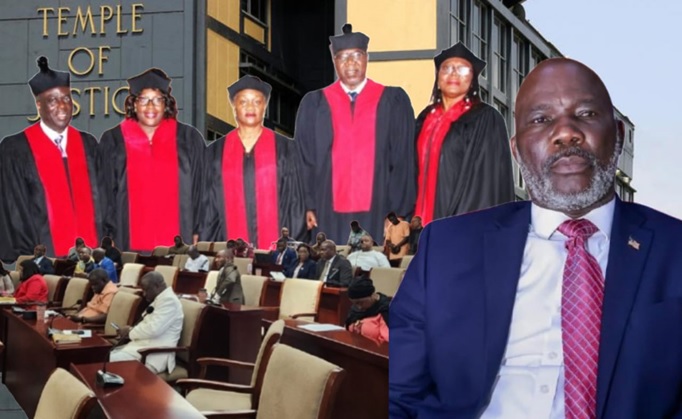
MONROVIA, LIBERIA – In a stunning display of legislative defiance, the House of Representatives on Tuesday, June 3, 2025, passed a resolution seeking to retroactively validate all actions taken by the controversial “Majority Bloc” earlier this year, including the passage of the 2025 national budget. This move comes just weeks after the Supreme Court of Liberia ruled that the bloc’s actions were unconstitutional and void, throwing the country’s governance into further legal uncertainty. What unfolded during Tuesday’s session was not just a vote on a resolution; it was a direct challenge to the constitutional framework that governs the separation of powers in Liberia.
The resolution, introduced by Chief Clerk Mildred Siryon and moved by Montserrado County District 16 Representative Dixon Seboe, aims to give legal effect to decisions taken by a group of lawmakers who had attempted to oust then-Speaker Jonathan Fonati Koffa and operated under what the Supreme Court declared to be an illegitimate leadership structure. That same leadership passed the 2025 national budget and took numerous administrative actions while functioning in legal limbo. The resolution passed unanimously, without debate, and was immediately forwarded to the Liberian Senate for concurrence.
This development raises serious constitutional and ethical questions. Liberia’s Constitution, under Article 65, gives the Supreme Court the exclusive authority to interpret the law and determine what is constitutional. The Court’s April 2025 ruling was clear and decisive: the actions of the breakaway Majority Bloc were unconstitutional. That the House would now attempt to override the Court’s judgment through a simple resolution signals a profound disregard for the rule of law. The implications of such legislative behavior are grave. If left unchecked, it sets a dangerous precedent where unconstitutional actions can be papered over by legislative fiat, eroding the very foundations of democratic governance.
Supporters of the resolution, like Rep. Seboe, argue that it is a necessary step toward reconciliation and national stability. They claim that rescinded suspensions and reinstated benefits signal a return to normalcy and that legitimizing past actions is essential to moving the country forward. However, national reconciliation cannot be achieved at the expense of the law. Stability built on illegality is inherently unstable. Worse, it sends a signal to the public and future lawmakers that constitutional violations are tolerable so long as they are later blessed by a cooperative majority.
Prominent voices in the legal community have expressed deep concern. Renowned constitutional lawyer Cllr. Taiwan Gongloe emphasized that the national budget, as a statute, requires a formal legislative process involving public hearings and debate. “It cannot be validated by a mere resolution passed after the fact,” Gongloe stated. He also warned that under the Public Financial Management Act of 2017, the government is only permitted to spend up to one-twelfth of the previous year’s budget in the absence of a duly passed new budget. Any expenditure beyond that threshold, he noted, would be considered unlawful and potentially subject to criminal penalties.
Critics of the Boakai administration have also seized on this controversy as evidence of a deepening democratic crisis. Political commentator Matthew Nyanplu did not mince words, accusing the president and his allies of gross constitutional violations. He argued that Liberia’s recent diplomatic achievement of securing a non-permanent seat on the United Nations Security Council is meaningless if the country’s leadership cannot uphold the rule of law at home. Nyanplu’s remarks reflect a growing public skepticism toward the administration’s commitment to justice, governance, and democratic principles. He warned that symbolic victories on the international stage do nothing to address the daily struggles of Liberians or restore trust in domestic institutions.
What the House of Representatives has done is more than a procedural maneuver; it is an assault on judicial authority. It attempts to normalize unconstitutional conduct by rewriting the legal history of a deeply flawed episode in the Legislature’s operations. The argument that this is about healing the nation is disingenuous. True healing requires accountability, transparency, and an unwavering respect for the Constitution. The Supreme Court’s decision should be final and binding, not subject to reinterpretation by a political majority acting out of convenience.
All eyes now turn to the Senate, which faces a pivotal test of integrity. Will it rubber-stamp this blatant circumvention of constitutional order, or will it act as a safeguard of democratic norms? The Senate’s decision will determine not only the fate of the resolution but also Liberia’s credibility as a constitutional democracy.
The broader public must also take note. Citizens must understand that while legislative bodies are empowered to make laws, they are not above the law. The Supreme Court exists as a check on majoritarian overreach, and its authority must be respected. Allowing the House to rewrite constitutional rulings through resolution invites lawlessness and puts Liberia’s democratic experiment at grave risk.
The resolution may have passed, but the real test lies ahead. Will Liberia choose the path of legality, or will it embrace expediency at the cost of justice and constitutional order? The answer to that question will define not just this administration, but the future of Liberian democracy.