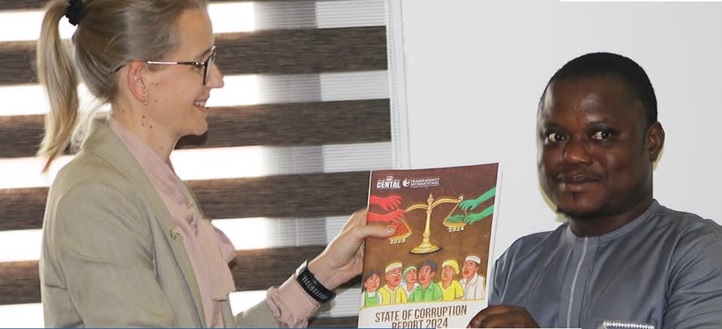
MONROVIA – The Center for Transparency and Accountability in Liberia (CENTAL), with support from the Swedish International Development Cooperation Agency (SIDA) through the Embassy of Sweden, officially launched the fourth edition of its flagship State of Corruption Report (SCORE) on Wednesday, June 11, 2025, at the Boulevard Palace Hotel in Sinkor.
The SCORE report, a key component of CENTAL’s National Integrity Building and Anti-Corruption Program, aims to provide a comprehensive assessment of Liberia’s corruption landscape, combining public perception, institutional performance, and media monitoring.
Welcoming participants from civil society organizations, youth and student groups, people with disabilities, and members of the media, CENTAL Program Officer Jereyline T. Wonde hailed the gathering as a “turning point in the fight against corruption.” She encouraged attendees to view the day’s event as a collective effort toward creating a corruption-free Liberia.
CENTAL’s Executive Director Anderson D. Miamen stressed the significance of the SCORE report in enhancing the country’s anti-corruption architecture. “Corruption has remained a persistent issue in Liberia,” Miamen stated. “Although many reports have been published over the years, we lacked a national document that deeply analyzes the trend of corruption from multiple dimensions, including citizens’ perceptions, the role of media, and the effectiveness of public integrity institutions.”
According to Miamen, the first SCORE report was introduced in 2021 and has since become a vital tool for policymakers, civil society, and development partners. The fourth edition, he said, draws from interviews conducted across nine counties, media analysis, and performance assessments of key institutions. It not only captures public sentiment but also evaluates real developments in Liberia’s ongoing anti-corruption battle.
Program Manager Atty. Gerald D. Yeakula, who presented the findings, said the report was informed by a sample of 752 respondents from counties including Montserrado, Nimba, Bong, Bassa, and others. He explained that data collection was carried out between November 2024 and January 2025 and combined survey responses with expert interviews and document analysis.
“This report is not just about listing problems. It highlights both the bad and the good, where progress has been made and where challenges persist,” said Yeakula. “It also questions the extent to which existing anti-corruption laws are being implemented and whether institutions are adequately resourced to fulfill their mandates.”
He acknowledged the report’s limitations, including logistical constraints that restricted fieldwork to more accessible areas and excluded the southeastern counties. However, he stressed that the findings remain statistically significant and offer valuable insights into corruption trends in Liberia.
Representing the Embassy of Sweden, Program Officer Nikolina Stalhand reaffirmed Sweden’s commitment to supporting integrity initiatives in Liberia. “This report is a reflection of our shared belief that transparency and accountability are essential for inclusive development,” she remarked. “While Liberia has taken steps in the right direction, such as the establishment of the Office of the Ombudsman and renewed momentum around the War and Economic Crimes Court, much more needs to be done.”
Stalhand emphasized that institutions must not only exist on paper but must also be empowered to function effectively. She called for strict adherence to laws, the end of impunity, and deeper citizen engagement in governance. As she prepares to leave Liberia after four years of service, she thanked CENTAL for its dedication and partnership.
The SCORE 2024 report is expected to inform advocacy strategies, public discourse, and policymaking in Liberia’s ongoing efforts to strengthen transparency and accountability. CENTAL and its partners pledged to ensure the report’s findings and recommendations are widely disseminated and incorporated into national reform initiatives.