By Socrates Smythe Saywon
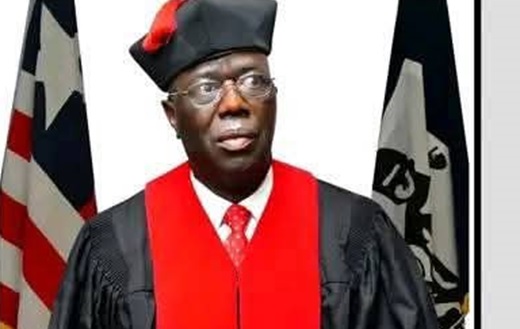
MONROVIA – Liberia’s Judiciary entered a new era on Wednesday, August 20, 2025, when Yamie Quiqui Gbeisay was formally inducted as Chief Justice of the Republic of Liberia. The induction ceremony, held in the Chambers of the Supreme Court, was graced by Vice President Jeremiah Kpan Koung, Speaker Richard Nagbe Koon, Senate Pro Tempore Nyonblee Karnga-Lawrence, members of both houses of the Legislature, justices, judges, cabinet officials, members of the diplomatic corps, and representatives of the Liberia National Bar Association.
Chief Justice Gbeisay, delivering his first major address in the role, pledged to lead a Judiciary committed to accountability, discipline, and reform, stressing that justice must be delivered without fear or favor in line with the Constitution and the laws of Liberia.
“In accordance with the provision of Judicial Canon #2, this seating program today is the last step of the processes required for my colleague, Mr. Justice Boakai Kanneh, and I to formally sit on this Bench in our respective capacities to take part in the work of this Court,” Gbeisay told the audience, thanking God for his elevation and pledging to meet the challenges of the position.
Reflecting on his journey through the legal system, Gbeisay reminded the public that he had practiced law for 17 years, served seven years as a Circuit Court Judge, and three years as an Associate Justice before his appointment as Chief Justice. “I believe I know the problems of the Judiciary from all perspectives. I will work along with the other members of this Court and the support staff of the Judiciary to find the solutions,” he said.
The Chief Justice outlined a sweeping reform agenda, beginning with the continuation of the rebranding program of his predecessor. He promised “credential audits” to verify the academic qualifications of judicial staff, while highlighting infrastructure challenges, especially the lack of electricity at rural courts. “We will make appropriate arrangements for the provision of solar panels as an alternative,” he said.
He also announced the transformation of the Inspectorate Division into the Judiciary Monitoring and Evaluation Division (JM&ED), which will track performance, analyze case returns, and ensure accountability among judges and magistrates. “My administration will be robust and result-oriented. Chief Justice Gbeisay will be a man of few words; I intend to talk less but do more,” he declared.
On discipline within the bench, Gbeisay warned that laziness and neglect would not be tolerated. “Some judges believe that a judge is untouchable or above the law. Such attitude and mindset are totally wrong and unacceptable; they will have no place under our watch,” he cautioned, adding that judges and court staff must report to work on time and meet their responsibilities.
The Chief Justice also vowed to push for better salaries and benefits for judges, insisting that the Judiciary must no longer be treated as inferior to the Executive and Legislative branches. “We will demand our rights under the Constitution and ensure that the Judiciary is no longer a stepchild of the other two branches of Government. We are co-equal and must be seen as co-equal in all decisions, including financial administration,” he said, commending the Boakai administration for beginning to implement the Judiciary’s Financial Autonomy Act.
Gbeisay pledged to strengthen judicial training, mandating refresher courses for judges and staff through the James A. A. Pierre Judicial Institute. He criticized judges who issue vague rulings, relying only on phrases such as “in the mind of the court,” and warned that such practices would no longer be accepted.
He further committed to addressing challenges such as lawyers misusing remedial writs to delay cases, the solo practice of law that disrupts proceedings when lawyers travel, and the rising tide of fraudulent land transactions. “If nothing is done, we will not be surprised if someone appears in court with ‘original deed’ for the land occupied by Temple of Justice itself or the Executive Mansion,” he warned.
On corruption, the Chief Justice pledged zero tolerance, announcing preventive measures such as installing CCTV cameras in courts, posting anti-bribery signages, and requiring indemnity bonds from judicial officers. “There will be zero tolerance for corruption and ethical malpractice by judicial actors, whether a judge, a lawyer or support staff,” he vowed. “We will work to ensure that the Judiciary is a place where justice is served to all, the rich or poor, irrespective of color, creed or political connections.”
Closing his remarks, Gbeisay assured Liberians that under his watch, the Judiciary will be a true beacon of hope. “Here, we only look at the facts, evidence and the applicable laws as our guards, nothing more, and nothing less,” he said. “May God Almighty continue to bless the Judiciary and save the State.”