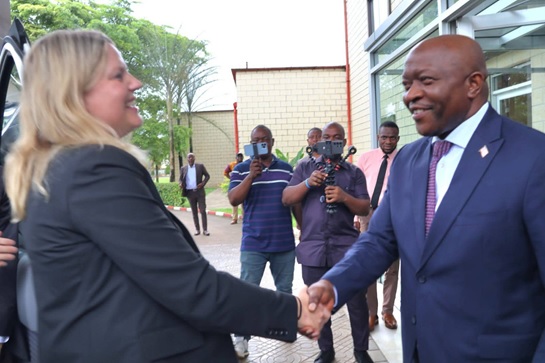
MONROVIA – A high-level delegation from the United States Government’s Millennium Challenge Corporation (MCC) arrived in Liberia on Monday, September 22, 2025, marking the beginning of a decisive review of Liberia’s readiness for a second Compact. Finance and Development Planning Minister Augustine Kpehe Ngafuan led a team of Liberian officials at Roberts International Airport in Margibi County to receive the delegation, which is headed by Ms. Carrie Monahan, MCC’s Managing Director for Africa.
The team includes senior experts in finance, trade, and economic analysis, among them Deidre Fair, Director of Finance and Trade; economists Steve Anderson, Peter Glick, and Sophia Marcus; Finance and Trade Specialist Sheena Cooper; and Arif Mamun, Deputy Vice President for the Economic Analysis Division. Their mission, according to the Ministry of Finance and Development Planning (MFDP), will form part of MCC’s “Constraints Analysis,” a diagnostic exercise designed to identify structural barriers to growth and pinpoint sectors best positioned for investment.
The visit comes at a critical time as MCC prepares for its next board meeting in December 2025, when Liberia’s eligibility for a second Compact will be reviewed. Over the coming days, the team is expected to hold a series of engagements with key government ministries, regulators, and private sector stakeholders, including the Ministry of Foreign Affairs, National Investment Commission, Central Bank of Liberia, Liberia Institute of Statistics and Geo-Information Services (LISGIS), Ministry of Mines and Energy, and the Liberia Extractive Industries Transparency Initiative (LEITI).
For Liberia, the stakes could not be higher. A second Compact would potentially unlock hundreds of millions of dollars in new investment and reaffirm the international community’s confidence in the country’s governance and economic trajectory. The process had stalled in recent years, largely due to shifts in U.S. domestic politics and evolving global development priorities, but the resumption of talks signals renewed momentum.
Liberia’s first MCC Compact, signed in 2015 and valued at $257 million, concentrated on the energy and road sectors. Its centerpiece was the rehabilitation of the Mount Coffee Hydropower Plant, which significantly expanded electricity generation for Monrovia and surrounding areas. The Compact also supported institutional strengthening at the Liberia Electricity Corporation (LEC) and reforms in road maintenance.
While the program was widely credited with stabilizing the country’s fragile energy sector, it was not without shortcomings. Project delays, weak institutional capacity, and governance concerns limited the overall impact. Civil society groups have argued that despite increased generation, chronic electricity shortages, high tariffs, and limited distribution meant that ordinary Liberians saw only marginal improvements in their daily lives.
“MCC money did help stabilize the energy sector, but the ripple effects were less transformative than expected,” said an analyst with a local governance watchdog. “The hope is that a second Compact will take into account the structural weaknesses that continue to stifle growth.”
As Liberia awaits the MCC board’s December review, attention has turned to the Boakai administration’s governance record. The MCC scorecard, which measures indicators such as control of corruption, rule of law, trade policy, and investment in human capital, will play a pivotal role in determining eligibility. For President Boakai, whose administration launched the National Development Plan, known as the ARREST Agenda for Inclusive Development, on January 15, 2025, the assessment will also serve as a test of his government’s ability to deliver on promises of reform and accountability.
Analysts suggest that if approved, a second Compact could prioritize sectors beyond energy, including agriculture, transport, and digital infrastructure, areas critical to broad-based, inclusive growth. It may also align closely with reforms in revenue generation, trade facilitation, and land governance, priorities that are central to the ARREST Agenda.
For many Liberians, the MCC delegation’s visit represents more than a technical review. It is seen as a chance for the country to demonstrate that it is ready to turn the page on years of underperformance and governance shortcomings. The outcome of this process will not only shape the flow of development dollars but also signal whether Liberia’s reform path is convincing enough to attract lasting international support.
As the delegation begins its consultations, optimism is cautiously balanced with realism. The prospect of a second Compact is within reach, but Liberia must prove that it has the governance discipline, institutional strength, and economic vision to make it count.