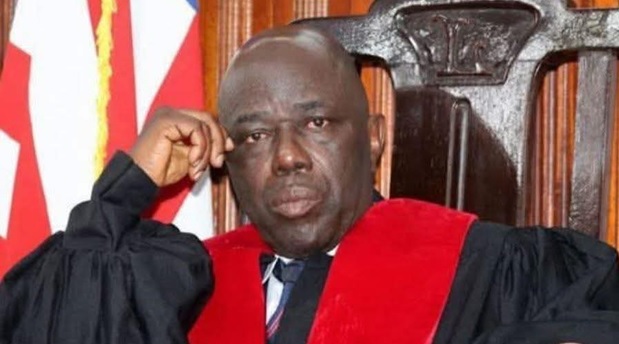
MONROVIA – Liberia’s judiciary is facing mounting criticism after Chief Justice Yamie Quiqui Gbeisay recommended his son, Willeyon Y. Gbeisay, along with several others, for magistrate positions across the country, despite allegations that many lack formal legal training or certification. The National Association of Trial Judges of Liberia (NATJL) has raised alarms over the appointments, warning that bypassing institutions such as the Louis Arthur Grimes School of Law and the James A.A. Pierre Judicial Training Institute undermines the credibility and professional standards of the judiciary.
In a response issued on Sunday, September 28, 2025, Chief Justice Gbeisay defended his decision, challenging NATJL to cite any legal authority that prevents a sitting Chief Justice from recommending a qualified individual, including a relative, for judicial appointment. “My son’s recommendation to serve as Associate Magistrate was not an act of favoritism but a reflection of his capabilities and interest in public service. The law does not disqualify him on the basis of relation, nor does it forbid me from exercising my right to recommend. Until NATJL can present a clear violation of law or ethical breach, their concerns remain speculative and unfounded. The Judiciary must operate on the basis of law, not innuendo,” he stated.
The Chief Justice’s remarks have drawn sharp criticism from political and legal circles. Former District Number 8 Representative Acarous Moses Gray, a member of the opposition Congress for Democratic Change (CDC), questioned whether the Chief Justice had considered the 2014 Code of Conduct governing public officials, particularly its provisions on nepotism. Gray highlighted sections that prohibit public officials from appointing, promoting, or advocating for relatives within their agency or branch of government, noting that violations could result in dismissal, suspension, demotion, or a prohibition from government service for up to five years. He warned that ignoring these provisions could have serious legal and ethical implications.
In a formal communication to Chief Justice Gbeisay on Wednesday, September 24, 2025, NATJL President Judge Nancy Finda Sammy commended prior efforts by the Supreme Court to encourage law students to pursue legal education with a view to future judicial appointments. However, she stressed that these gains are being threatened by appointments that circumvent formal legal recruitment and training processes. “If appointments can bypass the legal recruitment and training process,” Judge Sammy asked, “then what becomes of the necessity and credibility of the Law School and the Judicial Institute and of those presently undergoing legal training?”
The NATJL listed several individuals allegedly appointed as Associate Magistrates without completing the requisite training, including Rufus Kekeh at Zuolay Magisterial Court in Nimba County, Joseph K. K. Fallah at Gbar Magisterial Court in Bomi County, Windell Miller at Edina Magisterial Court in Grand Bassa County, Aaron Morgan Tokpah at Bopolu City Magisterial Court in Gbarpolu County, Jarty Barclay and Aquoi Kennedy at Kongbor Magisterial Court in Gbarpolu County, Harris M. Boakai at Voinjama City Magisterial Court in Lofa County, and Willeyon Y. Gbeisay at Paynesville Magisterial Court in Montserrado County.
Judge Sammy urged Chief Justice Gbeisay to intervene promptly, warning that continued disregard for legal qualifications could erode public confidence in the judiciary. She emphasized that the integrity and independence of the courts must be safeguarded and called for timely corrective action to restore trust in Liberia’s judicial system. The NATJL’s statement reflects growing concern among legal professionals that appointments outside established legal frameworks threaten the judiciary’s credibility and undermine years of effort to professionalize Liberia’s magistracy.