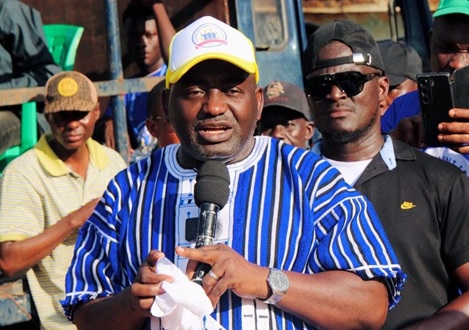
MONROVIA – The political credibility of businessman-turned-politician Musa Hassan Bility has come under renewed scrutiny following the resignation of Madam Grace R. Guar, a founding member and strong supporter of the Citizens Movement for Change (CMC). Guar’s exit, which she attributed to a lack of transparency within the party, has rattled Bility’s movement less than a year after its establishment.
In a press release issued by the CMC’s Media and Communications Director, Smith M. Toby, on October 26, 2025, the party confirmed Guar’s resignation from her post as USA/Canada Diaspora Chairperson. The statement conveyed the political leader’s “heartfelt appreciation” for her service and wished her success in future endeavors. Yet, the release conspicuously avoided addressing the reasons behind her decision to step down, leaving a cloud of speculation hanging over Bility’s leadership.
Guar’s departure has prompted unease among supporters who were drawn to the CMC through her influence. One such supporter, who spoke to Smart News Liberia on condition of anonymity, expressed dismay in a letter addressed to Guar: “As someone who was instrumental in encouraging me to join this movement, your departure has left me feeling uncertain and lost. Your leadership was more than just about guiding the organization; it was about building relationships and fostering a sense of community.”
The supporter went further to note discomfort with the direction of the CMC’s leadership under Dr. Francies, writing: “To be honest, I’m not comfortable with Dr. Francies’ leadership style. It’s vastly different from yours, and I’m finding it challenging to adjust.” The sentiments echo a broader perception that Guar’s exit was not an isolated act of disillusionment but part of a growing frustration among members over the way Bility runs the movement.
Several party insiders have hinted that Guar’s resignation stemmed from what they described as a “culture of opacity and control” within the CMC. According to one senior member, who requested anonymity for fear of reprisal, “Everything about the party now revolves around Bility, his decisions, his circle, his image. The rest of us are left guessing what’s really going on.”
The CMC was launched with fanfare in 2024, promising a new political alternative to Liberia’s traditional power blocs. However, within months, its leader’s checkered past began resurfacing, raising questions about whether Bility could credibly champion accountability and reform.
Before entering formal politics, Musa Hassan Bility was a prominent figure in Liberian football administration. His tenure as president of the Liberia Football Association (LFA) from 2010 to 2018 ended in disgrace after the Fédération Internationale de Football Association (FIFA) banned him for ten years in 2019. The adjudicatory chamber of FIFA’s independent ethics committee found Bility guilty of misappropriating funds, receiving improper benefits, and engaging in conflicts of interest. He was also fined CHF 500,000.
Bility’s reputation took further hits in national politics. As a representative of Nimba County District 7, he faced public criticism for bypassing due process in development projects. In October 2025, the Ministry of Public Works reportedly halted a bridge project he backed in Bong County because it lacked technical approval and legal documentation, an episode that reinforced perceptions of mismanagement in his leadership style.
Against this backdrop, Guar’s resignation has reignited concerns about Bility’s ability to maintain credibility in leading a reformist movement. “It’s ironic,” said one political analyst in Monrovia, “that the man promising transparency and change continues to be dogged by the very issues he claims to fight against.”
The internal unrest comes at a time when the CMC is attempting to expand its base among disenchanted youth and diaspora Liberians. Guar’s influential role in the party’s North American operations made her departure particularly damaging. Her supporters, many of whom she personally recruited, now appear to be reconsidering their loyalty.
In her absence, party cohesion is visibly weakening. Some members privately admit that several other figures within the diaspora chapter are “on the verge of following the same path,” citing mistrust and centralization of decision-making at the top.
For Bility, the challenge is twofold: repairing his image as a political reformer while regaining the confidence of a movement he has struggled to keep united. Though the CMC’s statement praised Guar’s “shared dream of a peaceful and prosperous Liberia,” the message failed to address the core issues of accountability and transparency that triggered her exit.
Observers note that such avoidance mirrors Bility’s long-standing pattern of acknowledging dissent without addressing the substance of criticism. “He knows how to craft words that sound conciliatory,” said a CMC insider, “but nothing ever changes in practice.”
As discontent simmers, political commentators warn that Bility risks turning the CMC into yet another personality-driven venture lacking internal democracy and built around the ambitions of one man.
In a political landscape already fatigued by failed promises, the resignation of a respected founding member like Guar signals that Bility’s credibility as a reformist is slipping fast. Whether the CMC can recover from this early fracture remains uncertain, but the fallout once again puts Musa Bility’s leadership and his troubled legacy under the national spotlight.