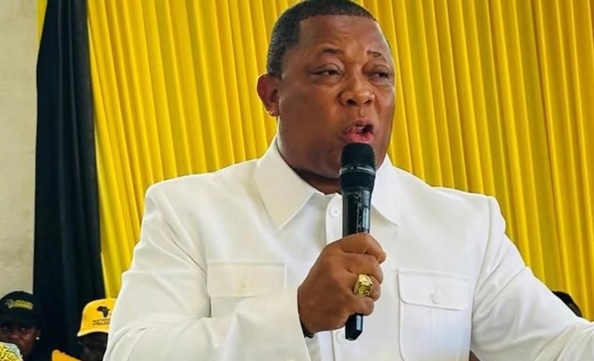
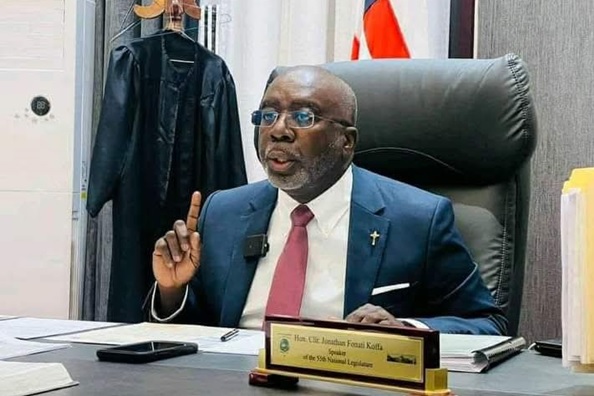
MONROVIA — On Liberia’s national Thanksgiving holiday, Thursday, November 6, 2025, Cllr. J. Fonati Koffa, Representative for Grand Kru County District #2 and former Speaker of the House of Representatives, issued a blistering public warning over the controversial petroleum agreement signed with Oranto Petroleum Liberia Limited. In a message that immediately ignited national debate, Koffa described the deal as an “empty shell” constructed to shield Atlas Oranto, a major Nigerian oil conglomerate, from legal and financial liability in Liberia.
Koffa stated that the entity named in the agreement, Oranto Petroleum Liberia Limited, has no assets, no operational history, and no substantive guarantees attached to it. “This is like doing a deal with a zogo to buy your house. It has nothing. It is empty,” he wrote. His message sharply criticizes what he says is a deliberate corporate design to insulate Atlas Oranto from accountability, a structure he believes leaves Liberia dangerously exposed.
Central to Koffa’s alarm is Article 33 of the petroleum agreement, which requires Oranto Nigeria to guarantee the Liberian subsidiary. However, he points out that the so-called guarantee, contained in Annex III, is nothing more than an unsigned, incomplete template. According to Koffa, the document lists no guarantor, no financial backing, no obligations, and no signatures, effectively rendering it void. “We basically just have an agreement with a zogo oil company owned by Prince Eze and some unnamed Liberian partners,” he added.
His statement lands at a time when the Legislature is already grappling with widespread public concern over the transparency of the eight production sharing contracts recently signed by the Government of Liberia. Four of these contracts involve Oranto Petroleum Liberia Limited, while the remaining four involve TotalEnergies EP Liberia LLC. Just this week, the Joint Committee on Hydrocarbon, Investment and Concessions, Judiciary, and Contracts and Monopolies requested more time from plenary to scrutinize the agreements after citizens, civil society groups, and lawmakers raised red flags.
Koffa’s latest warning expands on a previous letter he co-authored with Nimba County Representative Musa Hassan Bility on October 29, 2025. In that communication, the lawmakers described the Oranto deal as “corrupt and dangerous,” noting irregularities such as bypassed competitive bidding, unexplained reductions in the signature bonus from US$10 million to US$1.2 million, and the concealment of Liberian partners’ identities. The Thanksgiving statement sharpens his position even further by exposing what he calls the “illusory guarantees” behind the contract.
Observers say Koffa’s aggressive posture marks a decisive shift in his legislative focus. Once a central figure in House leadership, including his tenure as Speaker in 2024, Koffa has recently emerged as one of the Legislature’s most outspoken voices on resource governance and accountability. With Liberia increasingly turning toward oil exploration as a potential pillar of national revenue, his criticisms have drawn both support and pushback.
Those backing Koffa argue that Liberia cannot afford to repeat past mistakes in its natural resource sector, where opaque agreements led to stalled operations and minimal returns for the state. They point out that engaging a company with no assets or verifiable financial backing effectively risks granting oil rights for free. They also caution that such agreements invite long-term litigation and potential disputes over contract validity.
Supporters of the Oranto deal, however, counter that Liberia must remain competitive in attracting oil exploration companies, given the high risks associated with offshore drilling. They argue that rigid financial requirements or high bonuses could deter investment and that standard petroleum contracts often allow companies to recover exploration costs before profit-sharing begins. Some have even labeled Koffa’s criticisms as alarmist and harmful to investor confidence.
Still, the Joint Committee’s request for expanded review time signals that the Legislature has taken public concerns seriously. Koffa’s sharp language only amplifies the pressure on lawmakers to subject the contract to a more rigorous examination. With issues of national sovereignty, financial transparency, and institutional credibility at stake, the Oranto deal has quickly become a defining test for the 55th Legislature.
As Liberia navigates the complex terrain of oil exploration, Koffa’s Thanksgiving message has transformed what might have been a technical contract dispute into a broader national reckoning. His plea, “May God save our country,” closes not merely as a holiday benediction but as a warning that the future of Liberia’s natural wealth hinges on transparency, accountability, and a refusal to settle for “empty shell” agreements.