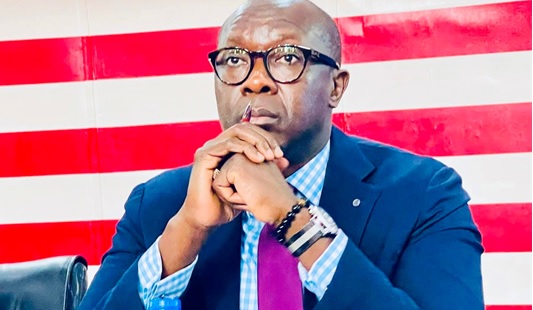
MONROVIA – Gbarpolu County Senator Amara Mohammed Konneh has expressed conditional support for the Concession and Access Agreement signed between the Government of Liberia and Ivanhoe Liberia Ltd., while also outlining major risks he believes the Liberian Senate must thoroughly examine before granting approval. The agreement, signed on July 5, 2025, and submitted to the Senate by President Joseph Nyuma Boakai last month, seeks to overhaul key rail and port infrastructure to facilitate the export of Guinean iron ore through Liberian territory.
In a statement issued on Sunday, November 9, 2025, Senator Konneh explained that the deal grants Ivanhoe Atlantic Inc., an American mining firm, significant rights to rehabilitate sections of Liberia’s railway corridor linking Nimba, Bong, and Grand Bassa Counties, as well as upgrade the Buchanan Port. He described the proposal as a transformative regional economic initiative that could reposition Liberia as a major transit hub for mineral exports.
Konneh voiced strong support for the project’s potential, noting its roots in what he called new commercial diplomacy between Liberia and the United States. Citing projected benefits, he said the concession is expected to “deliver substantial economic benefits, including over $1.4 billion in rail user fees, taxes, and job creation during both the construction and operational phases.” He also emphasized the alignment of the deal with ECOWAS and Mano River Union goals to deepen economic integration across the region.
Detailing the financial benefits attached to the concession, Konneh pointed out that two upfront payments, US$7 million and US$30 million, were already made to the previous administration, with an additional US$35 million in milestone-linked disbursements anticipated once the agreement progresses. He described these payments as timely fiscal inflows that support Liberia’s immediate development needs.
He further highlighted multiple revenue streams embedded in the agreement, including the recurring per-ton fees from ore shipments. These include a US$0.10 cross-border transit fee and tiered product access fees starting at US$1.95 per ton and decreasing to US$1.55 as volume increases. Worked estimates, he said, show effective fees of around US$2.05 per wet metric ton for high-volume exports.
Konneh also welcomed provisions safeguarding Liberia’s fiscal stability, such as clauses requiring Ivanhoe to pay 50 percent of any annual revenue shortfall if it ships less ore than projected. Additionally, he cited the fixed annual US$500,000 customs service fee for ore transiting Liberia as a stable source of revenue outside traditional customs frameworks.
Workforce development and local procurement were also highlighted among the agreement’s strengths. Konneh noted that the concession mandates 50 percent Liberian representation in management positions within five years and 70 percent within ten years. “The agreement also requires procurement plans and local procurement reporting,” he said, while acknowledging that the US$50,000 penalty for non-compliance remains limited relative to the project’s scale.
Beyond revenue and jobs, Konneh praised the introduction of a community development fund, which will eventually rise to US$5 million annually after the fifth year, distributed among Nimba, Grand Bassa, and Bong Counties. He described the initiative as a vital step in ensuring that communities hosting the rail corridor share in the project’s economic benefits.
The agreement also contains major infrastructure commitments, including rehabilitation of the Buchanan quay, the Buchanan handling facility, and the Tokadeh facility. These upgrades, the senator explained, will remain government-owned assets, even though Ivanhoe will maintain operational control during the life of the concession. He also noted the requirement to establish a National Railway Authority as an important institutional advancement.
However, despite expressing support, Konneh flagged several critical risks he believes require Senate scrutiny. He warned that high-volume Guinean ore exports could “cannibalize” the corridor, limiting access for domestic users and undermining Liberia’s ability to develop its own mining sector. He also said contracted export volumes could receive priority over smaller Liberian operators, creating an uneven playing field.
Konneh cautioned that the fee structure appears low for such a strategic asset, arguing that relative to other African bulk transport corridors, the per-ton charges may undervalue Liberia’s infrastructure. He added that the 15-year fiscal stabilization clause could prevent Liberia from adjusting fees should global market conditions improve significantly, thus locking the country into terms that may become less favorable over time.
Another major concern, he noted, is the weak enforceability of localization commitments. According to Konneh, the language allowing Ivanhoe to comply on a “reasonable endeavors” basis weakens the targets, and the penalty for failing to meet procurement requirements is too small to influence company behavior. Slow dispute resolution mechanisms in cases involving third-party concessions were also cited as a potential barrier to Liberia’s leverage.
Environmental and social safeguards featured prominently among his concerns. Konneh noted that while environmental and social impact assessments are required, their success depends on the government’s capacity to regulate effectively, capacity which he described as limited. He warned that without strong financial guarantees, Liberia risks shouldering environmental consequences without adequate compensation.
Konneh also raised questions about the reasonableness of the revenue Liberia stands to earn from the fixed and variable fees, arguing that the arrangement may limit the country’s future earning potential. “The flat customs transit fee of US$500,000 replaces per-ton revenue with a static amount, reducing benefits from increased volume,” he stressed.
Despite highlighting these concerns, Senator Konneh reiterated that he supports the deal in principle and believes it represents a significant opportunity for national development. He said the objective is not to obstruct progress, but to ensure Liberia negotiates from a position of strength so that the agreement truly advances President Boakai’s AAID agenda and provides the fiscal space needed to improve the lives of Liberians.
Konneh pledged to submit his recommendations to the Senate’s Joint Committee reviewing the agreement, even though he does not serve on the committee. He said he decided to publish his analysis because, in his words, “our citizens deserve transparency, and our institutions must negotiate from a position of strength.”
He concluded by encouraging the Senate to publish all investment instruments under review, arguing that public scrutiny will strengthen Liberia’s democratic governance and ensure accountability in the management of major national assets.