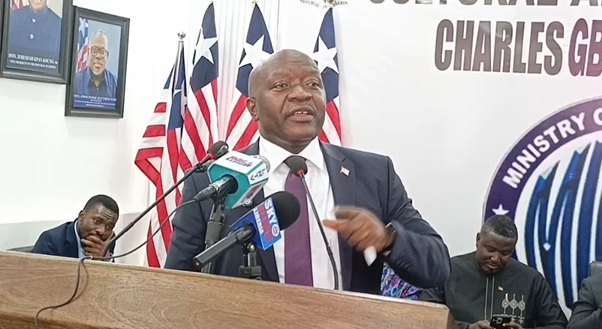
MONROVIA – Finance and Development Planning Minister Hon. Augustine Kpehe Ngafuan on Monday defended the administration’s draft US$1.2 billion National Budget for Fiscal Year 2026, describing it as an ambitious but achievable financial blueprint that reflects rising domestic revenue performance, expanded public investment, and a stronger macroeconomic outlook. Addressing journalists at the Ministry of Information’s Special Press Briefing in Monrovia, Ngafuan expressed confidence that the coming year will outperform the current one. “What I can assure you is that next year will be better than this year,” he told reporters. “From where I sit and what I see, there are so many good things happening, and too many good things will happen. The budget is going to deliver a whole lot of goodies.”
The minister recalled that the draft budget was formally submitted to the National Legislature by House Speaker Richard Nagbe Koon on Friday, November 7, 2025, following instructions from President Joseph Nyuma Boakai. Ngafuan emphasized that the Ministry of Finance immediately published the document online to ensure public access. “We see that a lot of people have become budget analysts, which is very good for this society,” he said. “The budget is to be talked about, and I think our transparency rating will go up.”
Providing key figures, Ngafuan disclosed that the total revenue estimate is US$1.211 billion, driven largely by domestic revenue at US$1.13 billion, representing 94 percent of the total. He hailed this as evidence of improving national financial capacity. “Domestic revenue has reached 94 percent of our projection. This is on account of the country doing well for itself,” he noted. Only six percent of the budget, US$72 million, comes from external sources. Tax revenue is projected at US$797 million, while long-term revenue includes an expected US$200 million signature bonus from the pending Mittal concession agreement.
A major highlight of the 2026 budget is the substantial expansion of the Public Sector Investment Program (PSIP), which has risen from US$107 million in 2025 to US$281 million for 2026. Ngafuan described this as a deliberate shift toward development-focused spending. He said US$200 million of the amount is linked to the anticipated concession bonus, with energy and road infrastructure receiving the largest shares. “One hundred million of that amount goes to our top priorities, that is, energy and road infrastructure,” he explained, adding that US$50 million will support the Liberia Electricity Corporation to improve access, strengthen smart metering, and stabilize power during the dry season.
In addition to infrastructure, Ngafuan said the budget targets counties hosting major extractive operations. Nimba, Grand Bassa, and Bong Counties each received an additional US$15 million, while priority institutions such as the University of Liberia and the judiciary also received increased allocations. He announced that the government will assume part of the financial responsibility at ELWA Hospital to prevent its collapse. “We cannot sit down and allow the hospital to go under,” he stressed, revealing that funds have been allocated to hire additional staff and maintain operations ahead of the facility’s expected dedication in January or February.
Turning to Liberia’s debt obligations, the minister said the country’s total debt stock now stands at approximately US$2.7 billion. As a result, debt servicing has increased significantly, from US$150 million in the previous fiscal year to US$230 million in the draft 2026 budget. He cautioned the public against viewing debt negatively. “We cannot just turn our eyes away from debt service,” he said. “But we should not demonize debt. The issue is how to use the debt.” He noted that all new borrowing will be aligned with the government’s debt management strategy to ensure high economic returns.
Ngafuan addressed speculation over past fiscal performance, clarifying that 2024 ended without a revenue shortfall despite early challenges. He said the abrupt loss of more than US$300 million in USAID-supported programs destabilized the first quarter of 2025, but the government navigated the turbulence successfully. “As I said then, this ship is being captained by an experienced captain. The captain of this ship is President Joseph Nyuma Boakai. He’s a good captain,” he emphasized.
The minister praised the Liberia Revenue Authority for helping the country reach nearly US$700 million in domestic revenue last year, a first in Liberia’s history. He said the 2026 budget continues to empower revenue-generating institutions to ensure improved service delivery and economic stability. “To actualize the plan, there must be work, there must be sweat,” he said, urging teamwork across government.
As he outlined the budget’s investment-driven outlook, Ngafuan told business owners to prepare for economic opportunities. “When you hear about almost US$300 million in the public sector investment program, it’s going to be contracts, jobs, opportunities,” he declared. He reaffirmed the government’s commitment to achieving full budget execution, saying, “We intend to reach the US$1 billion mark. We do not intend to take backward steps.”
With the draft now before the Legislature, Ngafuan said the next phase is a robust democratic debate. He urged citizens and lawmakers to scrutinize the budget while maintaining faith in its objectives. “We do not claim perfection. There will be some back and forth,” he stated. “But in the end, the budget will be approved, and Liberia will move forward.” He concluded with renewed optimism: “What I can assure you is that next year will be better. Too many good things have happened. Too many good things will happen. The budget is going to deliver major gains for our country.”