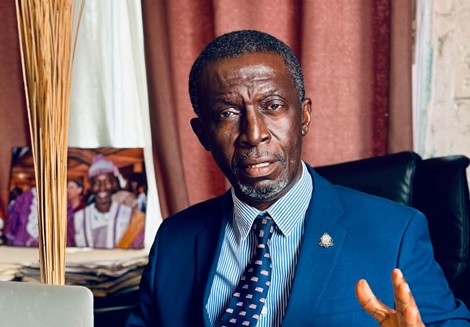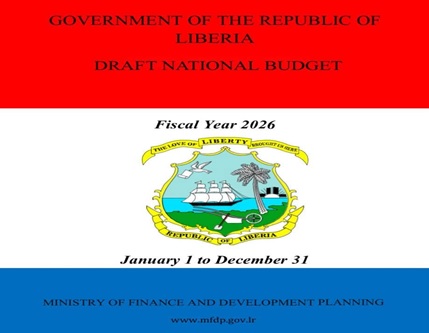
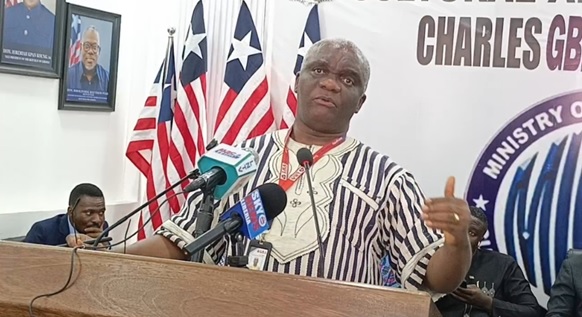
MONROVIA – Liberia Revenue Authority (LRA) Commissioner General James Dorbor Jallah on Monday, November 10, 2025, delivered a defense of the country’s revenue performance, pushing back against claims of underperformance and insisting that Liberia is firmly on track to meet its annual domestic revenue targets. Speaking at the Ministry of Information, Cultural Affairs and Tourism (MICAT) regular press briefing, just days after President Joseph Nyuma Boakai submitted a US$1.2 billion draft national budget to the Legislature, Jallah outlined what he called “the facts, not the rumors” surrounding the nation’s fiscal trajectory.
Jallah reminded the public that the LRA not only met its domestic revenue obligation last fiscal year but surpassed it. “We informed the country that we met our target,” he said. “Subsequently, we have had engagements with the media and informed the country that we have actually overperformed our last year’s target by almost US$10 million.” He explained that the institution had been tasked with collecting US$690 million, but ultimately generated nearly US$700 million, a result he described as “clear evidence of consistent progress.”
The Commissioner General dismissed allegations circulating in political and public circles that the LRA is underperforming in the current fiscal year. “We’re hearing detractors, naysayers, and scaremongers saying there is underperformance this year. That is not true,” he stressed. He acknowledged revenue collection challenges in the first quarter but attributed them to delayed implementation of new fiscal policies approved by the Legislature. According to him, “Those reforms were passed during the budget process, but before implementation could start, they were a month late into the fiscal year, and because of the late start, we missed out on collecting revenues that should have been collected earlier.”
Despite early setbacks, Jallah insisted that the LRA has rebounded strongly. As of the end of October, he said, the authority had collected approximately 78 percent of its 2025 target. He noted that the institution had averaged “US$67 million per month over the last 10 months,” surpassing the monthly target of US$62 million needed to stay on course. “If you look at an average performance of US$67 million a month compared to a target of US$62 million, then clearly, there is no if, but, or and about that,” Jallah stated with confidence.
To increase transparency and counter misinformation, the LRA is preparing to unveil a public digital platform that will display real-time revenue data. “We have worked and developed a public portal where we are reporting in real time our collection numbers,” Jallah disclosed. Once launched, he said, “each of you will be able to go to the website, and as we collect the money daily, you will see the numbers changing in near real time.” The initiative, he said, is intended to “once and for all” settle ongoing debates about the LRA’s performance.
Jallah also clarified misconceptions surrounding media reports that credited the LRA’s revenue boost solely to ArcelorMittal’s US$200 million signature bonus. Calling such suggestions “misleading,” he noted that Liberia was already projected to surpass US$1 billion in domestic collections next year based on existing capacity. “Even if we didn’t have the US$200 million signature bonus, next year was already earmarked to be our year of the billion,” he said. “The ArcelorMittal bonus just added more flavor. We were just barely going to cross the line, but now we cross it with grandeur.”
He emphasized that achieving long-term revenue growth is critical to sustaining Liberia’s development agenda. According to him, the country needs to raise roughly US$1.4 billion annually to fully fund government programs and projects. “For the past year, and up to this year, we haven’t been able to do that,” he noted, stressing that increased domestic revenue remains essential. “If we don’t raise the revenue, particularly locally, we might not be able to implement some of the adopted projects in the development plan.”
In a passionate appeal, Jallah urged national unity ahead of the 2026 revenue effort, invoking Liberia’s long history of resilience. “Revenue collection, especially for next year, is going to be daunting,” he warned. “But the same Liberia that defeated Ebola, the same Liberia that survived nearly two decades of civil war, the same Liberia that overcame COVID, if we all work together, a billion dollars will be nothing compared to our collective effort.”
He called on the media to take a leading role in promoting tax compliance and combating misinformation. “We want to ask all of you in the media to work with us because creating awareness for tax compliance is very important,” he said. “If we are to raise these billions so that our country can see the current development, then we must do this together.”
With the 2026 budget now before the Legislature and public debate intensifying, Jallah’s detailed presentation signals the Boakai administration’s determination to defend its fiscal record while preparing the nation for what he described as “Liberia’s year of the billion.”