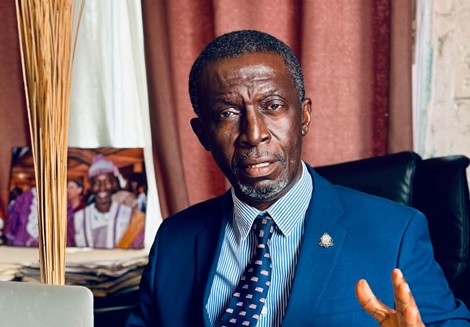
MONROVIA – Veteran human rights lawyer and former senator Cllr. Tiawan Saye Gongloe on Monday, November 10, 2025, strongly criticized a recent move by members of the Liberian Senate to propose a purely domestic War Crimes Court, describing it as “a betrayal of justice and legislative bad faith.” Speaking in a detailed commentary, Gongloe argued that the Senate’s proposal, which envisions a court composed entirely of Liberian judges and prosecutors with all appeals going to the Supreme Court, directly undermines the transitional justice framework established under Joint Resolution #JR-001/2024.
“This proposal directly contradicts Joint Resolution #JR-001/2024, which the Senate and the House of Representatives jointly enacted on April 8, 2024,” Gongloe said. “That Resolution expressly mandated the Executive Branch, not the Senate, to develop a legal framework for the establishment of an Extraordinary Criminal Court for Liberia and an Anti-Corruption Court.” He stressed that the Senate’s unilateral submission of its own bill bypassed the Executive-led process already underway through the War and Economic Crimes Court (WECC) Secretariat, which is working with national and international experts to draft the required legislation.
Gongloe pointed out that Joint Resolution #JR-001/2024 explicitly called for the creation of a “UN-backed Special War Crimes Court for Liberia (SWACCOL),” designed to include both international and domestic participation in cooperation with the United Nations, the European Union, and the United States Government. “Nowhere did the Resolution authorize the Senate to unilaterally craft a domestic bill or reduce the envisioned hybrid tribunal into an ordinary national court,” he emphasized. “The new Senate proposal defies the Legislature’s own record and undermines the transitional justice process rooted in the Accra Peace Agreement.”
He described the Senate’s justification of “sovereignty” as both “misplaced and hypocritical,” arguing that it confuses true sovereignty with isolationism and nationalism with self-deception. “Liberia’s civil wars were not caused by foreign interference, they were caused by bad governance, corruption, abuse of power, and contempt for human rights,” Gongloe said. He reminded that over 300,000 Liberians lost their lives during the conflicts, and that the pursuit of justice is a moral obligation that cannot be surrendered under the guise of protecting sovereignty.
Cllr. Gongloe further highlighted Liberia’s international obligations, including its adherence to the four Geneva Conventions of 1949 and their Additional Protocols of 1977. “To walk away from that responsibility now would not only dishonor Liberia’s dead, it would violate its international commitments and betray the very principles of justice that form the foundation of civilized nations,” he asserted.
Citing regional precedents, Gongloe emphasized the effectiveness of hybrid courts in addressing mass atrocities. He referenced the Special Court in Sierra Leone, which successfully convicted former President Charles Taylor and other key perpetrators, and Senegal’s Extraordinary African Chambers, which tried Hissène Habré for crimes against humanity. “Experience across Africa shows that credible justice for mass atrocities requires a hybrid court, not a domestic one,” he said, noting that mixed tribunals provide both impartiality and competence while securing international credibility and financial support.
He also pointed to Liberian perpetrators who have been successfully prosecuted abroad through partnerships with organizations such as the Open Society Justice Initiative and CIVITAS Maxima. “If justice for Liberia can happen in Philadelphia, London, and Paris, why not in Monrovia under the right conditions?” Gongloe asked, emphasizing that domestic-only courts lack the necessary independence and expertise to deliver credible justice.
Gongloe stressed that the proposed War and Economic Crimes Court is a transitional justice mechanism, not an ordinary constitutional court. “It must be rooted in international humanitarian law, and composed of both Liberian and foreign judges, prosecutors, and investigators, with a majority of international personnel to guarantee impartiality, credibility, and adherence to global standards,” he said. Anything less, he warned, would result in a compromised institution “strong on paper, weak in principle.”
The legal expert concluded by condemning the Senate’s unilateral actions as both procedurally illegal and morally indefensible. “The Senate’s bill substitutes political convenience for justice, undermines Liberia’s international reputation, and risks turning the pursuit of accountability into another exercise in deception,” Gongloe said. He urged the country to honor its international commitments and reaffirm its covenant with the victims of Liberia’s civil wars.
“Only a hybrid War and Economic Crimes Court, internationally anchored and nationally embraced, can fulfill Liberia’s promise of ‘Never Again,’” Gongloe declared, stressing that true sovereignty is exercised through justice, not isolation. He warned that any attempt to bypass international participation would weaken Liberia’s credibility and betray the victims of war crimes, emphasizing that lasting peace is anchored in genuine justice.