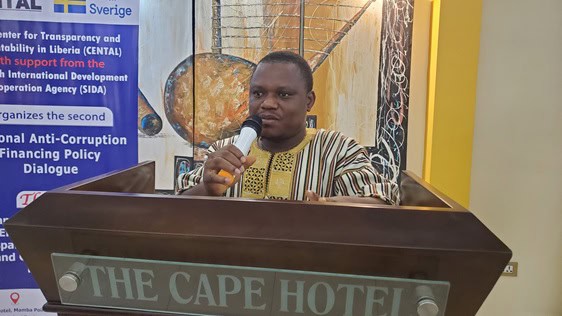

MONROVIA – Liberia’s former Anti-Corruption Czar, Cllr. James Nyepan Verdier, Jr., has issued a stark warning that the country’s anti-corruption drive will remain weak, fragile, and largely symbolic unless government commits predictable, independent, and sufficient financing to its integrity institutions. Verdier, now Chief of Staff in the Office of the Speaker of the 55th Legislature, Richard Nagbe Koon, delivered the keynote address on Wednesday, November 19, 2025, at the National Anti-Corruption Financing Policy Dialogue organized by the Center for Transparency and Accountability in Liberia (CENTAL) at the Cape Hotel in Monrovia.
Addressing diplomats, civil society leaders, policymakers, and anti-graft actors, Verdier described corruption as “an economic cancer” that deprives the population of essential services and threatens national stability. “Corruption is not just a moral failing, it is an economic cancer,” he declared. “It diverts public resources from schools, clinics, and roads. It erodes trust in our institutions. It weakens our democracy. And it disproportionately hurts the poor and vulnerable.” Verdier stressed that corruption endures not because it is unavoidable but because “systems are weak, oversight is absent, and institutions are underfunded and undermined.”
According to Verdier, the urgency to adequately finance anti-graft institutions cannot be overstated. He said Liberia’s key oversight bodies, including the Liberia Anti-Corruption Commission (LACC), General Auditing Commission (GAC), Public Procurement and Concessions Commission (PPCC), Internal Audit Agency (IAA), and Financial Intelligence Agency (FIA), remain structurally disadvantaged because they are continuously denied the financial resources needed to perform effectively. “We cannot expect these institutions to deliver results if we starve them of the resources they need,” he cautioned.
Verdier argued that Liberia must prioritize sustainable funding built on institutional independence, multiyear commitments, and strategic collaboration. He explained that while international partners and philanthropic organizations play meaningful roles, government must be the primary provider of financing since external contributions are often short-term and tied to specific projects. He advocated for funding mechanisms linked to measurable outcomes and performance metrics.
The former LACC boss emphasized the need for anti-corruption institutions to operate free from political interference. He referenced a troubling pattern where budget cuts are used as retaliation against institutions engaged in politically sensitive investigations. “Budgets are often cut as a reprisal after or during investigations, effectively punishing LACC and GAC for doing their jobs,” Verdier warned. He described this as a “fundamental conflict of interest,” noting that the very institutions mandated to hold the powerful accountable are financially dependent on those they investigate.
Verdier also called for legislative reforms to safeguard institutional independence. He proposed that the Legislature, not the Executive, should set budgets for anti-graft institutions, noting that multi-year budget commitments and protections against arbitrary mid-year cuts would improve planning and operational stability. He further recommended giving anti-corruption institutions the authority to retain a percentage of recovered stolen assets, citing global studies showing that such autonomy significantly increases recovery rates.
He stressed that effective financing requires more than allocating funds; it demands transparency, credible oversight, and active public engagement. Verdier urged the government to publicly disclose budget allocations, expenditures, and procurement transactions to reduce opportunities for corruption. He said civil society organizations must be empowered to monitor public spending and use transparency portals to hold institutions accountable.
Verdier further underscored the importance of collaboration among anti-graft institutions, law enforcement, international partners, and government ministries. He said complex activities such as forensic investigations, data sharing, and asset recovery require strong inter-agency coordination. Without such cooperation, he warned, anti-corruption efforts risk becoming fragmented and ineffective.
The keynote speaker described funding integrity institutions as a sound national investment rather than a financial burden. “Every dollar recovered or saved by an integrity institution is a dollar that can be spent on public good,” he said, adding that strengthening institutional capacity will result in better service delivery, improved governance, and restored public trust.
Verdier concluded by commending CENTAL and the Swedish International Development Cooperation Agency (SIDA) for convening the dialogue, describing it as timely and impactful. He called for renewed national commitment to fighting corruption through adequate financing, strong political will, and legal reforms that guarantee institutional independence. He warned that the cost of inaction is a continued erosion of public trust, weakened democracy, and stalled development, but the payoff for decisive investment is “a more just, prosperous, and stable society for everyone.”