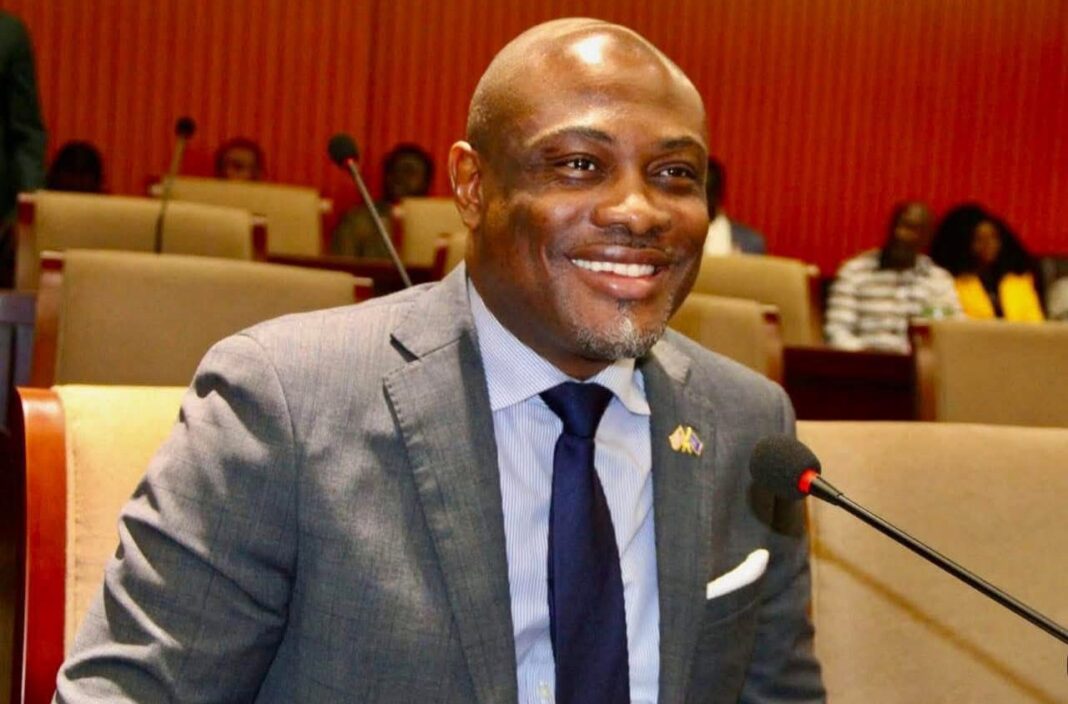
CAPITOL HILL, MONROVIA – In a legislative move that could redefine both short-term economic empowerment and long-term national wealth management, Nimba County District #9 Representative Taa Z. Wongbe on Tuesday, November 25, 2025, submitted two bills to the House of Representatives. The proposals, titled The National Community & MSME Stimulus Bill, 2026 and The Liberia Future Generations Extractive Savings Fund Act, 2025, seek to simultaneously place financial resources directly in the hands of Liberians while establishing a structured national savings plan to secure future generations. The dual submission has ignited discussions across Capitol Hill about the country’s development priorities and the evolving role of the Legislature in driving transformative economic reforms.
The National Community & MSME Stimulus Bill, 2026, sets aside US$10 million in the FY2026 national budget to directly fund small businesses, farmer groups, women-led initiatives, and community-based organizations in all 73 districts. Wongbe’s proposal departs from Liberia’s long-standing bureaucracy-heavy spending model and places ordinary citizens at the center of state financial interventions. According to the bill, 95 percent of funds must be delivered directly to beneficiaries via bank or mobile money transfer systems, offering a transparent and streamlined distribution method aimed at minimizing corruption and administrative bottlenecks.
If passed, the program could issue grants ranging from US$250 to US$7,500, with more than 5,000 micro, small, and medium enterprises expected to benefit. Wongbe emphasizes that at least half of these resources must go to women-led groups, an intentional inclusion meant to strengthen female economic participation in a country where gender disparities remain pronounced. He further proposes a standardized allocation formula that guarantees each district receives its fair share, a measure designed to eliminate political favoritism and ensure nationwide impact.
A key transparency feature of the bill is the creation of an online public database that lists all beneficiaries of the program. Advocates argue that such disclosure mechanisms are crucial for preventing fraud and strengthening public confidence. Representative Wongbe has described the initiative as a bold shift in fiscal philosophy, declaring that it will “turn the national budget into a tool of empowerment, not bureaucracy.” However, skeptics are already questioning whether Liberia’s limited fiscal space can sustain such an ambitious undertaking without jeopardizing other critical sectors.
The second bill, The Liberia Future Generations Extractive Savings Fund Act, 2025, focuses on preserving the country’s natural resource revenues through a long-term sovereign-style savings mechanism. It calls for the mandatory deposit of 10 percent of all extractive revenues, including mining and forestry, into a permanent national savings and investment fund. In a country where natural resources have historically generated wealth for a few rather than national prosperity, the bill seeks to reverse this trajectory by institutionalizing mandatory savings.
The proposed fund consists of two components, a Heritage or Generation Fund that secures 70 percent of the resources for long-term investment, and a Stabilization Fund comprising the remaining 30 percent to help the country absorb economic shocks. The structure is modeled after global best practices used by resource-rich nations seeking stability in volatile commodity markets. To prevent political interference, the fund will be governed by an autonomous seven-member board and audited annually by both the General Auditing Commission and a reputable international audit firm.
Wongbe has described the savings bill as “a historic opportunity to secure the blessings of our natural resources for all Liberians today and for decades to come.” Supporters say the proposal offers a safeguard against future economic downturns and a practical solution to Liberia’s long-standing dependency on fluctuating commodity prices. Still, the bill’s passage will require robust political will and improved monitoring of extractive sector revenues, areas where previous governments have faced considerable challenges.
The introduction of these two bills represents one of the most comprehensive attempts in recent years to stimulate grassroots economic growth while simultaneously promoting long-term fiscal resilience. Wongbe’s dual approach, delivering immediate financial relief through direct community grants and securing the nation’s economic future through mandatory savings, signals a broader shift in legislative thinking toward sustainability and citizen-centered policymaking.
If adopted, the bills could significantly alter Liberia’s development trajectory, reorienting public spending toward transparency, empowerment, and generational accountability. Yet their success will depend on careful legislative scrutiny, realistic financial planning, and a bipartisan commitment to national interest over political expediency. As debate unfolds, Liberians will be watching closely to see whether the Legislature embraces these reforms or retreats to more familiar but less effective patterns of public financial management.