MONROVIA – Political commentator and presidential hopeful Matthew Nyanplu has sharply criticized President Joseph Nyuma Boakai and several senior government officials, accusing them of openly violating Liberia’s Code of Conduct for public officials. In a statement issued on Saturday, November 29, 2025, Nyanplu alleged that President Boakai is presiding over what he described as “a flagrant disregard for the laws of the Republic,” despite repeated commitments to transparency, integrity, and good governance.
In a post on his official Facebook page, Nyanplu directly cited Part V, Section 5.1 of the Code of Conduct, emphasizing the clear restrictions placed on appointed officials. He wrote: “Mr. Boakai’s Unity Party Government officials must be put on notice: section 5.1 of the Code of Conduct Act is clear.” He continued by quoting the law in full, underscoring that appointed officials “shall not engage in political activities, canvass or contest for elected offices; use Government facilities, equipment or resources in support of partisan or political activities; or serve on a campaign team of any political party or independent candidate.”
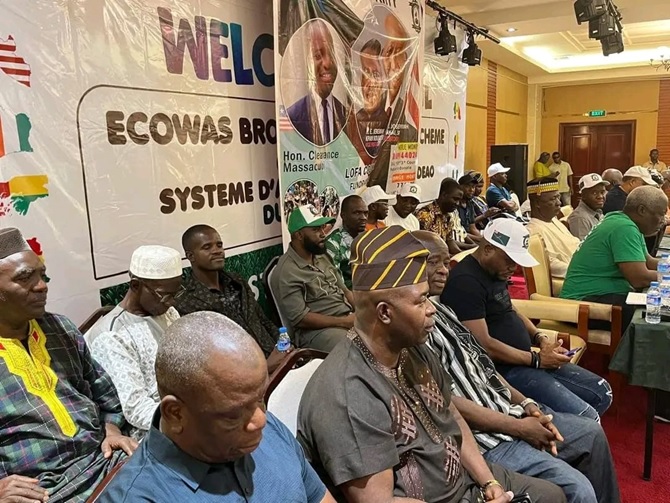
Nyanplu posted multiple photos he said were taken earlier that day at the Ministerial Complex during a Unity Party “Homegoing” mobilization program for Lofa County. “Prominent in these pictures are Augustine Ngafuan, Minister of Finance; his brother Richard Ngafuan, Head of LISGIS; Galakpai Kortimai, Head of GSA; Francis Nyumalin, Minister of Internal Affairs; and Gabriel Ndupellar, Assistant Corrections Minister at Justice,” Nyanplu wrote. According to him, the officials were participating in a partisan event while occupying public office, an act he insisted amounts to a direct violation of the Code of Conduct.
He argued that the gathering at the Ministerial Complex was especially troubling because it involved the use of a government facility for a political purpose, which the Code of Conduct explicitly prohibits. Nyanplu questioned why the President, who frequently speaks of rule of law and institutional integrity, would allow government spaces to be used for partisan mobilization. He asked, “How can a President who vows to uphold integrity permit his top officials to openly politicize government property?”
Nyanplu also highlighted another incident in Nimba County, where Deputy Finance Minister Dehpue Zuo was photographed at a Unity Party event wearing full party attire. To Nyanplu, the repetition of such actions suggests a troubling pattern. He questioned, “If these officials know the law and still violate it, is this not a sign that the President himself sanctions or ignores these actions?”
The political commentator intensified his criticism by accusing President Boakai of enabling and participating in these violations. “Mr. Boakai presides over the flagrant violation of our laws that he himself violates daily,” Nyanplu declared, suggesting that the President’s own involvement in partisan activities while holding public office undermines public trust and weakens the country’s governance structures.
Nyanplu’s assertions raise critical questions about the administration’s commitment to the legal frameworks it claims to uphold. He wondered whether Liberia’s integrity institutions, the LACC, the Ombudsman, and related agencies, will have the independence or willingness to act in cases where violations involve senior members of the Executive Branch. His statement adds to ongoing national concern about whether rules meant to regulate political conduct are being applied selectively.
The allegations cut deep into the narrative President Boakai built during his 2023 campaign, when he pledged to restore accountability, strengthen public sector ethics, and distance government operations from partisan influence. Nyanplu’s claims, if proven, could erode that image and raise doubts about whether the administration is truly committed to the reform agenda it promised.
The situation also underscores a broader debate about how Liberia’s political culture continues to struggle with the separation between governance and partisanship. As Nyanplu emphasized, Liberia cannot build strong public institutions if government officials feel free to ignore the very laws intended to restrict the misuse of power. He added that the Code of Conduct exists to protect governance, not political parties.
The allegations come at a time when Liberians are increasingly concerned about rising political tensions and the unrestricted involvement of government officials in partisan activities. Analysts argue that if the President does not respond decisively, the controversy could deepen public mistrust and complicate the administration’s efforts to push its broader development agenda.
Nyanplu concluded his statement with a stern reminder of the government’s duty to uphold the rule of law. “We cannot ask ordinary Liberians to obey the law when those who govern them treat it as optional,” he said. His remarks leave Liberians questioning what steps, if any, the Boakai administration will take to address the growing accusations and whether the President can maintain the moral credibility he promised when he took office.