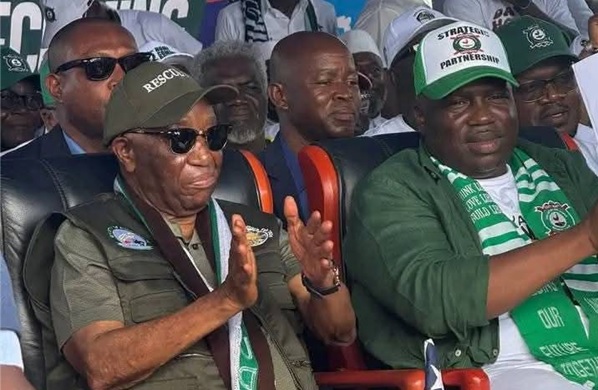
MONROVIA – Thousands of supporters of the ruling Unity Party (UP) converged on Congo Town on Saturday, December 6, 2025, as the party officially returned to its previously evicted headquarters. The occasion, branded as the “Unity Party’s Homecoming Fundraise and Membership Drive,” drew members, sympathizers, and political enthusiasts from across the nation, turning the party’s headquarters into a lively hub of celebration, speeches, and fundraising activity.
The atmosphere was electrified with music, dancing, and jubilation, as party loyalists hailed the return of their political home. The event, heavily publicized in recent weeks, signaled the party’s commitment to strengthening its presence across Liberia, both organizationally and financially. Party leaders emphasized that the gathering was not only a celebration of returning to the headquarters but also a critical step in mobilizing resources for nationwide party infrastructure.
President Joseph Nyuma Boakai, the political leader of the Unity Party, addressed the massive crowd, reiterating his vision for Liberia’s development. “In 2023, the Liberian people rejected chaos. They rejected incompetence. They rejected recklessness,” he declared. “The people want their lives to be better, and this is what we have started in a short period of time.” The President’s remarks drew loud applause, reflecting broad support among the assembled attendees.
In a key announcement during the rally, the Unity Party disclosed that it had raised over US$1.3 million from the first round of its nationwide fundraising initiative. Deputy Minister for Administration at the Ministry of State for Presidential Affairs, Cornelia Kruah, confirmed that contributions had been collected via mobile money platforms including Lonestar and Orange, as well as through cheques and direct cash donations.
According to the party, Lofa County emerged as the highest contributor, followed by Bong, Nimba, Montserrado, Margibi, Grand Bassa, Bomi, Grand Cape Mount, River Cess, and Sinoe counties. Party officials emphasized that the funds would support the construction of party offices across the country, strengthen organizational structures, and facilitate future political campaigns.
Deputy Speaker of the House of Representatives, Thomas P. Fallah, took the stage to declare his full support for President Boakai, stressing that his decision was motivated solely by the national interest. “Liberia’s progress must outweigh partisanship or past political differences,” Fallah said, appealing to citizens and lawmakers alike to prioritize national development over political rivalry.
The rally also highlighted unexpected political realignments, as some lawmakers from Lofa County, previously elected under the Coalition for Democratic Change (CDC), publicly aligned with Deputy Speaker Fallah in support of the President. This cross-party backing underscores growing collaboration among legislators committed to advancing Boakai’s development agenda.
During the event, Deputy Speaker Fallah announced key financial contributions, pledging US$5,000 in his personal capacity, another US$5,000 on behalf of the Lofa County Legislative Caucus, and a collective sum of US$20,000 from lawmakers across several counties who joined him on stage. These pledges were celebrated as a demonstration of confidence in the Unity Party’s leadership and its national agenda.
In a further show of political momentum, four lawmakers, Rep. Austin Taylor of Maryland, Sumo Mulbah of Montserrado District #3, Prince Koniah of Bong, and Alex Grant of RiverCess, officially joined the Unity Party. Party officials described this as a sign of growing trust in the leadership and direction of President Boakai, as well as evidence of the party’s expanding appeal across county and political lines.
The Unity Party emphasized that its ongoing fundraising drive would continue, with the goal of bolstering party infrastructure, preparing for upcoming electoral challenges, and promoting a cohesive development-focused agenda. Party leaders vowed that the headquarters in Congo Town would remain a vibrant center for political engagement, while mobilization efforts continue to unite Liberians around shared goals of progress, stability, and national growth.