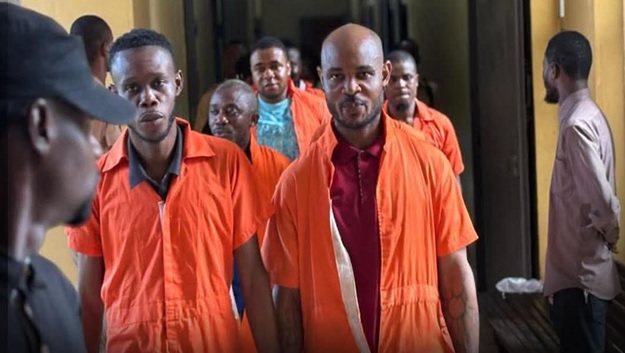
MONROVIA – The Capitol Building arson trial in Monrovia took a new turn as prosecution witness Rafael Wilson, an investigator with the Liberia National Police, delivered testimony that prosecutors say directly links key defendants to the scene of the fire that devastated the Legislature’s Joint Chambers. Wilson’s account added fresh momentum to the state’s case and sharpened the courtroom battle between prosecutors and defense lawyers.
Testifying before the court, Wilson told jurors that co-defendant Thomas Etheridge and others entered the Capitol compound in a vehicle bearing license plate HOR 98. He said the vehicle allegedly transported the suspects to the scene on the night of the incident, placing them inside the compound shortly before the fire broke out. The investigator disclosed that the vehicle remains unaccounted for.
Wilson further revealed that the scope of the investigation was extensive, with 59 additional persons of interest initially invited for questioning. According to him, the large number reflected the seriousness of the crime and the effort by investigators to piece together movements and activities linked to the arson attack on the nation’s legislative seat.
Detailing the prosecution’s evidence, Wilson pointed to significant security lapses at the Capitol on the night of the fire. He testified that state police secured only the outer perimeter of the building, while internal security personnel clocked out by 5:00 p.m., leaving the interior of the Capitol vulnerable during the night hours.
The court also heard about a key forensic discovery made during the investigation. Wilson said investigators found a chloral bottle emitting a strong smell of gasoline near the Speaker’s parking area within the Capitol compound. The bottle was collected as evidence and, according to the prosecution, supports the allegation that an accelerant was used to ignite the fire.
In what prosecutors described as a critical link, Wilson testified that geo-spatial analysis placed Etheridge at the Capitol during the time of the incident. He said the digital report corroborates other elements of the investigation and strengthens the claim that the defendant was physically present at the scene when the arson occurred.
During cross-examination, defense lawyers aggressively challenged Wilson’s testimony, focusing on what they described as gaps in the investigation. They questioned why no formal written request was made to recover the HOR 98 vehicle, despite its alleged central role in transporting suspects to the Capitol.
Wilson admitted under questioning that the request to retrieve the vehicle was made verbally rather than in writing. The defense seized on the admission, arguing that the lack of formal documentation raises serious concerns about investigative rigor and weakens the credibility of the prosecution’s claims.
Defense counsel also cast doubt on the reliability of the geo-spatial evidence, suggesting that inadequate documentation and unclear methodology undermine its probative value. They argued that without a clear chain of custody and detailed records, the evidence does not conclusively place Etheridge or other defendants at the crime scene.
The case arises from the December 18, 2024 fire that severely damaged the Legislature’s Joint Chambers, triggering national outrage and prompting urgent questions about security at the Capitol. The incident led to indictments for arson, conspiracy, mischief, and endangerment of public infrastructure.
The trial is set to resume on Thursday, with additional witnesses expected to testify. As the defense prepares to intensify its challenge to the police investigation, the case is shaping up as a high-stakes legal showdown, with significant implications for accountability and the protection of Liberia’s democratic institutions.