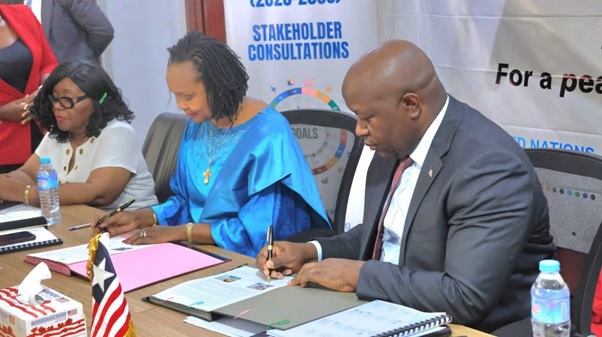
MONROVIA – The Government of Liberia and the United Nations on Tuesday, December 16, 2025, signed a new Cooperation Framework that will shape development assistance to the country from 2026 to 2030, renewing a long-standing partnership at a time when Liberia faces mounting economic pressure and shrinking external support.
The agreement, signed at the Ministry of Finance and Development Planning, commits an estimated US$883 million toward programs aimed at inclusive, resilient, and sustainable growth. While government officials hailed the framework as a strategic turning point, the scale of the commitment also places renewed scrutiny on Liberia’s capacity to convert ambitious plans into measurable improvements for ordinary citizens.
Finance and Development Planning Minister Augustine Kpehe Ngafuan framed the agreement as a test of trust forged during difficult times, noting that Liberia navigated “strong headwinds” in a year marked by global uncertainty and shifting donor priorities. He acknowledged that while some development partners reduced their engagement, the United Nations chose to deepen its involvement, a move he described as a demonstration of solidarity.
Yet beyond expressions of goodwill, Minister Ngafuan underscored a critical shift in tone, stressing that the era of planning must now give way to performance. He cautioned that the framework must not remain a document of promises and projections, emphasizing that real success will be judged by timely execution and visible impact at the community level.
The framework’s estimated US$883 million envelope, part of which is already secured, signals both opportunity and risk. With Liberia’s development needs far exceeding available resources, the pressure will be on the government and UN agencies to prioritize effectively, avoid duplication, and ensure that funds are directed toward programs with the greatest potential for transformation.
United Nations Resident Coordinator Christine Umutoni described the signing as a milestone, marking the transition from the outgoing framework ending in 2025 to a new phase beginning in January 2026. She said the agreement reflects a shared vision of a peaceful and inclusive Liberia, with a particular focus on children, youth, women, and vulnerable populations who remain disproportionately affected by poverty and weak social services.
Ms. Umutoni emphasized that national ownership sits at the center of the framework, with the Liberian government responsible for setting priorities aligned with its ARREST Agenda for Inclusive Development, Vision 2030, regional commitments under Agenda 2063, and the Sustainable Development Goals. This alignment places the burden squarely on state institutions to lead, coordinate, and account for results.
The Cooperation Framework is anchored on three priority pillars: human capital development, good governance and the rule of law, and economic sustainability. These areas reflect long-standing gaps in Liberia’s development trajectory, particularly in education, institutional strength, and job creation, sectors where progress has often been slow and uneven.
Flagship programs under the framework include education and skills development for employment, empowerment of adolescent girls, digital governance solutions, and climate-smart agriculture and food systems. While these initiatives signal a modern and forward-looking approach, their success will depend on effective coordination, adequate staffing, and the ability to overcome entrenched structural challenges.
To manage implementation, a high-level steering committee co-chaired by the Minister of Finance and the UN Resident Coordinator will provide strategic oversight, supported by technical working groups. This structure is intended to improve coordination and accountability, but it also raises expectations that bottlenecks, delays, and underperformance will be addressed decisively rather than tolerated.
Both the Government of Liberia and the United Nations acknowledged that the global development landscape is becoming increasingly constrained, with traditional aid declining. Against this backdrop, the framework’s emphasis on innovative financing, domestic resource mobilization, and strengthened partnerships reflects an implicit recognition that Liberia can no longer rely solely on external assistance to meet its development goals.
As the 2026–2030 Cooperation Framework takes effect, it positions Liberia and the United Nations at a critical crossroads. The agreement offers a substantial opportunity to accelerate progress, but it also sharpens public attention on whether this latest cycle of funding and promises will finally translate into lasting, visible change in the lives of Liberians.