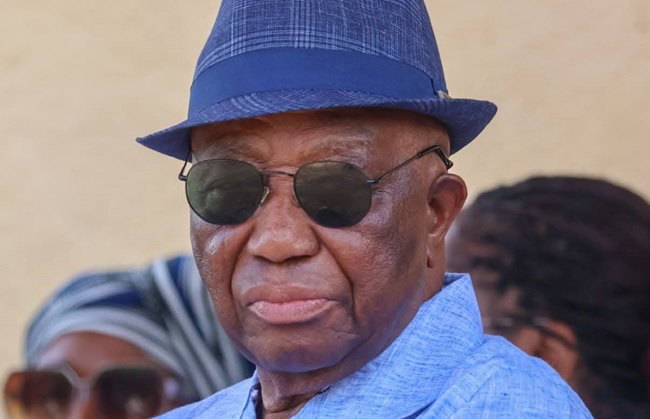
MONROVIA – President Joseph Nyuma Boakai is under renewed political fire as sharp criticism mounts over the rising cost of living, with opposition voices accusing his Unity Party–led government of failing to deliver meaningful relief on bread-and-butter issues despite repeated promises under the Rescue Agenda.
The latest and most pointed attack comes from political commentator and stalwart of the opposition Congress for Democratic Change (CDC), Wantoe Teah Wantoe, who on Saturday, December 27, 2025, issued a statement challenging President Boakai’s economic stewardship.
“For Liberians, bread and butter is not a slogan,” Wantoe said. “It is rice on the table, cassava in the kitchen, palm oil in the pot, transport to work, and fuel at the pump. On these issues, the record is clear: the CDC outperforms the Unity Party.”
Wantoe framed his criticism as a factual indictment of the Boakai administration rather than partisan rhetoric, insisting that economic performance must be measured by outcomes that directly affect household survival.
“This is not a matter of persuasion,” he declared. “It is a matter of record.”
According to Wantoe, comparisons across three governing periods, the Unity Party’s Agenda for Transformation, the CDC administration, and President Boakai’s current Rescue Agenda, reveal a troubling trend for the ruling party.
“From 2026 and beyond, the defense of the CDC’s governance record will rest on data and verifiable outcomes,” he said. “The figures speak more clearly than slogans ever could.”
Wantoe cited average annual prices for a 25-kilogram bag of rice and a gallon of gasoline from 2010 to 2025, using twelve-month averages, the accepted statistical standard, applied uniformly across all three administrations.
The results, he argued, undermine the Rescue Agenda’s central promise of economic relief. Under the CDC administration, the average price of a 25-kilogram bag of rice stood at US$14.48. Under the Agenda for Transformation, it averaged US$15.55. Under President Boakai’s Rescue Agenda, the price has climbed to US$16.95 after just two fiscal years.
Fuel prices followed the same trajectory. Gasoline averaged US$3.57 per gallon during the CDC years, rose to US$3.80 under the Agenda for Transformation, and now stands at US$4.00 under President Boakai’s government.
“These are averages, not anecdotes,” Wantoe stressed. “The assumption that prices must automatically be lower in the past does not withstand scrutiny. That assumption has been overturned.”
For President Boakai, the criticism strikes at the core of his political mandate. The Rescue Agenda was sold to voters as a corrective, a promise to ease hardship and restore purchasing power, yet the data suggests that essential commodities are now more expensive.
“This matters,” Wantoe said, “because by this point, the Unity Party should already be demonstrating tangible relief in food prices, fuel costs, and household purchasing power. That was the promise made to the public. Instead, prices are higher.”
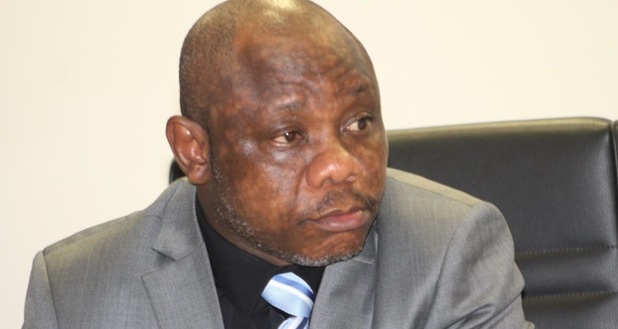
The attack drew a strong response from within the ruling Unity Party. Mo Ali, Managing Director of the Liberia Water and Sewer Corporation (LWSC), rejected the criticism and accused detractors of ignoring the government’s progress.
“Let us avoid being deliberately obtuse regarding the progress made on bread-and-butter issues,” Ali said, referencing excerpts from ‘Addressing Liberia’s Bread and Butter Debate as We Enter 2026.’
Ali argued that bread-and-butter concerns are about daily survival and claimed that President Boakai’s administration has made concrete gains under the AAID framework.
On rice, Ali stated that the price of a 25-kilogram bag has dropped from around US$18 to US$14.50, while availability has remained consistent. “A cup of rice that once cost about 120 Liberian dollars now sells for around 50,” he said, describing rice as one of Liberia’s most politically sensitive commodities.
On fuel, Ali said the government has reduced petroleum costs and stabilized supply, easing transportation challenges and improving market access for farmers across the country.
Ali also pointed to gains in electricity access, claiming national coverage has increased from about 23 percent to 33 percent, significantly reducing household dependence on generators. “Today, US$45 worth of electricity tokens can last 25 to 30 days,” he said.
Infrastructure improvements were another pillar of his defense. Ali highlighted improved road connectivity from Maryland County to Monrovia and the extension of pipe-borne water to communities neglected since the civil crisis. “That’s bread and butter to the core,” he asserted.