MONROVIA – Veteran Liberian journalist Philibert Brown has stirred national debate with a forceful investigative piece under his column “From Where I Sit,” claiming to have dug deep into the controversial Foya Mano River Union project and bringing what he describes as an end to one of the longest-running political speculations in Liberia’s recent history.
Brown traces the origin of the Foya project to a private mid-2024 conversation between President Joseph Nyuma Boakai and the late Minister of State Sylvester Grigsby, during which the President reportedly expressed concern about instability in the Mano River Union basin and the absence of a suitable venue to convene regional heads of state.
According to Brown, Grigsby interpreted the President’s remarks as a call to action and immediately began crafting a plan without the President’s direct authorization to establish a high-level meeting facility in Foya, Lofa County, the President’s hometown, intended to host Mano River Union engagements.
Brown alleges that Grigsby secretly enlisted Architect Joe Mulbah, the President’s nephew and a nationally recognized figure, to design the project and prepare architectural plans, pointing to a long-standing working relationship between the two men.
The article recalls earlier instances in which Grigsby and Mulbah allegedly altered the President’s office and constructed a modern hall on the presidential compound during Boakai’s foreign trips, actions Brown presents as initiatives taken without the President’s prior approval.
Brown states that the Foya Mano River Union Center was costed at approximately US$5.5 million, covering land acquisition, architectural designs, imported materials, and construction, with funding quietly mobilized through State Owned Enterprises after Grigsby reportedly persuaded their leadership to support the project.
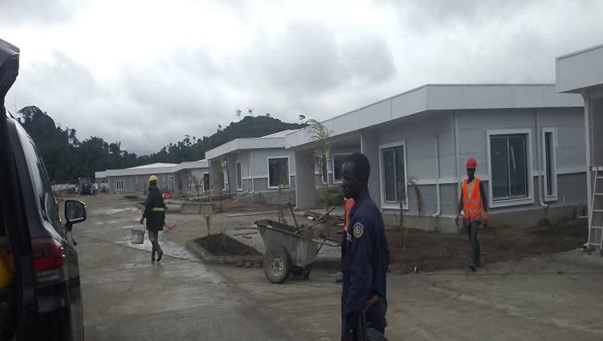
The project, as outlined by Brown, consists of fifteen structures including five three-bedroom presidential villas equipped with offices and kitchens, five staff quarters, and five security buildings designed to accommodate visiting heads of state, aides, and security personnel.
Following the death of Minister Grigsby, Brown notes that financial support to the project slowed, resulting in delays, including dozens of containers reportedly stranded at a Turkish port due to funding gaps.
Brown adds that renewed commitments from several State Owned Enterprises later allowed construction to resume, pushing the project closer to completion.
Central to Brown’s argument is his assertion that the Foya project is not a personal asset of President Boakai but the property of the Republic of Liberia, fully financed by Liberian institutions and not by Mano River Union member states.
He further maintains that President Boakai had no prior knowledge of the project and that it was intended as a national surprise rather than a private development or a misuse of public funds.
Brown also emphasizes the strategic importance of the facility, noting that it was designed to host high-level regional meetings and promote Liberia’s influence in the Mano River Union while providing secure accommodations for visiting heads of state.
Declaring an end to speculation, Brown insists that the heads of State Owned Enterprises who contributed resources committed no wrongdoing and acted in what he describes as the national interest.
That position has drawn sharp criticism from political commentator Wantoe Teah Wantoe, who argues that Brown’s account, even if accepted as factual, raises serious constitutional concerns rather than resolving them.
Wantoe challenges the credibility of a claim that a multimillion-dollar project financed by SOEs, involving land purchases, imported materials, and guarded by Executive Protection Service personnel, could proceed without the President’s knowledge.
He further questions how President Boakai could later visit the site for evaluation if he was unaware of its existence, arguing that evaluation necessarily implies awareness and responsibility.
Wantoe also raises concerns about the legal basis for land acquisition, the absence of publicly disclosed documentation, and the use of State Owned Enterprise funds without visible legislative approval.
On the Mano River Union framing, Wantoe disputes labeling the facility an MRU project, noting that no MRU country contributed financially, which he says contradicts the principles governing treaty-based regional initiatives.
He further warns that if Brown’s account is accepted, it implies that shadow actors can mobilize SOEs, acquire land, and construct presidential-grade facilities without oversight, suggesting a dangerous lapse in executive control.
Wantoe concludes that Brown’s narrative portrays a Presidency either lacking effective control over its administration or benefiting from actions later disowned, insisting that only full public disclosure of land deeds, procurement approvals, and financing records can settle the controversy surrounding the Foya project.