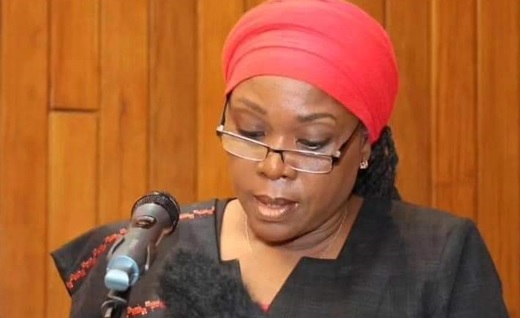
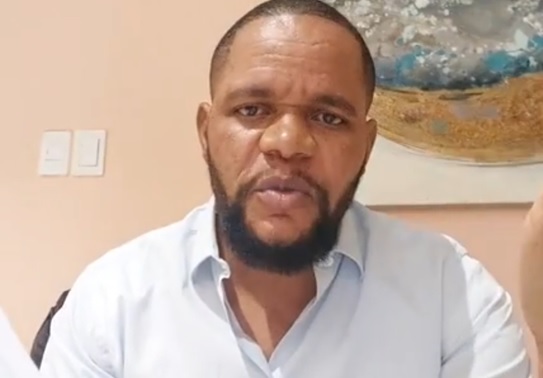
Liberia’s political and legislative environment has come under renewed strain following explosive allegations by political commentator and talk show host Henry P. Costa that senior members of the Liberian Senate are conspiring to concession the Port of Buchanan to French billionaire Vincent Bolloré. The claims, which directly implicate Senate Pro-Tempore Nyonblee Karnga-Lawrence and Montserrado County Senator Abraham Darius Dillon, Chair of the Liberian Senate Committee on Foreign Affairs, have intensified scrutiny over ongoing port reforms and the management of Liberia’s strategic maritime assets.
Costa made the allegations during a podcast broadcast on his official Facebook page on Tuesday, January 6, 2026, asserting that discussions surrounding the Buchanan Port are not driven by public interest but by private financial motives. He claimed to be in possession of photographs and related materials which, according to him, include a request seeking presidential approval for the alleged deal.
According to Costa, the proposed transaction is being advanced under the banner of port decentralization and modernization. However, he warned that similar reforms in the past have resulted in increased hardship for ordinary Liberians, particularly importers and exporters, while politically connected individuals benefited disproportionately.
The allegations come amid an ongoing legislative battle over sweeping port-sector reforms anchored in two closely linked laws: the Liberia Sea and Inland Ports Regulatory Authority Act of 2024 and the Liberia Sea and Inland Ports Decentralization and Modernization Act of 2024. Together, the Acts repeal the long-standing National Port Authority (NPA) Act, dissolve the NPA, and establish four autonomous seaports in Monrovia, Buchanan, Greenville, and Harper, alongside a new ports regulatory authority with nationwide oversight.
Both bills were introduced by Grand Bassa County Senator and Senate Pro-Tempore Nyonblee Karnga-Lawrence and reviewed by a Joint Senate Committee chaired by Montserrado County Senator H. Saah Joseph and Sinoe County Senator Augustine Chea. The legislation fundamentally restructures Liberia’s maritime governance framework, making it one of the most far-reaching institutional reforms in the sector since independence.
President Joseph Nyuma Boakai vetoed the bills and returned them to the Legislature under Article 35 of the Constitution, urging lawmakers to reconsider the measures in the broader interest of national stability and effective governance. In his veto message, the President warned that the two Acts are legally and operationally inseparable and that restructuring ports without a coherent regulatory framework would invite fragmentation and confusion.
Despite the veto, the Senate proceeded to re-pass the legislation. Prior to the vote, the Joint Committee informed the plenary that the President’s concerns largely centered on issues of nomenclature and formatting, an assessment that sharply contrasted with the substantive legal and constitutional objections outlined in the veto message.
Costa seized on this development to reinforce his allegations, arguing that the push to decentralize ports provides fertile ground for backroom concession deals. He linked the alleged Buchanan Port scheme to previous port agreements, including the APM Terminals deal, which he claimed contributed to rising costs and economic hardship for Liberians.
In his broadcast, Costa also revisited recent political developments that elevated several lawmakers to national prominence. He questioned whether protest movements widely viewed as genuine public demands for reform were leveraged to position political allies into strategic offices within government.
Referring specifically to the June 7 protests, Costa linked Senator Dillon’s rise to that period, suggesting that the movement may have served political ends beyond its stated objectives. He asserted that the public narrative of reform masked calculated political maneuvering.
“Dillon is colluding with Nyonblee to sell the Buchanan Port to a corrupt French company. He is not innocent. I created him, and I have the right to call him out at any time,” Costa said. He added, “I love Dillon and I love Nyonblee, but I am deeply disappointed in them.”
Costa further stated that he played a decisive role in facilitating the election of Senate Pro-Tempore Karnga-Lawrence on two occasions. According to him, this influence denied the people of Grand Bassa County the opportunity to freely choose their senator, raising broader questions about political leverage and accountability within the Senate.
Beyond the political allegations, the port legislation itself has drawn serious legal concern. In a July 14, 2025 opinion, Justice Minister and Attorney General Oswald Tweh warned that the proposed Ports Regulatory Authority would combine regulatory, oversight, and operational functions, creating conflicts of interest and undermining regulatory independence.
The Attorney General also cautioned that the proposed authority would overlap significantly with the Liberia Maritime Authority (LiMA), potentially weakening Liberia’s compliance with international maritime conventions and eroding an institutional framework that has guided the sector for decades.
President Boakai echoed these concerns, particularly objecting to the dissolution of the National Port Authority without sufficient transition mechanisms. He warned that dismantling an authority with substantial assets, liabilities, contracts, and workforce protections could trigger legal disputes and violate Article 25 of the Constitution, which safeguards contractual obligations.
The Decentralization and Modernization Act further grants extensive financial and administrative autonomy to the four new ports, allowing them to retain revenues and manage infrastructure independently. The President warned that such fragmentation, if poorly coordinated, could disrupt customs operations, revenue collection, and national security.
Against this backdrop, Costa alleged that the Buchanan Port is now being positioned as the next major asset for concession, arguing that placing all ports under autonomous structures increases opportunities for lawmakers to benefit financially while deepening economic hardship for the population.
In response to Costa’s claims, the Office of the Senate Pro-Tempore dismissed the allegations. Media Head Roland Solomon Glay said the bill referenced by Costa originated from a Senate retreat in Grand Bassa County and is intended to promote economic decentralization. He explained that the Senate mandated the Committee on Public Corporations to work on the proposal as part of its oversight reform agenda and said the Senate would “appropriately respond” to the allegations.