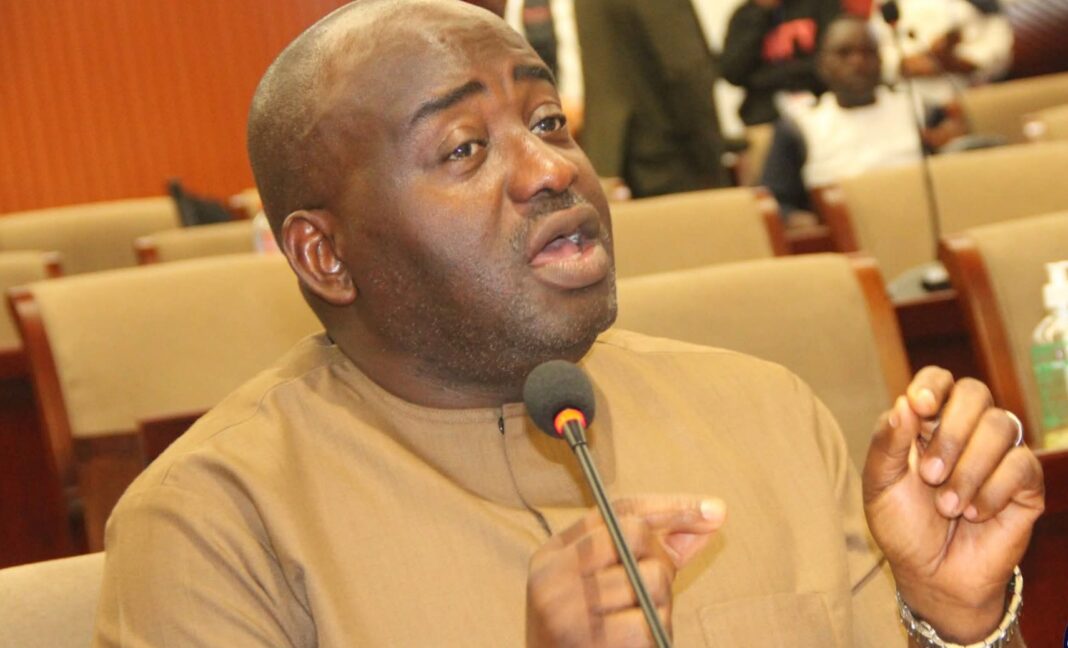

MONROVIA – Former Minister of Education, George Kronnisanyon Werner, has sharply criticized President Joseph Nyuma Boakai’s proposal to establish a National Planning Commission, warning that the move would weaken Liberia’s development planning framework rather than strengthen it. Werner made the argument on Tuesday, January 27, 2026, a day after President Boakai delivered his 2026 State of the Nation Address (SONA) to a joint session of the National Legislature.
Writing under the title “Why I Believe the Speechwriters Got It Wrong About the National Planning Commission,” Werner said the proposal stood out not for its ambition, but for what it quietly acknowledged and what it wrongly prescribed. According to him, the idea reflects an acknowledgment that Liberia’s development planning function has deteriorated, but misidentifies the solution.
“When President Joseph Nyuma Boakai presented his 2026 legislative agenda, one proposal stood out for what it quietly acknowledged and what it wrongly prescribed,” Werner wrote. He said the admission that planning has weakened is valid, but creating a new institution is not the answer.
Werner reminded that Liberia has already confronted this problem in the past and resolved it deliberately. Following the civil war, the government recognized that separating planning from finance produced a structural failure, where development plans could not be funded and budgets were disconnected from national priorities.
He explained that the former arrangement, in which the Ministry of Planning and Economic Affairs designed strategies while the Ministry of Finance controlled resources, resulted in fragmentation and inefficiency. “Plans that could not be funded and budgets that did not follow plans became the norm,” Werner wrote.
According to him, the creation of the Ministry of Finance and Development Planning (MFDP) was a deliberate reform meant to end that divide by placing planning at the fiscal center of government. MFDP was designed to ensure that development choices are costed, sequenced, and disciplined through the national budget.
Werner warned that proposing a National Planning Commission quietly reverses that logic. He said it pulls planning out of the institution that controls implementation and reintroduces the very fragmentation the MFDP reform was meant to eliminate.
“This is not a legal necessity,” Werner stressed, noting that Liberia’s public finance framework already gives the President and the Minister authority to structure MFDP, delegate responsibility, and strengthen planning leadership internally.
He described the proposal as a problem of institutional use, not institutional absence. In his view, the issue lies in how MFDP is being utilized, not in the lack of a planning body.
Werner further cautioned that creating a new commission is not a neutral administrative act. He pointed to the immediate fiscal consequences, including commissioners, a secretariat, office space, vehicles, salaries, allowances, and a permanent recurrent budget line.
“In a country already struggling with a heavy wage bill and limited fiscal space, these costs are not theoretical. They are permanent,” he wrote, warning that new institutions are often added without eliminating old structures, quietly expanding the payroll over time.
He also raised concerns about administrative disruption, noting that nearly one hundred professionals already work within MFDP’s planning functions. According to Werner, a new commission would either duplicate their roles, drain talent from the Ministry, or marginalize existing expertise.
Such a move, he said, would scatter institutional memory, weaken coordination, and create competition rather than coherence between planners in the commission and budget officers in MFDP.
Politically, Werner argued that a commission would blur accountability. When development plans fail, responsibility would be diffused between the planning body and the budgeting ministry, making underperformance easier to explain and harder to correct.
“This is how governments end up with elegant strategies and poor results,” he wrote, “because no single institution owns the full chain from planning to execution.”
Werner also warned of decentralization risks. He said a National Planning Commission would almost certainly be based in Monrovia, even as the government claims to be empowering counties through the Local Government Act.
“Planning that sits in Monrovia while counties implement is not decentralization; it is recentralization under a different name,” Werner argued, adding that counties would remain recipients rather than co-authors of development priorities.
He described it as deeply ironic that MFDP, created so planning could discipline finance, is now being bypassed. If MFDP has drifted into being mainly a budget ministry, Werner said that drift is not justification for a new commission but a call to restore the Ministry’s original mandate.
As an alternative, Werner proposed a cleaner and cheaper reform path. He suggested strengthening MFDP through executive authority by appointing a Deputy Minister for Planning and Development, supported by assistant ministers responsible for sectoral planning and national development coordination.
According to him, this approach would preserve institutional memory, avoid wage-bill expansion, align planning with decentralization, and place authority where implementation decisions are actually made.
In concluding, Werner said the speechwriters were correct to flag weaknesses in Liberia’s planning system, but fundamentally wrong in how to address them. “Reform is not about creating new signboards,” he wrote, “it is about making existing institutions work as they were designed to work.”
He warned that ignoring the history behind MFDP risks repeating past mistakes, stressing that Liberia has already paid too high a price for institutional fragmentation to repeat it again.