
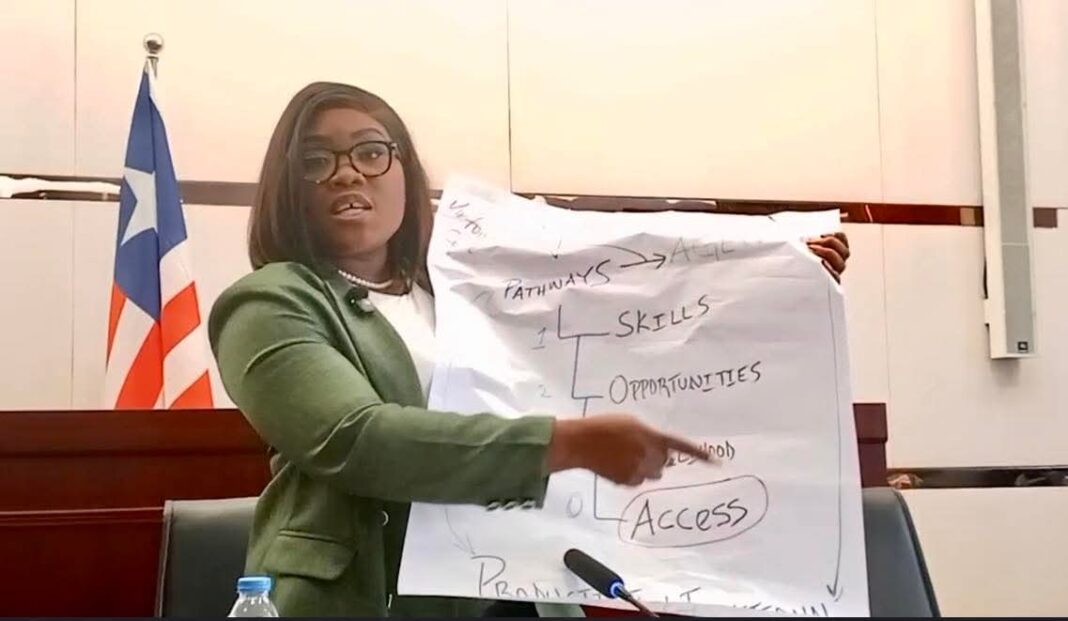
CAPITOL HILL, MONROVIA – Atty. Cornelia Wonkerleh Kruah opened her confirmation hearing with a direct appeal to substance over symbolism, urging Liberians to judge her not by age, appearance, or lineage, but by ideas, decisions, and outcomes. Appearing before the Liberian Senate on Monday at the Capitol, the Youth and Sports Minister-designate framed her nomination as a test of whether Liberia is prepared to build real pathways for a generation that has long been promised opportunity but denied access.
“Honorable Senators, I plan to be a youthful minister,” Kruah told lawmakers. “But I ask you: do not judge me by my age, and certainly not by my appearance. Judge me by my ideas. Judge me by my decisions. Judge me by my results.” Her statement set the tone for a hearing unfolding under intense public scrutiny, particularly from youth groups and student activists.
Addressing allegations of favoritism linked to her family background, Kruah did not retreat. Instead, she acknowledged privilege while emphasizing personal responsibility. “Some have suggested that my father’s position in government explains why I stand before you today, and why I shouldn’t,” she said. “I am proud to come from a family that removed barriers from my journey. But I am equally aware that without hard work, discipline, and competence, I would have squandered those opportunities.”
Kruah argued that the very opportunities critics cite are the same opportunities denied to hundreds of thousands of young Liberians. “The pathways that my family and community helped create for me are the same pathways that are missing for our youth,” she said. “I know the value of pathways, and that is why I am committed to building them.”
Placing youth development at the center of national survival, Kruah reminded senators that Liberia is overwhelmingly young. “In a country where nearly 75 percent of the population is below 35, and over 40 percent below 18, youth development is not only a social issue,” she said. “It is an economic imperative. It is a governance necessity. It is national survival.”
She further pledged inclusive leadership if confirmed. “I will be the minister of all youths in Liberia,” Kruah assured. “The majority of our population is young people. As a country, we can decide to use this as an advantage or a disadvantage. My leadership has decided to use this reality as an advantage.”
However, days before the hearing, strong warnings had already been issued by Polay Nyan Emmanuel, Chairman on Propaganda of the Student Unification Party (SUP) at the University of Liberia, who cautioned against what he described as a scripted confirmation process disconnected from youth realities. “The stage is set for Monday, and we will be watching closely the confirmation hearing of the Minister-designate for Youth and Sports,” Nyan declared.
Nyan stressed that more than three million young Liberians were watching the Senate, not out of curiosity, but necessity. He painted a grim picture of youth conditions, noting that about 80 percent are unemployed, 32 percent are forced out of high school, 10 percent are trapped in drug addiction, and nearly 94 percent are unlikely to reach their full potential by age 35. “These are not just statistics; they are lived realities,” he emphasized.
The SUP official warned lawmakers against manufacturing public consent through staged displays. “What some of us expect, once again, is the familiar political theater: a few idle and desperate youths mobilized and paraded at the Capitol to falsely suggest that millions of young people endorse this appointment,” Nyan said, adding that SUP rejects such deception outright.
He also cautioned the Senate against rubber-stamping the nomination under political pressure. According to Nyan, a confirmation driven by “empty rhetoric” would deepen alienation among young people who already feel excluded from governance and decision-making.
Despite his skepticism, Nyan said the truth about youth suffering cannot be erased. “What cannot be taken from us is the truth,” he said, arguing that no confirmation hearing, staged crowd, or performance can erase years of deprivation and neglect. “The suffering of the youth is real, and it will not be silenced,” he added, stressing that young people demand concrete actions, not symbolic gestures.
Turning directly to Kruah, Nyan said SUP hopes she understands the gravity of the ministry she seeks to lead. While acknowledging her youth and energy, he warned that patience would be limited if past patterns persist. Referencing what he described as concerning engagement styles during her time at the Ministry of State, Nyan declared, “We are here and will continue to put her feet to the fire in doing what is right.”