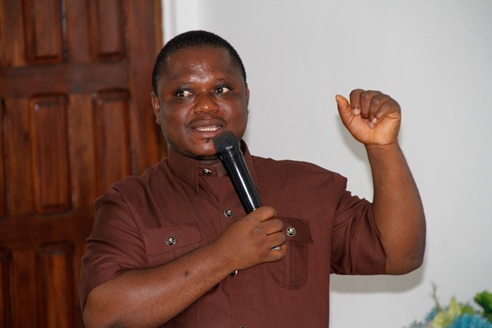
MONROVIA – “Liberia cannot afford complacency because corruption immunity remains dangerously high.” This was the stark warning sounded by Anderson D. Miamen, Executive Director of the Center for Transparency and Accountability in Liberia (CENTAL), as he unveiled the findings of Transparency International’s 2025 Corruption Perception Index (CPI), placing Liberia’s modest progress under sharp scrutiny.
Speaking at a press conference on Tuesday, February 10, 2026, at CENTAL’s headquarters in Monrovia, Miamen acknowledged Liberia’s marginal improvement on the CPI but cautioned that the gains are far too limited to justify celebration. “Yes, Liberia moved one point up, but that does not change the reality that impunity for corruption is still deeply entrenched,” he warned.
The 2025 CPI, now in its 31st edition, assesses perceived levels of public sector corruption across 182 countries worldwide. Scores range from zero, indicating highly corrupt public sectors, to 100, representing very clean systems. The index draws on 13 credible data sources, including expert assessments and business executives’ views on bribery, diversion of public funds, procurement abuses, nepotism, and abuse of public office for private gain.
According to the report, Liberia scored 28 out of 100 in 2025, ranking 136th out of 182 countries. This marks a one-point increase from its 2024 score of 27, making it the second consecutive year of marginal improvement under the Boakai-Koung administration.
Despite this incremental gain, CENTAL stressed that Liberia remains among the world’s worst long-term decliners on corruption control. “Liberia has lost 13 points on the CPI since 2012,” Miamen emphasized, noting that nine points were lost under former President Ellen Johnson Sirleaf and seven points during the administration of former President George Manneh Weah.
CENTAL expressed deep concern over the country’s consistently poor performance, arguing that the structural drivers of corruption remain largely unaddressed. Miamen pointed to the continued underfunding of integrity institutions, weak enforcement of asset declaration requirements, and the absence of decisive action against sanctioned former officials accused of acquiring illicit wealth.
He also criticized recent developments that, in his view, undermine the rule of law, including what he described as an arbitrary appointment at the Independent National Commission on Human Rights. According to Miamen, such actions contradict the principles of transparency, inclusiveness, and competitiveness required for public appointments.
On the regional front, the CPI paints a troubling picture for Sub-Saharan Africa, which recorded an average score of 32, the lowest of any region globally. Miamen said systemic corruption across the region continues to erode democracy, shrink civic space, and weaken press freedom. While countries such as Seychelles, Cabo Verde, Botswana, and Rwanda performed relatively well, Liberia remains among those with the sharpest long-term declines.
Globally, the report reveals a broader crisis of accountability, with the average CPI score dropping to 42 out of 100, its lowest level in more than a decade. More than two-thirds of countries assessed scored below 50, highlighting widespread failure to effectively control corruption.
Denmark topped the index for the eighth consecutive year with a score of 89, followed by Finland and Singapore, countries characterized by open government, strong parliaments, press freedom, and independent judiciaries. At the bottom of the index were countries such as South Sudan, Somalia, and Venezuela, where corruption thrives amid instability and repression.
Miamen stressed that the gap between top-performing and bottom-performing countries offers a clear lesson for Liberia. “Countries that perform well on the CPI invest in accountability, transparency, and strong institutions,” he said, adding that Liberia continues to lag behind in all these areas.
Turning to recommendations, CENTAL argued that President Joseph Nyuma Boakai must accelerate anti-corruption reforms rather than slow them down. Miamen observed that the one-point gain in 2025, compared to a two-point increase in 2024, signals reduced momentum instead of the bold, revolutionary approach needed to reverse Liberia’s downward trend.
CENTAL called for decisive actions, including ending impunity for corruption, strengthening oversight of state-owned enterprises, ensuring transparent and evidence-based use of the national budget, establishing a specialized anti-corruption court, and adequately financing anti-graft institutions. The group also urged reforms within the judiciary and stronger legislative oversight.
The organization further emphasized the importance of transparency and meaningful participation of civil society and citizens in government decision-making, arguing that sustained public pressure is essential to restoring integrity in public service.
In closing, Miamen commended journalists, activists, and ordinary Liberians who have remained vocal against corruption and bad governance over the past two years. He challenged President Boakai, Speaker Richard N. Koon, Senate Pro-Tempore Nyonblee Karnga-Lawrence, and Chief Justice Yamie Q. Gbeisay to use their collective authority to place Liberia’s anti-corruption fight on a credible and irreversible path.