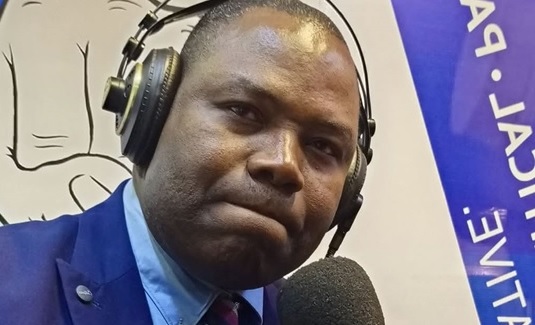
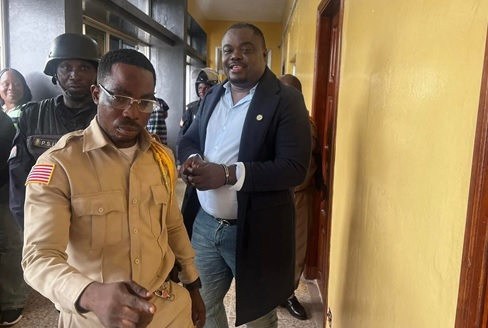
SUPREME COURT, MONROVIA – The Supreme Court of Liberia has sentenced controversial preacher Justin Oldman Yeazehn, widely known as Prophet Key, to six months imprisonment for criminal contempt, triggering a heated national debate over free speech, judicial authority, and equal justice under the law. The ruling, delivered Friday, February 13, 2026, at the Temple of Justice, marks one of the strongest assertions of judicial power in recent years.
Presiding over the matter was Chief Justice Yamie Quiqui Gbeisay, alongside Associate Justices Jamesetta Howard Wolokolie, Yussif D. Kaba, Ceaineh D. Clinton Johnson, and Boakai N. Kanneh. The Full Bench found Prophet Key guilty of engaging in sustained vulgar attacks and invectives against the judiciary, including offensive remarks directed at the mother of the Chief Justice.
In its judgment, the Court anchored its decision on Articles 5, 14, and 15 of the 1986 Constitution. While acknowledging that freedom of speech is guaranteed, the Court emphasized that such freedom carries responsibility. The justices ruled that speech designed to degrade, defame, or undermine the dignity of the judiciary crosses constitutional boundaries and constitutes punishable abuse.
The ruling declared that the contemnor’s conduct ran “contrary to the spirit, letters and intent of the Constitution,” particularly given Liberia’s cultural values and respect for womanhood. The Court concluded that his actions subjected the nation’s highest judicial body to ridicule and disrepute, warranting immediate and decisive punishment.
Prophet Key was sentenced to six months or 180 calendar days at the Monrovia Central Prison. Additionally, the Court ordered him to publish a letter of apology to the Supreme Court and to all Liberians, especially Liberian women, in three widely circulated newspapers for five consecutive days. As a condition for release, he must also execute a behavior bond pledging to refrain from future vulgar or abusive conduct.
While the Court framed its decision as a defense of constitutional order, Senator Amara Konneh of Gbarpolu County immediately raised concerns about equal justice and the integrity of the judiciary. Observing the proceedings as a non-lawyer, Konneh acknowledged that Article 15 guarantees free expression but emphasized that individuals are accountable for abuse, citing support from Cllr. Tiawan Saye Gongloe and others.
Konneh confronted the Supreme Court’s approach, questioning whether the same swift justice would apply if the insults had targeted a private citizen or an official in the Legislative or Executive branches rather than the Chief Justice. “Would the court have been just as quick to dispense justice?” he asked, highlighting potential inconsistencies in judicial enforcement.
The senator also challenged the judiciary to address what he described as corruption within the court system, pointing to claims raised by Prophet Key in the same podcast where the insults occurred. “We must endeavor to let justice be done to all men and women in our country. No cherry-picking,” Konneh declared.
Konneh clarified that his critique did not condone Prophet Key’s vulgar remarks, which he described as disgraceful. Drawing from his upbringing in rural Liberia, he emphasized that cultural values once demanded discipline and accountability for insulting elders or women. “The entire village raised its children,” he reflected, calling for a return to decency and respect.
The Supreme Court’s ruling demonstrates its unwavering stance on defending judicial integrity and enforcing accountability, leaving no doubt that contempt of court will carry serious consequences.
Senator Amara Konneh, however, immediately challenged the Court’s approach, pressing for consistency and equal application of the law. He asked whether similar punishment would have been applied if insults targeted a private citizen or another branch of government, highlighting the need for justice “to be done to all men and women in our country, no cherry-picking.”
The exchange highlights a fundamental tension, with the Court insisting on upholding institutional authority and cultural norms, while Konneh calls for the judiciary to address broader issues of fairness and impartiality in enforcing the law.
This confrontation between the Supreme Court and Senator Konneh crystallizes the debate over the limits of free expression, accountability, and equal protection under Liberian law, leaving a stark message that respect for the judiciary and consistent application of justice must coexist.