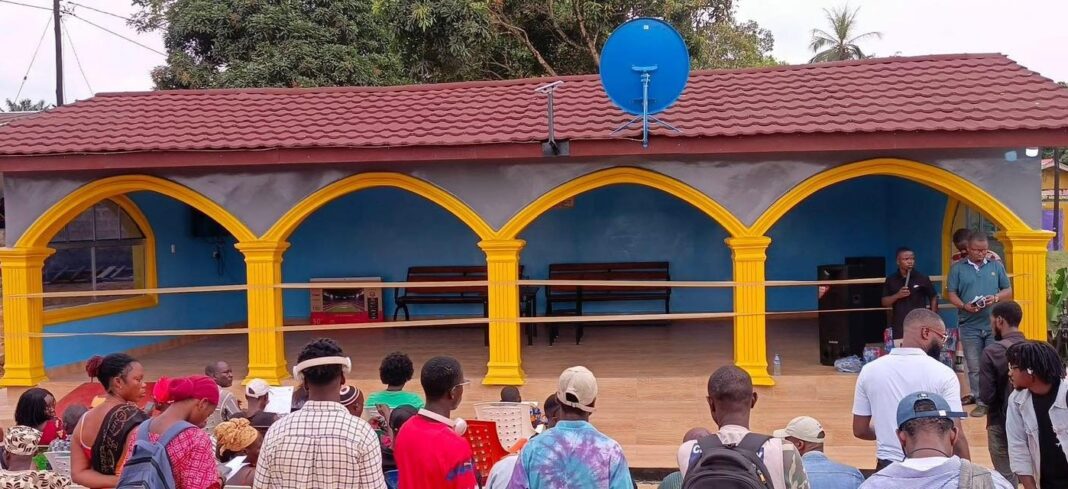
KLAY, BOMI COUNTY – Prominent Liberian exiled activist Martin K.N. Kollie on Friday, February 13, 2026, formally handed over a groundbreaking, state-of-the-art multipurpose bus stop to residents of Klay District, setting what many observers describe as a new benchmark for rural infrastructure development in Liberia.
The project was unveiled during a well-attended ceremony, as community members gathered to witness the commissioning of a facility that seamlessly blends public transportation with advanced technology. For many in the district, the structure marks a significant departure from the modest roadside shelters typically seen across the country.
Addressing residents virtually from exile, Kollie dismissed speculation that the initiative was intended to launch a political bid in Bomi County. Instead, he framed the project as a demonstration of the level of quality and respect that ordinary Liberians deserve from those entrusted with leadership.
“I have no intention of contesting in Bomi County. I did not build the bus stop because of politics,” Kollie stated. “Our people deserve dignity and excellence. If we are going to do something for them, it must meet the highest standard.”
He explained that the facility was deliberately constructed to counter what he considers a culture of mediocrity in public works delivered to communities outside the capital. According to him, rural counties should not be subjected to inferior infrastructure under the guise of development.
The new bus stop distinguishes itself by functioning as more than a transit point. It serves as a modern community center equipped with high-speed internet powered by Starlink, significantly expanding digital access in an area where connectivity has often been unreliable.
In addition to internet access, the facility offers digital satellite television through DSTV, providing access to over 100 channels. The structure is supported by a hybrid energy system that combines solar lighting with connection to the Liberia Electricity Corporation, ensuring stable electricity supply.
Accessibility was also prioritized in the design. The building includes ramps for persons with disabilities, comfortable customized seating, and refined architectural finishes that elevate its appearance beyond traditional public transport facilities.
Kollie’s decision to invest in tangible infrastructure while residing abroad has fueled vibrant public debate. Many social media users view the project as a subtle but powerful statement to elected officials, urging them to raise the standard of development initiatives in their respective constituencies.
Supporters argue that the Klay bus stop demonstrates what is possible when vision, resources, and commitment align. They say it challenges long-standing assumptions that rural communities must settle for minimal or poorly executed projects.
Andrew Werlay Jaye, Jr. publicly praised Kollie and his foundation for the initiative, describing the facility as “wondrously constructed.” He referred to Kollie as “an activist in the form of a humanist,” echoing sentiments shared by many who believe the project could reshape expectations for community-centered development across Liberia.