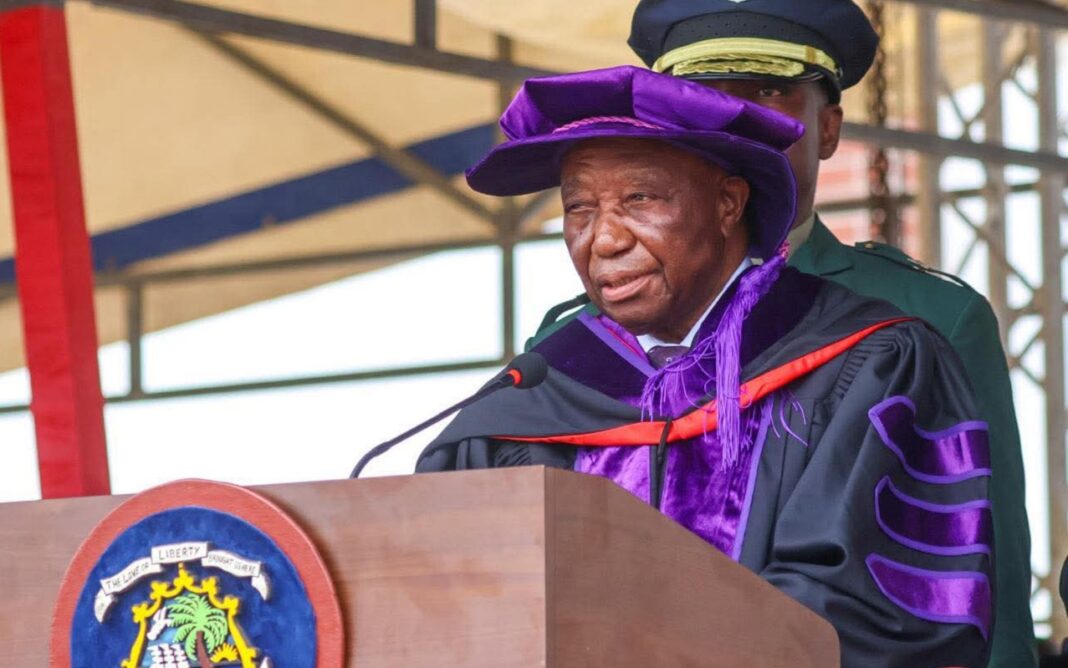

MONROVIA – The Tiawan Saye Gongloe controversy surrounding the designation of “Dux” at the Louis Arthur Grimes School of Law has intensified after Gongloe issued an official statement clarifying his role in the disputed recognition of graduate Izetta Jones-Howe. The statement comes in the wake of public debate and conflicting social media posts concerning the honors of the 2025 graduating class.
Gongloe said that a post on his official Facebook page congratulating Jones-Howe as “Dux” was published prematurely by a member of his administrative team, before the University’s internal review process. “In light of the recent public discussion concerning the designation of honors, I deem it appropriate to issue this clarifying statement grounded in responsibility, procedural fairness, and institutional integrity,” he said.
The human rights lawyer acknowledged that while the administrator acted without intent to mislead, the timing of the post created unnecessary misunderstandings. Gongloe stated that he first became aware of the publication when student Abraham Zaqi brought it to his attention at the Law School. “As the principal authority over my official platform, I accepted full responsibility for the negative effect of the post and instructed the administrator to remove it,” he said.
He stressed that the University of Liberia Administration remains the only authoritative source of official information regarding graduate rankings. Gongloe highlighted that several students, including Lansanah Maima, Abraham Zaqi, and Anthony Flomo, graduated with honors this year, and their achievements reflect sustained academic excellence.
Despite Gongloe’s clarification, public debate intensified. Activist Martin Kollie challenged the legitimacy of Jones-Howe’s Dux designation, publishing screenshots showing Gongloe’s original congratulatory message and a revised post recognizing her “academic recognition” more cautiously.
Kollie also raised questions about grade integrity, alleging that Jones-Howe had posted a ledger claiming an “A+” in Human Rights Law, a course taught by Gongloe, which he claims artificially boosted her GPA by nine points. Official records, he argued, indicate Abraham Zaqi earned the highest grade, 98 percent, in that course. “Dux-ship is earned through hard work and academic excellence, not through favor or patronage,” Kollie wrote, framing the controversy as part of “The Era of Credential Audit.”
Commentator Matthew Nyanplu criticized Gongloe’s statement, arguing that it highlights favoritism in the Law School’s grading system. Nyanplu recalled past 2024 allegations of students attempting to bribe professors during exams, questioning whether unresolved issues of academic integrity continue to plague the institution.
In response to growing public concern, the University of Liberia Board of Trustees issued a statement on February 25, 2026, led by Chairman Numene T. H. Bartekwa. The Board recommended that the announcement of a Law School Dux be postponed until a commissioned investigation is completed. The statement clarified that the University President’s prior statement was based on information available at the time and that new evidence required further review.
“The University places premium on the integrity of the academic process,” the Board emphasized, assuring the public that no student would be unfairly denied recognition nor granted honors undeservedly. The Board added that postponing the Dux announcement would not materially affect graduation ceremonies and urged all parties to remain calm.
Supporters of Gongloe argue that his acceptance of responsibility demonstrates accountability and institutional respect. They believe removing the post and deferring to University Administration was the correct response amid social media speculation and public scrutiny.
Critics contend the controversy exposes systemic weaknesses within Liberia’s premier law school. Allegations of grade manipulation or favoritism, if true, could erode public trust not only in the institution but in the broader justice system it serves.
At the center of the debate is the credibility of Liberia’s legal education system. The Louis Arthur Grimes School of Law is responsible for training the nation’s future lawyers, judges, and policymakers, making the accuracy and fairness of honors recognition critically important.
Graduating students, while officially recognized with Magna Cum Laude and Cum Laude distinctions, face lingering uncertainty over the Dux title. Many observers note that the incident casts a shadow over what should have been a celebratory milestone in their academic careers.
The ongoing investigation commissioned by the Board of Trustees will determine whether discrepancies reflect administrative oversight, miscommunication, or potential misconduct. Until a resolution is reached, debate continues between advocates of transparency and defenders of the original process.
This controversy underscores the necessity of maintaining rigorous checks and balances within higher education institutions. Ensuring that honors are awarded fairly and publicly verified is essential to preserve confidence in Liberia’s academic system.
What remains clear is the principle at stake: academic recognition must be earned and beyond reproach. For students, faculty, and the nation at large, the outcome of the investigation will signal whether the University of Liberia is committed to upholding this principle.
The UL Board’s intervention demonstrates that even in cases of high-profile social media statements, institutional oversight remains the ultimate authority. Observers now await the findings of the investigation, which will likely set a precedent for transparency and accountability in Liberia’s higher education sector.