By Socrates Smythe Saywon | Smart News Liberia
MONROVIA – Justice Minister and Attorney General, Oswald Tweh, has strongly defended the government’s handling of the high-profile corruption trial involving former Finance Minister Samuel D. Tweah and other officials of the former Coalition for Democratic Change (CDC) administration under ex-President George Weah, insisting that the acquittal of some defendants does not represent a defeat in Liberia’s broader war against corruption.
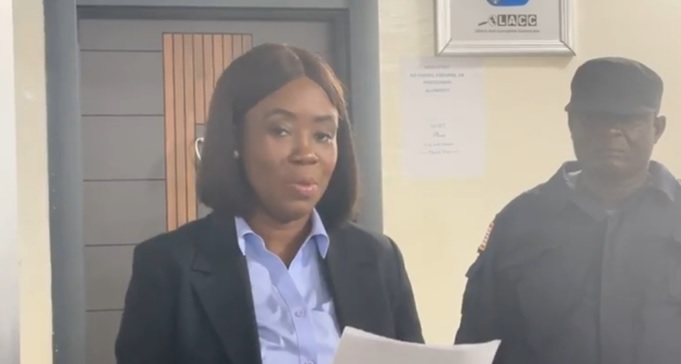
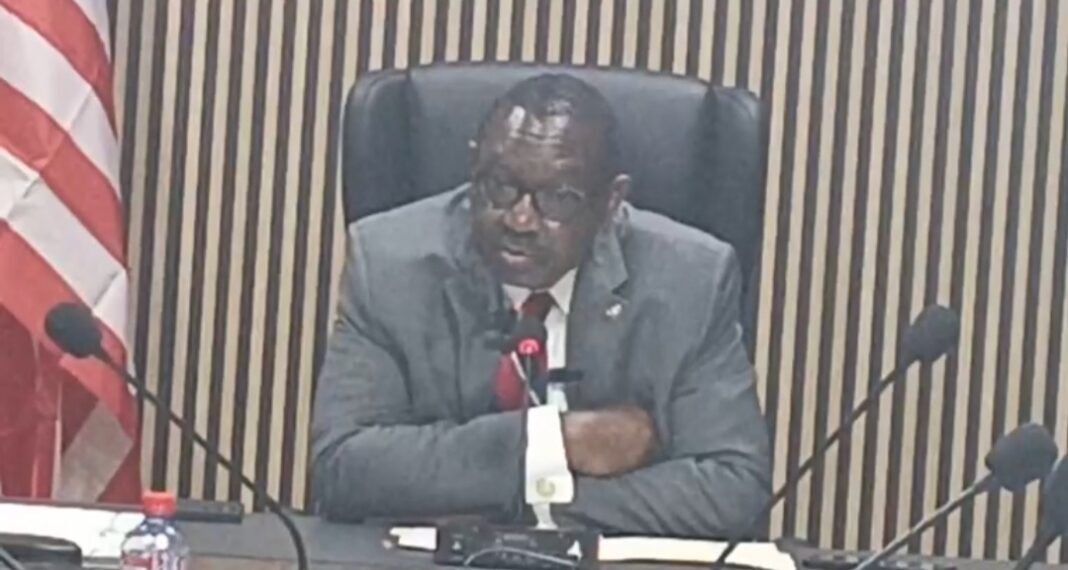
Speaking Wednesday, May 13, 2026, at the Ministry of Justice in Monrovia, Minister Tweh addressed journalists for the first time since the verdict delivered by Criminal Court “C” on Friday, May 8. The case, which triggered national attention for weeks, centered on allegations surrounding the transfer and withdrawal of more than US$6 million and over LD$1 billion in public funds allegedly moved outside lawful budgetary procedures through the Financial Intelligence Agency.
The jury ultimately acquitted former Finance Minister Samuel Tweah and former FIA Comptroller D. Moses P. Cooper of all charges. However, former Solicitor General Nyanti Tuan was convicted of theft of property, criminal facilitation, and criminal conspiracy, while former National Security Advisor Jefferson Karmoh was found guilty of criminal facilitation and criminal conspiracy. The jury failed to reach a verdict in the case of former FIA Director General Stanley S. Ford.
Addressing the mixed public reactions following the verdict, Minister Tweh acknowledged that many Liberians viewed the acquittal of Samuel Tweah as a setback for the government’s anti-corruption drive. However, he rejected that characterization, arguing that the case itself demonstrated the growing strength of Liberia’s justice system.
“The war against corruption is not decided by a single battle,” Minister Tweh declared. “It is decided by the strength of our institutions, by our willingness to take on difficult cases, and by the message we send to every public servant, past and present.”
According to the Justice Minister, the government prosecuted the case because investigators from the Liberia Anti-Corruption Commission uncovered what he described as an elaborate scheme involving public funds transferred outside the national budget and outside lawful appropriation procedures. Tweh emphasized that prosecutors pursued the matter based strictly on evidence and not political considerations.
“We charged all those whom the evidence implicated, the grand jury indicted them, we prosecuted them, and we left the final decision to a jury of their peers,” he stated.
Minister Tweh particularly highlighted the convictions of Nyanti Tuan and Jefferson Karmoh as a major milestone in Liberia’s anti-corruption campaign. He stressed that the convictions of two senior former officials send a powerful signal that even individuals occupying top government positions can be investigated and prosecuted.
“These are not small figures. These are not minor victories,” Tweh asserted. “These convictions send a clear, unmistakable message: whether you sit in the Ministry of Justice, the Executive Mansion, or at the head of an integrity institution, if you betray the public trust, you will be investigated, prosecuted, and may be convicted. No one is above the law.”
At the same time, the Attorney General defended the acquittals handed down by the jury, arguing that they actually reinforce the credibility and independence of Liberia’s judicial system. According to him, the ability of the courts to both convict and acquit demonstrates that the process was fair and not politically manipulated.
“The verdict of acquittal is not a weakness of our system; it is its strength,” he said. “An independent judiciary that acquits, as well as convicts, is the hallmark of a nation governed by law.”
Minister Tweh also disclosed that the trial almost never took place because defense lawyers initially attempted to stop the prosecution through the Supreme Court. According to him, the defendants argued that the transactions were tied to classified national security operations authorized by the National Security Council and therefore shielded from prosecution under presidential immunity.
The Justice Minister explained that the government fiercely resisted that legal challenge before the Supreme Court and eventually prevailed. He described the court’s refusal to halt the prosecution as one of the most important legal victories connected to the case.
“That legal victory was the foundation upon which everything else was built,” Tweh said. “It established a critical principle that neither a former President’s directive nor a claim of national security secrecy can be used as a blanket to block a criminal investigation into the disappearance of public funds.”
He added that the government’s success before the Supreme Court opened the door for ordinary Liberians serving on the jury to hear evidence involving some of the country’s most powerful former officials.
“We cleared the path. We opened the courtroom doors. We ensured that a jury of ordinary Liberians could hear evidence and pass judgment on officials of the highest rank,” he emphasized.
Defending the prosecution team against criticism from some sections of the public, Minister Tweh praised Solicitor General Augustine C. Fayiah and government lawyers for what he described as nearly two years of intense preparation and courtroom work.
According to him, prosecutors presented eight witnesses, including former military generals and Armed Forces officials, while introducing eighteen documentary exhibits into evidence. He said the government submitted original transfer letters allegedly signed by Samuel Tweah, Central Bank withdrawal records, canceled checks, and testimony from the Deputy Minister for Budget confirming that the transactions bypassed normal budgetary procedures.
“The prosecution did all this in the face of a defense that repeatedly tried to block inquiry by invoking the shield of national security secrecy,” Tweh stated. “I am proud of what the prosecution has accomplished.”
Despite defending the prosecution, the Justice Minister admitted that the government intends to review every phase of the case to identify weaknesses and improve future prosecutions. He disclosed that the Ministry of Justice and the Liberia Anti-Corruption Commission will conduct an internal assessment covering the investigation, presentation of evidence, and jury selection process.
“That is how we build a stronger prosecutorial capacity,” he explained. “That is how we prepare for the next case and the case after that.”
Minister Tweh also sought to clarify what he described as the undisputed facts established during the trial regardless of the acquittals. He alleged that the Financial Intelligence Agency, originally created to combat money laundering and corruption, was instead used as a conduit to transfer public funds outside legal procedures.
According to him, evidence presented in court showed that more than LD$1 billion and US$500,000 were transferred into FIA accounts without legislative appropriation or lawful budgetary authorization. He further alleged that the funds were later withdrawn in cash by FIA Comptroller Moses Cooper through checks made payable to himself.
“The evidence showed that between September 11, 2023, and October 17, 2023, the total amount of LD$1,055,145,040 was withdrawn by Mr. Cooper,” Tweh stated. “The evidence also showed that on September 22, 2023, Mr. Cooper withdrew US$500,000 from the FIA account at the Central Bank on the very same day the funds were transferred.”
The Attorney General argued that the defense failed to adequately account for where the money ultimately went, despite repeatedly invoking national security secrecy as justification. He insisted that classified operations cannot permanently shield public financial transactions from scrutiny.
“National security secrecy protects operational methods and sources. It does not, and never will, protect a simple account of where public money went,” he declared.
Minister Tweh further stressed that President Joseph Boakai remains fully committed to supporting independent anti-corruption institutions. He rejected suggestions that the prosecution was politically motivated, insisting that the case reflected the administration’s commitment to accountability and the rule of law.
“This trial was not a political project. It was a legal one,” he said. “President Boakai has made it clear from day one that his administration will support the independent work of the Liberia Anti-Corruption Commission and the Ministry of Justice.”
The Justice Minister also urged Liberians not to lose faith in the country’s justice system because of the acquittals. He warned against pressuring prosecutors to secure predetermined outcomes or undermining anti-corruption institutions whenever verdicts do not satisfy public expectations.
“This fight is long. It demands resilience,” Tweh said. “We must resist the temptation to scapegoat our own prosecutors or pressure them for a predetermined result.”
Meanwhile, Tweh disclosed that convicted defendants Nyanti Tuan and Jefferson Karmoh have already filed motions for a new trial. The Ministry of Justice, he said, has filed formal resistance to those motions and is prepared to continue fighting the case through the appeals process if necessary.
He indicated that if the motions are denied, prosecutors will push for harsh sentences designed to deter future abuse of public office.
“The Ministry will make vigorous submissions to the court, arguing for sentences that reflect the gravity of the defendants’ crimes and serve as a deterrent to future abuse of public office,” he declared.
Concluding his remarks, Minister Tweh described Liberia’s anti-corruption struggle as a “marathon” rather than a sprint, insisting that the country is gradually building a new culture of accountability through the courts.
“Public service is a sacred trust,” the Attorney General concluded. “Those who steal from the people will be pursued. They will be exposed. And sooner or later, they will face justice. That is my pledge to you today.”