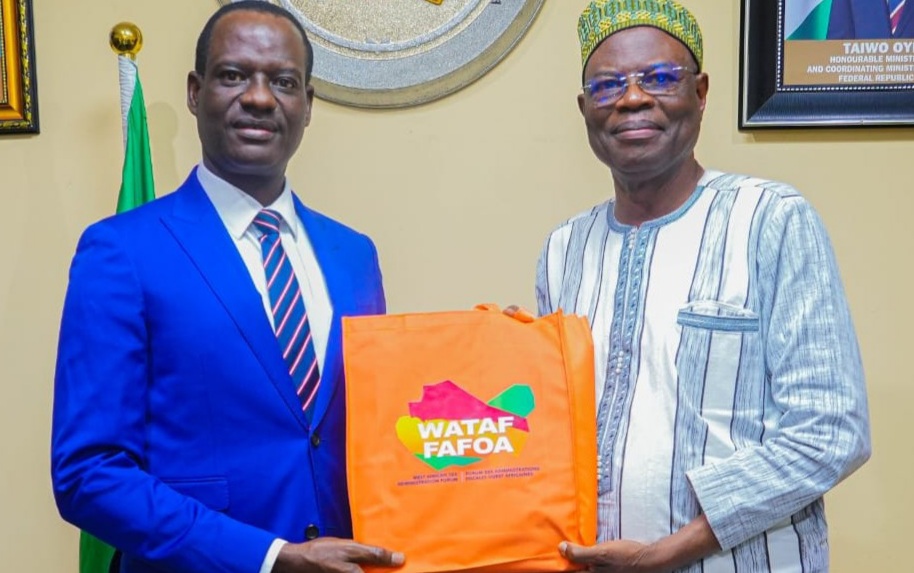
ABUJA, NIGERIA – The Secretariat of the West African Tax Administration Forum (WATAF), led by its Executive Secretary, Mr. Jules Tapsoba, on Monday (July 13) paid a courtesy working visit to the Minister of Finance and Coordinating Minister of the Economy of the Federal Republic of Nigeria, Mr. Taiwo Oyedele, in Abuja.
The visit formed part of WATAF’s continuing engagement with strategic partners to strengthen tax administration, domestic revenue mobilisation and regional cooperation across West Africa.
Speaking on behalf of WATAF, Mr. Tapsoba congratulated the Minister on his appointment and wished him success in the discharge of his responsibilities. He also acknowledged the critical role of the Ministry and the Federal Republic of Nigeria in supporting the establishment, growth and continued work of WATAF.
During a presentation delivered by WATAF’s Manager for Communication and IT, Mr. Danicius Kaihenneh Sengbeh, the delegation highlighted Nigeria’s longstanding contribution to the Organisation. Since WATAF’s establishment in 2011, Nigeria has served as an institutional backbone of the Forum, providing leadership, financial support, technical expertise, human resources and strategic partnerships that have contributed significantly to positioning WATAF as West Africa’s leading platform for tax administration cooperation.
The presentation reaffirmed that WATAF regards Nigeria not only as its host country but also as a strategic partner in advancing domestic revenue mobilisation and strengthening tax administration across the region. It further emphasised WATAF’s readiness to deepen collaboration with the Federal Ministry of Finance and Coordinating Ministry of the Economy, noting that by combining the Ministry’s policy leadership with WATAF’s regional technical expertise and convening power, both institutions can support Nigeria’s fiscal reform agenda while promoting more resilient, harmonised and effective tax systems throughout the ECOWAS region.
The delegation also highlighted WATAF’s growing impact across the region. Between 2025 and early 2026, the Forum trained nearly 2,000 tax officials from member administrations in key areas including VAT harmonisation, the Tax Administration Diagnostic Assessment Tool (TADAT), international taxation, digital economy taxation and other emerging tax policy issues, further strengthening institutional capacity and domestic revenue mobilisation across West Africa.
Welcoming the delegation, Minister Oyedele expressed pride in the work of WATAF as a regional institution promoting integration and the harmonisation of tax policies. He commended the Forum for its progress since its establishment in 2011 and acknowledged its contribution to building stronger and more resilient tax administrations across the region.
While acknowledging the domestic revenue mobilisation challenges facing many countries in the region, the Minister stressed that these also present opportunities for stronger cooperation, innovation and reform.
He challenged WATAF to take a more active role in monitoring the implementation of regional tax agreements by developing practical benchmarking tools and performance dashboards to assess member states’ compliance with ECOWAS tax directives. Such tools, he noted, would promote accountability, encourage peer learning and help raise tax administration standards across West Africa.
The Minister also encouraged WATAF to expand its benchmarking initiatives by identifying, documenting and showcasing best practices in key areas of tax administration, including digitalisation, taxation of the informal sector and broader tax policy reforms. He noted that greater peer learning and the adoption of proven practices would enable member countries to learn from one another and accelerate reforms across the region.
Officials of the Ministry also emphasised the importance of advancing regional tax harmonisation through common operational standards, closer alignment of value-added tax and customs regulations, accelerated digital transformation, knowledge transfer and continuous capacity development to support the implementation of emerging tax reforms across West Africa.
The discussions further reaffirmed the shared commitment of WATAF and the Federal Ministry of Finance and Coordinating Ministry of the Economy to strengthening cooperation in support of domestic revenue mobilisation, regional tax integration, institutional capacity development and more effective tax administration across the ECOWAS region.
Mr. Tapsoba thanked the Minister for receiving the WATAF delegation and for the constructive discussions. He subsequently presented the Minister with an official invitation to the 8th WATAF High-Level Policy Dialogue (HLPD).
Held under the theme “Building Stronger Tax Administrations for Revenue Mobilisation and Sustainable Development,” the High-Level Policy Dialogue will take place from 15–19 September 2026 at the Alisa Hotel in Accra, Ghana.
The event will be held alongside WATAF’s 23rd General Assembly and the celebration of the Organisation’s 15th Anniversary, marking fifteen years of advancing tax administration and domestic revenue mobilisation across West Africa. It is expected to convene more than 300 participants, including Ministers of Finance, Heads of Tax Administrations, senior policymakers, development partners and tax experts to discuss regional solutions for strengthening domestic revenue mobilisation, tax administration and sustainable development.
Other members of the WATAF delegation included Mr. Francis Ezeji, Administration Manager; Ms. Oluchi A. Okolo, Programme Manager; Ms. Azibator D. Obudah, Finance Manager; and Mr. Usman Ibrahim, Training and Capacity Development Manager.
About WATAF
The West African Tax Administration Forum (WATAF) is a regional body that brings together tax administrations across West Africa to strengthen domestic resource mobilization through cooperation, capacity development, and knowledge sharing. WATAF plays a leading role in shaping regional tax policy dialogue and supporting the modernization and harmonization of tax systems in line with regional and international standards.