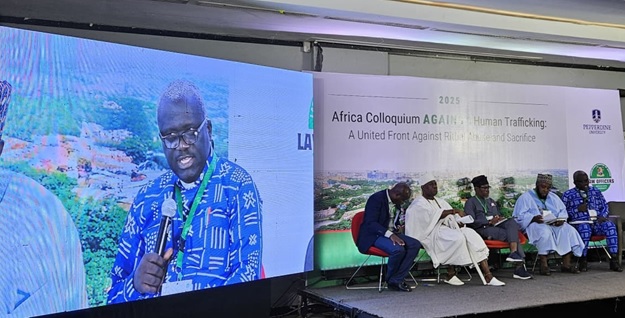
LAGOS, NIGERIA – Faith leaders across Africa have been urged to become agents of change by organizing a continent-wide campaign to eradicate ritualistic killings and human sacrifice. The call was made by Bishop Kortu K. Brown, former President of the Liberia Council of Churches (LCC), during a two-day colloquium held in Lagos, Nigeria, on Friday, October 24, 2025.
The event was organized by the Sudreau Global Justice Institute of Pepperdine University in California, USA, in collaboration with Nigeria’s Lagos State Ministry of Justice, under the theme “A United Front Against Ritual Abuse and Sacrifice.”
Bishop Brown spoke during the fourth session of the colloquium, which focused on the role of faith leaders and civil society in combating ritual abuse and sacrifice. The session explored the spiritual dimensions of the practice, including the influence of mysticism and the involvement of traditional healers, witch doctors, and diviners. It also presented Christian and Muslim perspectives that strongly denounce ritual abuse and sacrifice, emphasizing the critical role of faith leaders in shaping ethical responses and mobilizing communities.
“This is a serious fight,” Bishop Brown declared. “It is as old as Africa itself. To address it effectively, we must properly mobilize and organize religious leaders across the continent to lead campaigns at regional, national, and community levels to end ritualistic killings and human sacrifice in Africa.”
Faith leaders at the gathering reminded participants that all holy books condemn evil, including the shedding of innocent blood. They cited Proverbs 31:8–9, which instructs believers to “speak up for those who cannot speak for themselves” and to “defend the rights of the poor and needy.”
When asked why ritual abuse and sacrifice remain prevalent in countries with large Christian and Muslim populations, Bishop Brown attributed it to a lack of genuine faith among many followers and the continued influence of traditional beliefs and community norms. “One cultural element that fuels ritual abuse and sacrifice is the belief that these acts bring benefits,” he noted. “Many people still believe that such practices can bring them good fortune, children, appease deities, or guarantee victory during elections.”
“In Liberia,” he continued, “every election season is marked by reports of ritualistic killings and missing persons. People want power, but they seek it through the blood of other people’s children. This is wrong.” He urged faith leaders across Africa to rise up and confront the menace through community sensitization, challenging harmful cultural practices, reframing traditional beliefs, supporting victims, and collaborating with other stakeholders to eliminate the practice.
The organizers expressed hope that the event would serve as a turning point in the fight against human trafficking and ritual abuse in Africa. Prof. Cameron McCollum, Executive Director of the Sudreau Global Justice Institute, and Hon. Lawal Pedro (SAN, FCIArb), Attorney General and Commissioner for Justice of Lagos State, said the colloquium aimed to create a platform for leaders, advocates, practitioners, and policymakers to develop concrete strategies to eliminate ritual abuse and sacrifice across the continent.
The conference brought together about 200 participants from more than 15 African countries and the United States. The outcomes of the colloquium will be analyzed and reviewed by participants to finalize a roadmap to deter ritual abuse and sacrifice across Africa.
Liberia was represented by Church Aid Inc. (CAI) and the Human Trafficking Task Force of Liberia based at the Ministry of Labor.