MONROVIA – The legal battle surrounding the abrupt removal of Dr. Dougbeh Christopher Nyan from the National Public Health Institute of Liberia (NPHIL) has escalated into one of the most consequential tests of President Joseph Boakai’s commitment to the rule of law. As the Supreme Court deliberates the case, critics are sharpening their attacks, accusing the executive branch of a pattern of disregard for statutory procedures and judicial authority. On Tuesday, November 18, 2025, the Vanguard Student Unification Party’s Propaganda Chair, Polay Emmanuel Nyan, publicly condemned the government, declaring that “this regime stands on trial yet again, exposed for its lawlessness and abuse of power.” His comments have intensified an already heated national conversation.
The controversy stems from President Boakai’s October 15, 2025 decision to remove Dr. Nyan from his five-year tenure position as Director General of NPHIL, barely a year after appointing the internationally recognized biomedical scientist. Dr. Nyan, whose tenure is protected under Section 4.4 of the NPHIL Act of 2016, has petitioned the Supreme Court for prohibition, arguing that his removal not only violated the law but disregarded due process. He maintains that the resolution from the NPHIL Board, on which the President relied, contained “no evidence” and lacked any accusation or investigation of wrongdoing.
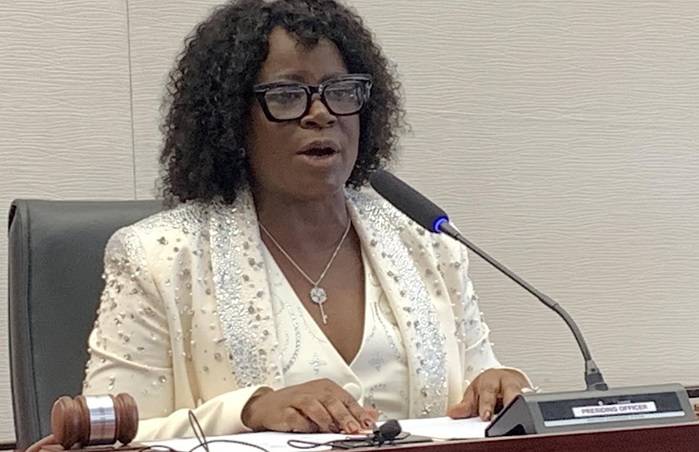
Associate Justice Jamesetta Howard-Wolokolie, sitting in Chambers, heard the matter during a two-day conference last week and has since reserved judgment. Legal sources say the Court has requested both sides to explore possible remedies, including Dr. Nyan’s reinstatement or compensation for breach of contract and damages. Any compensation, observers warn, could impose significant financial liabilities on the Boakai administration at a time when the government is already grappling with fiscal pressures and increasing public criticism.
Critics argue that the case exposes deeper concerns about governance under President Boakai. Emmanuel Nyan minced no words in accusing the administration of habitual defiance of legal limits. “Their disregard is intentional. Their arrogance is deliberate. Their disrespect is boundless,” he declared, warning that history would judge the administration harshly for what he characterized as repeated violations of the rule of law. His statements reflect growing frustration among civil society groups and political institutions that have accused the presidency of ignoring tenure protections across multiple agencies.
Dr. Nyan’s tenure at NPHIL was widely regarded as successful and transformative. Under his leadership, NPHIL strengthened epidemic surveillance, improved laboratory systems, and coordinated effective responses to outbreaks of Mpox, Lassa fever, and measles. The Institute also earned regional acclaim after being designated by the Africa CDC as an “Africa Regional Center of Excellence for National Public Health Institute Development.” These accomplishments have intensified public outcry, with many questioning why the administration would seek to remove a director whose performance was consistently praised.
Legal experts note that the Supreme Court’s eventual ruling could reshape the landscape of public-sector governance in Liberia. Lawyers representing Dr. Nyan, including Cllr. Tiawan Saye Gongloe and former Associate Justice Kabineh M. Ja’neh, have cited previous landmark decisions, such as Yealue et al. v. Executive Branch, which affirmed the protection of tenure positions in autonomous agencies. If the Court rules in Dr. Nyan’s favor, the decision would reaffirm the judiciary’s stance against political interference in tenured roles and could constrain the executive branch’s discretionary powers going forward.
The Boakai administration, facing increasing international pressure to strengthen adherence to the rule of law, now finds itself under growing judicial and public scrutiny. Diplomats, governance advocates, and development partners are watching closely, viewing the case as a litmus test for whether the administration intends to uphold legal norms or continue practices critics describe as politically motivated overreach. The outcome, analysts say, may influence the government’s credibility at a time when transparency and good governance remain critical components of foreign assistance and diplomatic engagement.
Public interest in the case is high, not only because of Dr. Nyan’s international reputation but because it has become symbolic of broader concerns about how decisions are made within the executive branch. Liberia’s governance structure, already strained by perceptions of political favoritism and administrative inconsistency, faces additional pressure as citizens seek assurances that tenure protections will not be manipulated for political convenience. Many believe the Court’s intervention marks a turning point in the ongoing struggle to reinforce legal boundaries around executive authority.
For his part, Dr. Nyan has expressed unwavering confidence in the judicial process. He reiterated that his fight is not merely personal but rooted in principle: respect for due process, institutional stability, and the integrity of Liberia’s public service. His supporters argue that defending statutory tenure is vital for protecting professionals who serve in critical national roles from political interference. “The judiciary must uphold constitutional order and fairness so that due process is respected in public service,” Dr. Nyan emphasized in his petition.
As Liberians await the Supreme Court’s ruling, the Boakai administration faces an uncomfortable spotlight. The case has raised pivotal questions about executive power, the fidelity of the administration to its own legal commitments, and the future of institutional governance in Liberia. Whatever the Court decides, the outcome will resonate far beyond the walls of the Temple of Justice, shaping not only the future of NPHIL but the public’s trust in a government increasingly under pressure to demonstrate that it governs within the confines of the law.