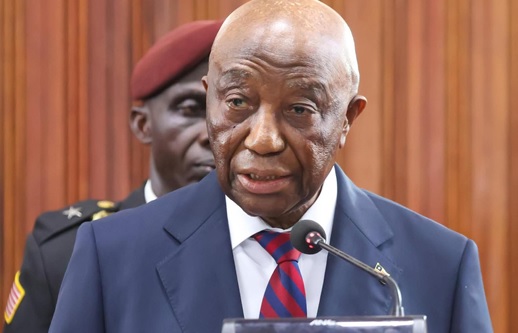
MONROVIA – President Joseph Nyuma Boakai on Monday, October 13, 2025, reaffirmed his administration’s commitment to an independent and strengthened Judiciary during the formal opening of the October Term of the Supreme Court of Liberia, held at the Temple of Justice. The ceremony brought together members of the three branches of government, the diplomatic corps, the Liberia National Bar Association, and senior judicial officials.
President Boakai hailed the occasion as a significant moment in the nation’s democratic journey, describing it as “not just the start of a new court term, but also the renewal of public trust in one of the three equal branches of our government.” He used the platform to express confidence in the new leadership of the Judiciary, which he said is critical to restoring public confidence in the rule of law.
The Liberian leader extended warm congratulations to Chief Justice Yamie Quiqui Gbeisay upon his ascension to the highest judicial office in the Republic. “We commend his expressed determination to pursue long-needed reforms within the Judiciary, reforms that will strengthen the rule of law and restore the confidence of our citizens,” President Boakai stated. He also welcomed Associate Justice Boakai N. Kanneh, whose appointment, he noted, brings new energy and perspective to the Supreme Court Bench.
Reflecting on the role of the Judiciary, Boakai emphasized its centrality to democracy and fairness. “The Judiciary stands as the ultimate guardian of liberty and fairness. It is here that every Liberian, rich or poor, educated or uneducated, must find protection and justice,” he said. According to him, when justice is applied impartially, trust in institutions grows and democracy flourishes.
Quoting an African proverb, Boakai cautioned against the erosion of institutional integrity. “The ruin of a nation begins in the homes of its people,” he said, adding that justice, integrity, and order must begin at the heart of national institutions. He warned that if the courts are weak, “the foundation of our democracy will not endure.”
The President acknowledged longstanding concerns raised by citizens regarding delays in trials, lack of transparency, and perceptions of judicial compromise. “These concerns are legitimate, and they demand urgent, courageous, and genuine reform,” Boakai said. He expressed encouragement over the Chief Justice’s vision to modernize court administration, improve case management, strengthen judicial integrity, and decentralize justice delivery.
President Boakai pledged his administration’s full support to the Judiciary’s reform agenda. “As President, I reaffirm my commitment to supporting the Judiciary’s independence while also ensuring improvement of the conditions under which our judges and magistrates work,” he noted. He promised better training, improved facilities, and enhanced logistical support for the courts, coupled with stronger collaboration with the Ministry of Justice and the Bar.
Highlighting the connection between justice and economic development, Boakai pointed to the government’s ARREST Agenda, particularly Pillar 3 on the Rule of Law. “A nation cannot progress where laws are ignored, where contracts are broken, or where the weak have no recourse,” he said. He added that investors are attracted to environments where “processes are predictable, the law is clear and respected, and citizens will obey laws that are fair and consistently enforced.”
The President called on judicial officers to exercise their duties with integrity and humility. “The robe you wear is not a symbol of privilege but of service,” he told Justices, Judges, and Magistrates. “Let your judgments be guided by truth and conscience, and let every decision you make strengthen the people’s trust in our courts.”
He also urged lawyers to uphold professional ethics and resist personal or external influence. “You are the lifeblood of justice. Let ethics and professionalism guide your advocacy. Let your pursuit of truth be untainted by personal gain or influence,” Boakai said. He reminded citizens that justice is not only dispensed in courts but also lived in communities through fairness and compassion.
As he closed his remarks, President Boakai described the new Supreme Court term as a “time of renewal, reflection, and recommitment.” He called for stronger collaboration among the Executive, Legislature, and Judiciary to build a justice system that is impartial, accessible, and trusted by the Liberian people. “Let us therefore walk together in pursuit of a justice system that is impartial, accessible, and worthy of the trust of our people,” he concluded.