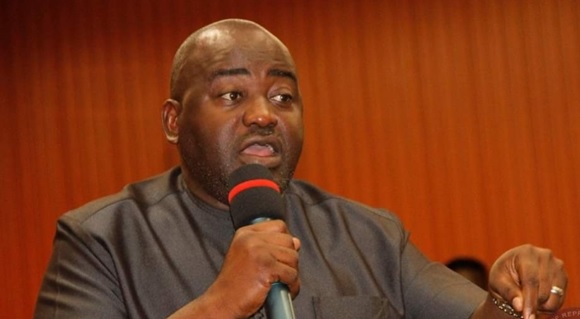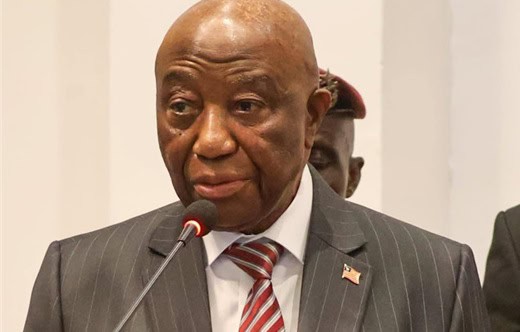
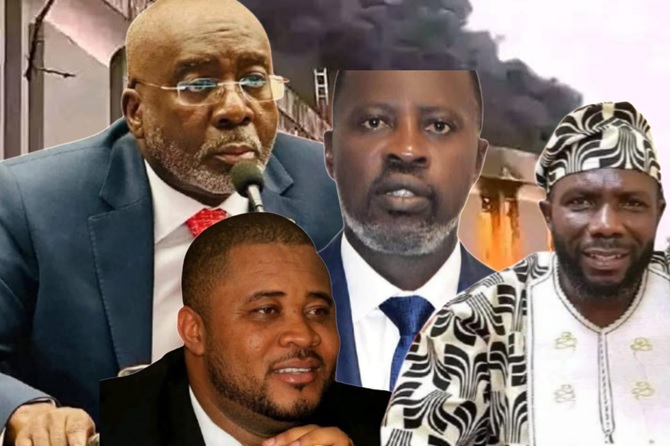
MONROVIA – Jury selection commenced on Tuesday at Criminal Court “A” in the Temple of Justice for the high-profile Capitol Building arson case involving former House Speaker J. Fonati Koffa, Representatives Dixon Seboe, Abu B. Kamara, Jacob Debee, and seven others accused of setting fire to parts of Liberia’s Capitol Building on December 18, 2024. While court officials maintain the process is standard, critics warn that the trial could test Liberia’s judicial independence in the face of intense political scrutiny.
Seven jurors were selected on the first day, leaving eight more needed to complete the 15-member panel required for the trial. Immediately after selection, the jurors were sequestered on the grounds of the Temple of Justice and barred from outside contact until the trial concludes. Court officers escorted them to their homes to collect personal belongings before returning them to sequestration, a measure intended to prevent outside influence.
Observers have questioned whether the jury pool is large and impartial enough given the political prominence of the defendants. Prospective jurors were vetted through reading and writing exercises and questioned by both prosecution and defense teams. Several were dismissed due to personal ties with defendants, raising concerns over whether social and religious networks could inadvertently affect jury composition.
One rejected juror disclosed he attends the same church as Representative Dixon Seboe, who serves as an elder. The court ruled that such direct personal connections made the candidate ineligible for service. Legal analysts caution that widespread networks among Liberia’s political and social elites may make it difficult to seat an entirely impartial jury.
The defendants, including Koffa and his colleagues, pleaded not guilty to multiple charges, including arson, criminal mischief, endangering, and attempted murder. The seriousness of these allegations, combined with the public profiles of the accused, has created a politically charged atmosphere that could influence juror perception despite strict procedural safeguards.
Earlier, the defendants petitioned the Supreme Court with a Writ of Certiorari seeking to suppress evidence linked to the incident. In September, Judge Roosevelt Z. Willie rejected their request. Critics have suggested that pre-trial rulings of this nature could impact perceptions of fairness, fueling suspicions that high-profile political defendants may face biased proceedings.
Sequestration, while designed to ensure juror impartiality, has also prompted debate over its psychological and practical effects. Experts warn that prolonged isolation may heighten stress and influence decision-making, particularly in a trial of this magnitude, where national attention and political implications are significant.
Legal commentators have emphasized that the trial’s outcome may serve as a benchmark for Liberia’s commitment to the rule of law. The selection of an impartial jury is pivotal, as political narratives and media coverage threaten to shape public opinion and, by extension, the deliberations of jurors.
Jury selection is expected to continue through the week as the court moves toward seating the full panel. Analysts note that any additional dismissals or challenges could prolong the process, adding to the public perception that political influence is an underlying factor in the trial.