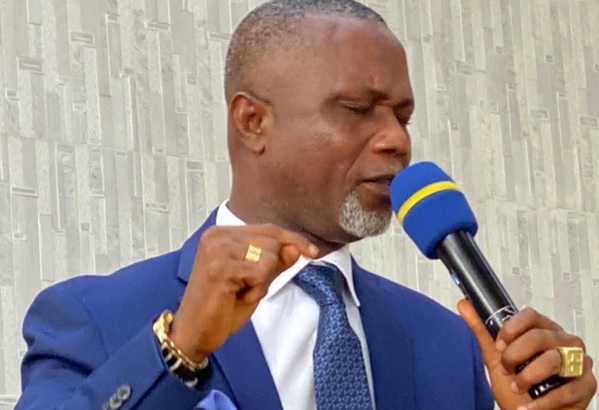
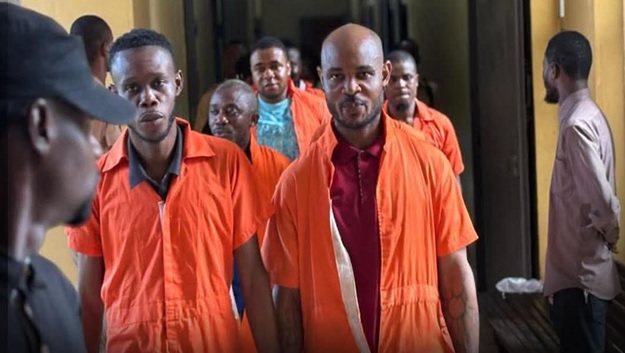
MONROVIA — The criminal trial surrounding the December 18, 2024, fire at the Capitol Building took a dramatic shift on Tuesday when the prosecution’s most anticipated piece of evidence, an audio recording allegedly capturing a plot to burn the national legislature, proved nearly impossible to decipher once played before Criminal Court “A.” The incident immediately raised concerns about the strength and credibility of the case built against former House Speaker Cllr. Jonathan Fonati Koffa and several co-defendants.
The courtroom fell into brief confusion as the distorted and barely audible recording echoed through the speakers, leaving jurors, lawyers, and observers struggling to make sense of the garbled sounds. For a prosecution attempting to link high-profile political figures to a national-security breach, the failure of the audio to communicate anything meaningful marked a significant blow.
Still, despite the defense’s fervent attempt to block its inclusion, Judge Roosevelt Z. Willie ruled that the clip would become part of the official evidence. He reasoned that the court was more interested in the substance and intent behind the recording than in the technical challenges of how it was captured. His ruling ensured that the jury will consider the audio, even though its contents remain unclear.
To support the recording’s authenticity, prosecutors called their first witness, Liberia National Police investigator Rafael Wilson. Wilson told the court that the audio had been turned over to him during the investigation. Under questioning, however, he acknowledged that he neither extracted the file from the device nor possessed training in voice analysis, admissions the defense used to attack his credibility.
Defense lawyers pushed back forcefully, arguing that Wilson could not authenticate a recording he did not handle from the beginning. They further warned that the file’s path, allegedly retrieved from defendant Thomas Ethridge’s phone by a still-unidentified national security officer known only as “Jay-Jay,” lacked the chain of custody required in major criminal cases. Concerns that the audio could be manipulated, AI-generated, or tampered with only added to their argument.
Those objections, however, did not persuade Judge Willie. In a remark that spurred discussion across the courtroom, he stated that “AI cannot be hearsay,” suggesting that the technological origin of a recording does not automatically disqualify it. The jury was instructed to receive the clip as part of the evidence despite its indistinct quality.
Adding yet another layer of inconsistency, the prosecution played the recording from a flash drive instead of the mobile phone they had repeatedly described as the original source. The defense seized on this discrepancy, accusing the state of mishandling crucial evidence in a case that demands precision.
In addition to the audio, prosecutors presented physical items they claim tie the defendants to the alleged arson: an empty Clorox bottle and a box of matches said to have been recovered from the scene. Defense lawyers countered that the matchbox displayed in court differed from the one shown during earlier proceedings, casting doubt on whether the evidence was the same.
Judge Willie reviewed the disputed items and concluded that the markings between the earlier photo and the box submitted Tuesday, “ROX” in one instance and “FOX/ROX” in another, were sufficiently similar to justify their acceptance. He ordered the evidence to be tested, pushing back against the defense’s insistence on inconsistencies.
Tuesday’s developments deepened the uncertainty surrounding one of Liberia’s most closely watched trials. What was expected to be a straightforward presentation of key evidence turned instead into a debate over authenticity, technology, and procedural integrity. For the prosecution, the unintelligible audio and contested physical exhibits represent new hurdles in their attempt to tie Koffa and the other defendants to the fire that shook the nation’s legislative branch.
As the case moves forward, both sides appear prepared for a lengthy legal showdown. Prosecutors insist that the full body of evidence will establish a clear link to the accused, while defense lawyers signal they will continue to challenge every weakness they can find. For now, the fate of the defendants rests heavily on how the jury interprets evidence that is already proving more complicated than expected.