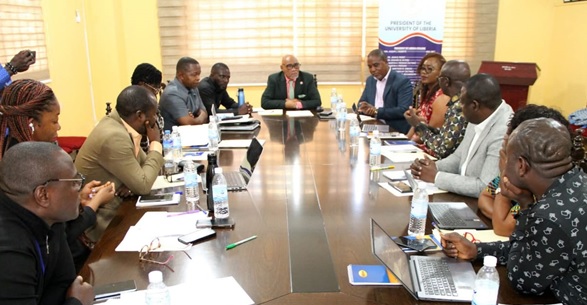
MONROVIA – The Working Committee on the Future Status of the Tubman National Institute of Medical Arts (TNIMA) has opened a three-day working session aimed at reviewing proposals for transforming the institution into a degree-granting medical school. The session is being held at the University of Liberia’s Nathaniel Cassell Administration Building on Capitol Hill.
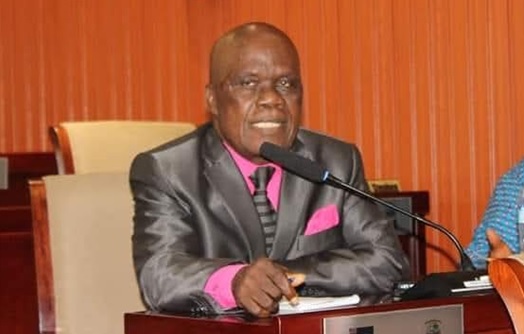
The committee, chaired by Hon. Prof. Thomas Romeo Quioh, has been mandated to produce recommendations that will guide legislative decision-making on TNIMA’s future. Speaking during the opening session, Prof. Quioh stressed that the deliberations will be evidence-based and inclusive. He noted that the goal is to ensure TNIMA’s elevation is aligned with Liberia’s broader vision of strengthening healthcare delivery and advancing medical education.
Representatives from the John F. Kennedy Medical Center (JFK) and the University of Liberia (UL) delivered 10-minute PowerPoint presentations on the opening day, each outlining perspectives on how TNIMA can be positioned for transformation. JFK’s presentation detailed the history and current operations of TNIMA, emphasizing its mission, programs, staffing, and facilities. The hospital underscored the need for degree-granting authority, arguing that such a move would enhance professional standards, expand curriculum offerings, and improve accreditation prospects.
JFK also highlighted the resource requirements that would accompany the elevation, including the development of laboratories, libraries, faculty capacity, and upgraded facilities. Partnerships with UL, Indiana University, and other international institutions were identified as critical to sustaining the initiative. Student enrollment patterns, challenges in the medical pipeline, and financial planning were also central to JFK’s recommendations.
The University of Liberia, meanwhile, outlined how it could play a direct role in supporting TNIMA’s transition. UL proposed integrating TNIMA students into its existing academic framework, offering pathways for higher degrees while expanding its collaboration with Liberia’s flagship medical training institution. UL emphasized that a partnership would help ensure academic standards, accreditation compliance, and professional alignment with national healthcare priorities.
Throughout the opening session, participants acknowledged that the proposed transformation comes at a critical moment for Liberia’s healthcare system, which continues to face challenges in staffing, quality of care, and infrastructure. By empowering TNIMA with degree-granting authority, proponents argue, the country could increase its capacity to train more qualified health professionals to meet growing national demand.
Prof. Quioh emphasized that the committee’s final report will serve as a roadmap for the House of Representatives in determining TNIMA’s future. He underscored that the discussions are not only about institutional reform but also about addressing systemic gaps in healthcare delivery. “Our deliberations must serve the interest of the Liberian people and the long-term strengthening of our health sector,” he remarked.
The session is expected to produce actionable recommendations on curriculum development, accreditation, regulatory oversight, funding strategies, and institutional partnerships. These recommendations will be submitted to lawmakers for consideration as part of the national effort to modernize Liberia’s medical education infrastructure.
As the working session continues, stakeholders expressed optimism that the outcomes will pave the way for TNIMA to make a more significant contribution to the country’s healthcare workforce. The three-day exercise will conclude with a set of proposals designed to ensure the institution’s sustainability, relevance, and alignment with international standards.
The future of TNIMA, established in 1945, has long been a subject of debate in Liberia’s health and education sectors. With this latest initiative, policymakers, educators, and healthcare leaders are seeking to give the institution a stronger mandate to serve as a cornerstone in training the nation’s next generation of doctors, nurses, and allied health professionals.