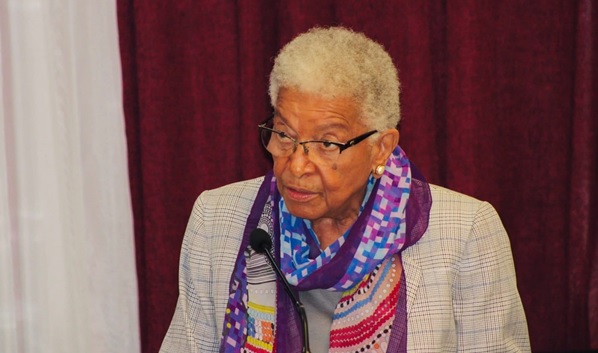
MONROVIA – Former Liberian President Ellen Johnson Sirleaf returned to the national spotlight on Thursday, March 5, 2026, when she addressed members of the House of Representatives of Liberia during a plenary session, urging lawmakers to confront some of the country’s most pressing national challenges. Her remarks, delivered before Speaker Richard Nagbe Koon, Deputy Speaker Thomas P. Fallah, and members of the 55th Legislature, focused on constitutional reform, land disputes, urban development, women’s representation, and the future of Liberia’s democracy.
Sirleaf described her invitation to address the plenary as an unprecedented moment in Liberia’s democratic history. Rather than delivering a traditional speech, she told lawmakers she intended to share reflections on key national issues requiring urgent legislative attention.
One of the most significant points raised by the former president was the controversial Article 27(b) of Liberia’s 1986 Constitution, which limits citizenship to persons who are Negroes or of Negro descent. Sirleaf called on lawmakers to consider amending the provision to reflect changing realities across the African continent.
According to her, constitutional reform in this area would enable Liberia to remain competitive and inclusive in a rapidly evolving global environment. She stressed that the country must adopt structural reforms that allow it to keep pace with emerging African nations.
The former Liberian leader also addressed the growing number of land disputes across the country, warning that the issue has become a major legal and social challenge. She observed that while some individuals and institutions hold vast tracts of undeveloped land, others occupy properties that do not legally belong to them.
Sirleaf argued that stronger policies and legal interventions are necessary to resolve these disputes and restore order in Liberia’s land governance system. She also emphasized the importance of proper zoning regulations and responsible land management as essential tools for national development.
Turning her attention to urban conditions, the former president expressed concern about the deteriorating state of Monrovia and other cities. She recalled that the capital was once admired for its historic landmarks and orderly structure but has since experienced significant decline.
Sirleaf urged lawmakers to provide legislative support for efforts aimed at restoring the dignity and development of Monrovia. According to her, rebuilding the capital is not only a matter of infrastructure but also a matter of national pride and identity.
Another issue she highlighted was the enforcement of Liberia’s Liberianization policy. Sirleaf warned that policies intended to protect Liberian participation in the national economy must be strengthened and properly enforced.
She cautioned that Liberia’s natural resources, including coastal areas and waterways, are increasingly being exploited by non-citizens without adequate regulation. Such practices, she said, pose serious environmental and economic risks to the country.
The former president also addressed the structure and strength of Liberia’s political party system. She emphasized the need for clearer laws and stronger enforcement mechanisms to ensure that political organizations operate in a disciplined and accountable manner.
A particularly troubling issue for Sirleaf was the low representation of women in national leadership. She noted that the House of Representatives currently has only nine women out of seventy-three members, while the Senate has just two women among thirty members.
Describing the situation as concerning, Sirleaf encouraged lawmakers to consider legal and political measures that would promote greater participation of women in governance. She stressed that women’s inclusion in leadership is critical to building a balanced and representative democracy.
Responding to critics who may question why many of these reforms were not implemented during her presidency, Sirleaf defended her record in office. “I did my best and served my country with distinction despite the numerous challenges at the time. I owe no apology to those that question my twelve years of leadership,” she said.
She further emphasized that her administration operated under difficult circumstances. “I know people will say she served for twelve years why didn’t she do those things? Let me say in response to this: I did my best under extenuating circumstances. As you all know, I served my country with dedication and honesty. I therefore make no apology to anybody,” Sirleaf stated.
For his part, Richard Nagbe Koon expressed appreciation to the former president for addressing the House of Representatives of Liberia, describing the occasion as a moment of reflection, learning, and national pride. He noted that the issues she raised, including citizenship reform, Liberianization policy, land governance, and urban development, touch on the core of Liberia’s national identity and future.
In recognition of her historic leadership and contributions, the House of Representatives conferred upon Sirleaf a Special Legislative Citation of Distinguished Honor. The citation acknowledged her role as Africa’s first democratically elected female president and her global advocacy for peace, democracy, and good governance.
Speaker Koon said the honor reflected the profound respect and appreciation of the representatives of the Liberian people for Sirleaf’s decades of service. He added that her leadership continues to inspire generations of Liberians and women across Africa and the world.
Sirleaf, who served as Liberia’s president from 2006 to 2018, remains an influential voice on issues of governance, peacebuilding, and women’s empowerment. Her address to the Legislature served as both a reflection on Liberia’s past and a call for bold reforms to shape the nation’s future.