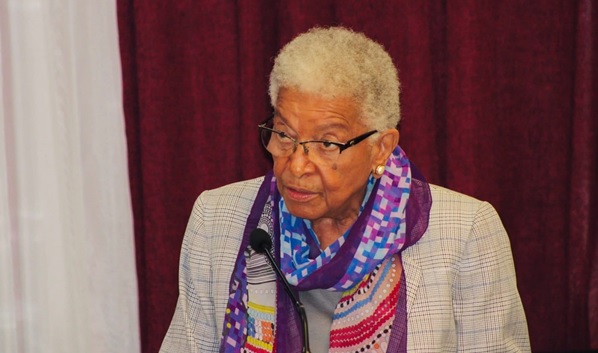
MONROVIA – Remarks made by former Liberian President Ellen Johnson Sirleaf during her recent appearance before the National Legislature of Liberia have sparked strong reactions from a student leader at the University of Liberia.
Sirleaf appeared before members of the 55th Legislature on Thursday, March 5, 2026, where she offered her perspectives on governance, constitutional issues, and the direction the country should take moving forward. Her remarks reportedly touched on the debate surrounding Article 27(b) of Liberia’s 1986 Constitution, which limits citizenship to persons of Negro descent.
Following her appearance, Emmanuel Polay Nyan, a student leader of the Student Unification Party, issued a strong public statement responding to the former president’s views and defending the constitutional provision.
Nyan acknowledged Sirleaf’s right to express her opinions but emphasized that other Liberians also have the constitutional right to challenge those views.
“Today, former President Ellen Johnson Sirleaf has the distinct honor of addressing the 55th Legislature and presenting her views on governance and constitutional issues,” Nyan stated.
“While her right to express these views is fully protected under Articles 13, 15, and 17 of the 1986 Constitution, we equally reserve the right to respond and offer a rejoinder to some of the most significant points raised in her discussion,” he added.
Central to Nyan’s response was the long-standing debate surrounding Article 27(b), which has drawn criticism from some advocates who describe the provision as outdated and discriminatory.
According to Nyan, such characterizations overlook the historical context in which the clause was created and preserved by successive constitutional framers.
“Former President Sirleaf and other critics of Article 27(b) often rely on emotionally appealing phrases such as ‘outdated’ and ‘racist’ to advance a narrative that is designed to sound persuasive and gain public sympathy,” Nyan said.
He further pointed to the national referendum held in 2020, during which Liberians voted to maintain the constitutional provision, arguing that the decision reflected the will of the people and should be respected.
“While there has been a well-organized campaign advocating for the amendment of this clause, we state emphatically that the decision of the Liberian people in the 2020 referendum to uphold this specific provision of our Constitution must be respected and protected,” Nyan asserted.
The student leader also emphasized that Article 27(b) symbolizes Liberia’s historical identity as Africa’s first independent Black republic.
“Article 27(b) stands as a symbol of Liberia’s unique identity as Africa’s first independent Black republic,” Nyan said. “In that context, the provision was never about exclusion for hatred; it was about preservation, dignity, and historical self-determination.”
Nyan rejected claims that the clause creates a racist system in Liberia, arguing that the country’s economic landscape shows significant participation and influence from foreign nationals.
“In Liberia today, many of our major businesses, industries, and technical institutions are controlled by non-Liberians,” he said, noting that such realities contradict claims that the country systematically discriminates against foreigners.
He further warned that the growing push to amend Article 27(b) could be linked to broader interests surrounding land ownership and access to natural resources.
According to Nyan, expanding citizenship and land rights without first addressing economic inequality could expose ordinary Liberians to greater economic displacement.
“At a time when Liberia is already experiencing high levels of land conflict and social tension, such a move could expose our citizens to deeper economic displacement while empowering those who already hold disproportionate economic power,” he cautioned.
Nyan concluded by stressing that Liberia’s main challenge is not the constitutional provision itself but the country’s governance and economic systems.
“What Liberia needs today is not the amendment of Article 27(b),” he declared. “What Liberia needs is a renewed commitment to responsible governance, economic justice, and the social welfare of our people.”
His remarks have added fresh momentum to the ongoing national debate over citizenship, land rights, and constitutional reform, issues that continue to generate significant discussion across Liberia’s political and academic communities.