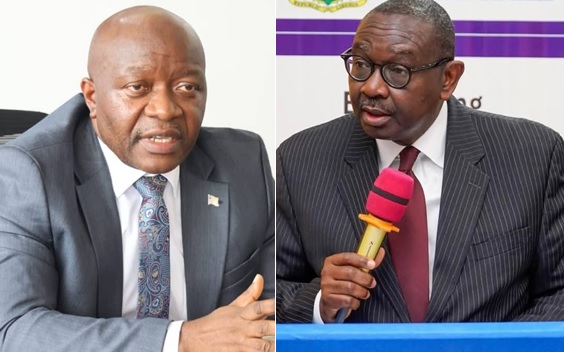
By D. Zawu Kota, Bea Mountain Supply Chain Specialist, Responds to Alexander B. Cummings and Musa Bility’s Solidified Paradox – Entrenched and Anchored in Contradictory Claims Across Liberia
A Reflection on the December 6 Unity Party Homecoming, Fundraising Rally – Solidarity Gathering
As Liberians gathered a coupled of days ago for the December 6 Solidarity Activity, an extraordinary display of public confidence in the governing Unity Party; it becomes increasingly necessary to confront and dismantle the politically charged claim that nothing has changed under President Joseph Nyuma Boakai, Sr. This phrase, recycled loudly by opposition actors and amplified by their echo chambers, seeks to reduce the complex realities of state reform to simplistic propaganda. Yet the sheer magnitude of citizens turning out in support of the Unity Party tells a different story of an intellectual argument weighting on an immaculate reality: a nation that recognizes change when it sees it and understands that genuine transformation is both steady and disciplined.
The UP large turnout at its Homecoming, Membership Drive, and Fundraising Solidarity Gathering offers a timely counterbalance, exceptionally vibrant, diverse, and spirited turnout to the claim by Alexander B. Cummings and Musa Bility that “nothing has changed” in Liberia. The overflowing crowds of loyal partisans, enthusiastic supporters, and hopeful well-wishers created an atmosphere that was both electrifying and affirming, reflecting a public that sees signs of renewed order, institutional seriousness, and a more deliberate approach to governance under President Joseph N. Boakai.
The scale and energy of the event demonstrated that many citizens perceive a shift in governance style and national direction under President Joseph Nyuma Boakai. Participants cite improvements in the openness of a flourishing and revitalized civic space, renewed institutional accountability, and the administration’s focus on rule-of-law reforms as early indicators of progress. While Liberia’s longstanding structural challenges cannot be resolved overnight, the public engagement seen at the gathering reflects a population that recognizes incremental movement and feels encouraged by the government’s efforts to restore transparency, order, and responsible leadership. This moment underscores a broader reality – assessments of national change are multidimensional, and the voices on the ground often tell a more nuanced story than the poorly political narratives registered unprecedentedly.
The allegation that Liberia is experiencing continuity rather than reform collapses when examined through any serious academic or governance lens that produces clear visibility. Take for example, the controversy involving Spoon Network Incorporated. Although the closure of the outlet drew criticism, what is academically notable is how the matter was handled, through formal judicial processes and not through executive intimidation or political policing like a fleetingly past administration of ex-President George M. Weah with a fragile leadership capacity – measuring as a broken wing bird, anchored to the earth by its brokenness. This alone signals a growing respect for the separation of state powers and a slow but meaningful renewal of the rule of law. The legal contest itself, public, energetic, and uninterrupted, proves that under the Boakai’s administration, democratic space remains engaged, robust, fortified and challenged.
Similarly, the ongoing investigation by the Liberia Anti Corruption Commission into former Minister of State Nathaniel Fallo McGill regarding alleged payroll irregularities marks a significant break from Liberia’s long tradition of protecting political elites from accountability. The very fact that individuals with strong political connections can be publicly examined through formal processes is evidence of institutional courage in a breath-taking space of tranquillity. While the opposition attempts to exploit this moment for advantage, the reality is that such investigations are signs of a government willing to confront old habits of impunity, not a government asleep while controlling a rigorous wheel at a high velocity of acceleration.
Furthermore, the active political presence of opposition figures like Alexander B. Cummings, who freely critiques governance issues and economic disparities, demonstrates that Liberia’s enriched and resilient civic space is alive, open, and diverse. A system where critics can speak without fear is exactly the system President Boakai promised, one in which dissent is accepted, not punished, and where open dialogue replaces intimidation. This alone challenges the false narrative of stagnation – a mature government, one not thin-skinned, but firmly resilient, built with layers of politically reinforced stability that prevent undue influence or infiltration from multiple forms of external pressure.
It is important to remember that the ongoing investigation into the alleged arson attack on the Capitol Building reflects a renewed commitment to accountability. For years, the public perception has been that certain individuals or groups, especially those considered part of the political or social elite; could evade scrutiny. The current investigation involving key stakeholders in society signals that justice is no longer selective, and that no one is above the law. This alone counters the narrative that Liberia remains stagnant.
The Asset Recovery Taskforce’s investigation into properties linked to the wife of ex-President George M. Weah, Madam Clar Marie Weah (former First Lady of Liberia) “Hope Foundation” underscores the administration’s willingness to examine and address possible misuse of public resources, regardless of former status or political influence. This is a sharp departure from past tendencies, where such inquiries were often avoided or quietly dismissed. These efforts point to a government attempting to restore transparency and rebuild public trust.
As a final point, an emerging crack within the Congress for Democratic Change, engineered by Counselor Kanio Bai Gbala through the formation of the Liberia Political Centrism Movement (LPCM), has produced a splinter group openly recognizing the meaningful progress taking place under President Boakai’s leadership. The LPCM’s voices have amplified national acknowledgment of the administration’s sparkling leadership, growing orderliness, and genuine transformation unfolding across all fifteen political subdivisions of Liberia. Their decision to align with the Boakai administration reflects not only a major political shift, but also a widening consensus that the government is moving the country in a positive direction. While the split may not have highlighted any long-standing fractures and inconsistencies within the CDC bloc, it also underscores the confidence many Liberians now place in President Boakai’s commitment to improved governance, stability, and national renewal. The momentum generated by these reforms continues to inspire hope, proving that meaningful change is indeed underway.
Equally significant, several other international initiatives further illustrate President Boakai’s deliverables – a few foreign-engagement actions highlight the administration’s expanding global footprint:
- October 2024: Official visits to Canada and the United States, where he addressed the UN General Assembly and hosted an investment forum positioning Liberia as an emerging global partner.
- January 2025: Signing of the Liberia Energy Compact at the Africa Energy Summit in Tanzania, advancing regional energy infrastructure collaboration.
- June 2025: Liberia’s election to a non-permanent seat on the UN Security Council for 2026–2027 – an extraordinary signal of restored international confidence.
- July 2025: Participation in the West Africa Economic Summit in Abuja, advocating for deeper ECOWAS economic integration.
- August 2025: Representation at TICAD 9 in Yokohama, strengthening ties with Asia and securing development commitments aligned with Liberian priorities.
- October 2025: A historic state visit to France, followed by engagement with the Liberian diaspora in Paris – renewing bilateral cooperation and expanding diaspora participation in national development.
What critics often ignore is that Liberia’s structural weaknesses, including corruption, institutional decline, and administrative decay, are the result of decades of past misrule and uncivilised culture that have turned to become normal due to a prolonged repetition and subsequently being served a new emerging generation. No serious scholar, public policy expert, or development specialist would expect such deep problems to disappear within a few months. President Boakai’s strategy has been calm, organized, and focused on reform. He has chosen to prioritize transparency, fiscal order, institutional repair, and professional public leadership. While the results of these reforms will take time to fully appear, the foundation has clearly been laid with solidified steel mats and rich concrete mortal to ensure lasting durability.
This is why the December 6 solidarity turnout was far from passive – it was a dynamic, and unforgettable event that became a monumental trailblazer. It represents a visible and undeniable rejection of the opposition narrative. It is a public declaration that Liberians see the early signs of renewal, even if the progress is gradual, and that they stand behind a leadership that values integrity over drama, process over noise, and national interest over personal ambition. The crowds gathering under the banner of the Unity Party show a citizenry that is observant, informed, and able to recognize genuine progress.
Thus, the claim that nothing has changed is not simply incorrect. It is a contradictory conclusion that survives only through deliberate refusal to acknowledge reality. Liberia is not standing still. Liberia is not moving backward. Liberia is entering a new period of accountability, emphasizes distributed leadership, and civic strength. The December 6 mass turnout was not only a political event. It is a democratic statement enshrined in national progress for all. And the message rising across the nation was clear; change has come, and it is being reinforced through patience, unity, and the collective resolve of the Liberian people.
Ultimately, the opposition must avoid the political colour-blindness that stems from frustration, arrogance and resentment. Liberia is the inheritance of every Liberian, not merely the battleground of competing ambitions. As national renewal takes shape, it is time for all political actors to embrace honesty, maturity, and patriotism. The Boakai’s Administration has chosen leadership over inefficiency, integrity over corruption, collaboration over conflict, compassion over indifference, innovation over complacency, peace over turmoil and unity over division. The message is unmistakable, responsible leaders must have the courage to recognize progress when it appears, even if it does not serve their immediate political script. Liberia is moving forward, steadily and deliberately; all who claim to love this nation must rise to that moment with clarity, humility, and purpose, and she (Liberia) will reward those who rise above bitterness and work for the collective good of the Republic.
Liberians have lived through tedious years of towering, echoing and lofty promises/enduring, sobering and crushing disappointments. We have seen what happens when a small group tries to control the destiny of an entire nation. And I stand here today to make it clear to our bold but reckless political aspirants/restless political climbers, that the era of an elitist, authoritarian and exploitative form of an oligarchy in Liberia is finished.
Our people have learned wisely; Our people are awake vigilantly – Our people know their powers consciously.
‘Nothing Has Changed’ – a Phrase Cradled in a Blanket of Misconception, Misdirection, Misguided, Unrealistic and a Deception of Concocted Lies.
I remain.