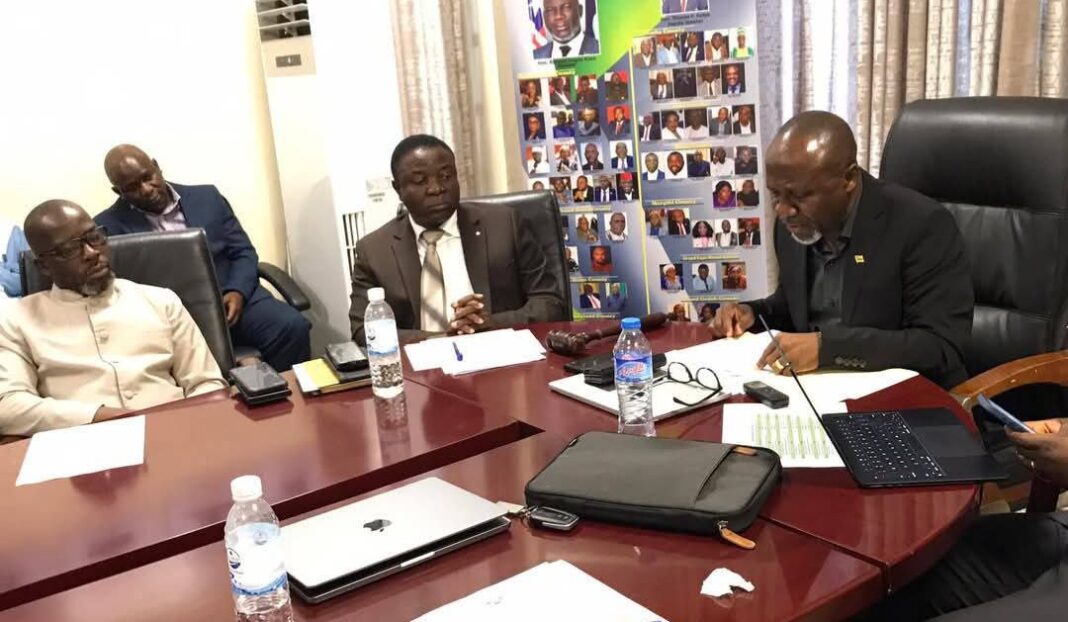
MONROVIA – The House of Representatives, through its Committee on Ways, Means, Finance, and Development Planning, on Wednesday, June 11, 2025, opened the first Quarterly Budget Performance Hearing under the mandates of the Public Financial Management (PFM) Law and the 2025 National Budget Law.
Speaking at the hearing, Committee Chairman Hon. P. Mike Jury described the national budget as more than a fiscal plan, emphasizing that it must reflect the financial realities of the country and serve as a transformational instrument measurable by the delivery of public services.
Hon. Jury reaffirmed the Committee’s commitment to collaborate with the Executive Branch to push Liberia’s national budget beyond the one-billion-dollar threshold. He also warned against revenue leakages that continue to undermine the country’s ability to meet its financial targets.
“These leakages,” Hon. Jury said, “are driven by inefficiencies, billing errors, tax evasion, and mismanagement. If left unchecked, they will erode our capacity to deliver on basic services and public expectations.”
According to the lawmaker, tackling these challenges is central to improving fiscal discipline and ensuring effective budget execution. He pointed out that the 2025 National Budget Law includes significant provisions to enforce transparency and accountability among government agencies and state-owned enterprises (SOEs).
Section 4 of the budget law requires all internally generated funds (IGFs) from public institutions to be deposited into the Consolidated Fund Account. In addition, every spending entity is obligated to submit monthly and quarterly reports detailing the use of these funds. The final quarterly report for Fiscal Year 2025 is due no later than January 31, 2026.
Hon. Jury also cited strict reporting deadlines, noting that all spending and revenue-generating agencies are required to present their comprehensive expenditure reports to the Legislature by the 15th day following the close of each quarter.
He emphasized the role of the Liberia Revenue Authority (LRA) in strengthening revenue administration, including timely collection of taxes, recovery of arrears, and enforcement of remittances in line with agreements such as those involving the Liberia International Ship and Corporate Registry (LISCR).
The 2025 budget law also introduces targeted allocations. The Liberia Immigration Service (LIS) is authorized to retain 5% of revenue from visa and residence permit services to enhance real-time service delivery, while the Liberia Telecommunication Authority (LTA) may allocate up to 8% of its revenue share to implement digital transformation initiatives across the country.
On the matter of SOE oversight, the Bureau of State Enterprises (BSE) is tasked with monthly monitoring of all SOEs and leading a debt-vetting process to determine collectible versus uncollectible debts. The law further grants the LRA viewing and garnishment rights over internal revenue-generating accounts of all revenue-generating entities, including SOEs.
As the hearing concluded, Hon. Jury reiterated the Legislature’s intention to ensure that the national budget becomes a credible and efficient instrument for change, built on measurable outcomes and public trust.