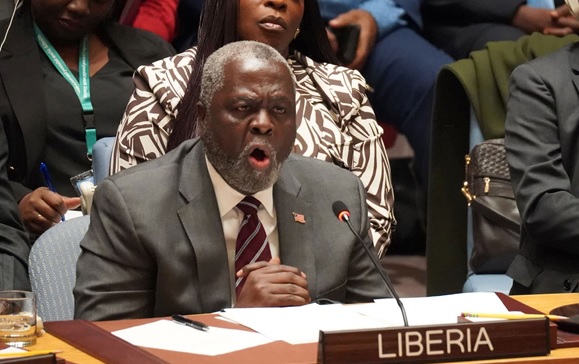
Liberia, speaking on behalf of the A3 group at the United Nations Security Council, has called for a fundamental shift in UN police peacekeeping operations, urging reforms that prioritize national sovereignty, institutional ownership, and sustainable capacity-building over substitution and dependency. The position was articulated by Liberia’s Permanent Representative to the UN, Ambassador Lewis Garsseedeh Brown II, during the Council’s 10,102nd meeting at UN Headquarters in New York on Thursday, February 5, 2026.
Delivering the statement on behalf of the A3, comprising the Democratic Republic of the Congo, Somalia, and Liberia, Ambassador Brown emphasized that effective UN policing must strengthen national institutions rather than replace them. “UN policing works best when it strengthens national institutions, not when it substitutes for them,” he told the Council, underscoring Africa’s dual role as both the largest host and one of the largest contributors to UN peace operations.
Before addressing mandates and reforms, the A3 paid tribute to fallen peacekeepers, noting that since 1948, more than 4,300 UN personnel, including police officers, soldiers, and civilians, have lost their lives in peace operations. Ambassador Brown stressed that these losses are not abstract figures but represent individuals who “defended communities they had never met and paid the ultimate price for a peace they would never get to see.”
The statement also highlighted Africa’s disproportionate contribution to UN policing, with African countries providing a substantial share of UN police personnel deployed globally. According to Ambassador Brown, this reality gives Africa both credibility and responsibility in shaping the future of peacekeeping reforms, especially in ensuring that missions support long-term national stability.
Outlining the A3’s core position, Ambassador Brown stated that UN assistance must be requested by host nations, structured as genuine partnerships, and focused on transferring capacity rather than “temporarily renting” it. He argued that sovereignty and operational effectiveness are not mutually exclusive but must reinforce each other to achieve sustainable peace.
Drawing from Liberia’s own post-conflict experience, Ambassador Brown cited the United Nations Mission in Liberia (UNMIL) as a practical example of nationally led reform. “UNMIL did not deliver miracles,” he said, “but it delivered something far more valuable, patient, nationally led police reform anchored in community trust.” He noted that the outcome was a police service Liberians could identify as their own, reinforcing the lesson that imposed peace is fragile, while owned peace endures.
The A3 further called for UN policing strategies that go beyond classroom-based training. Ambassador Brown stressed that real capacity is built through joint patrols, joint investigations, leadership mentoring, and systemic reforms rooted in national strategies. Without these elements, he warned, institutions risk remaining reliant rather than resilient.
Addressing the Security Council directly, the A3 criticized the persistent gap between mandates and resources. Ambassador Brown cautioned that authorizing missions without adequate means creates dangerous disparities between ambition and implementation. “A mandate without means is an unkept promise,” he said, warning that such gaps expose both civilians and peacekeepers to unnecessary risks.
The statement also urged restraint against politicizing peacekeeping mandates to serve the interests of individual Council members rather than host populations. Ambassador Brown emphasized that mandates must be clear, focused, and responsive to realities on the ground, rather than confusing or externally driven.
On modernization, the A3 called for responsible integration of technology in UN policing. While acknowledging the growing role of digital tools in combating crime and violence, Ambassador Brown warned against replacing old forms of dependency with new digital ones, insisting that host states must ultimately own, operate, and sustain these systems.
Gender inclusion featured prominently in the statement, with the A3 urging greater deployment and leadership opportunities for women police officers. Ambassador Brown described women in policing as an operational necessity rather than symbolic representation, noting their critical role in intelligence gathering, community trust, and reducing fear in conflict settings.
Concluding the address, the A3 reaffirmed its commitment to strengthening partnerships between the United Nations and African institutions, including the African Union Peace and Security Architecture. Ambassador Brown summarized the group’s vision as one rooted in partnership, empowerment, and sovereignty, declaring that Africa is not merely asking for better missions but is actively shaping the next generation of peace operations.