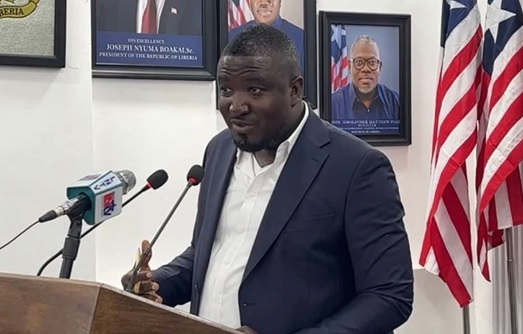

Liberia’s struggle with governance is often not about policy alone but also about the culture of leadership and public expectation. Recent developments surrounding President Joseph Nyuma Boakai’s return from an official visit to the United States have once again exposed the tension between symbolic gestures and substantive leadership. The Ministry of Information, Cultural Affairs and Tourism (MICAT) announced that upon his arrival on Tuesday, September 30, 2025, President Boakai will attend an intercessory service in his honor at the Life Center Church in Lower Margibi County. While some may view such ceremonies as customary, civil society voices like Anderson D. Miamen, Executive Director of the Center for Transparency and Accountability in Liberia (CENTAL), argue that this is a misuse of public resources and taxpayer time.
Miamen’s criticism is pointed. He questions why civil servants and government officials should leave their official duties, jobs funded by taxpayers, to attend a “welcome service” for the President. In his view, true support for leadership comes not through orchestrated events or ceremonial displays but through diligence, efficiency, and professional excellence. His concerns highlight a broader issue in Liberian governance; the prioritization of image and political theater over performance and accountability.
MICAT’s announcement frames the President’s return as a continuation of Liberia’s engagement on the international stage. While in the United States, President Boakai participated in the 80th Session of the United Nations General Assembly, held bilateral and multilateral meetings to garner support for Liberia’s development agenda, and launched the Liberia Diaspora Conference to encourage Liberians abroad to remain involved in national development initiatives. These are commendable efforts. They reflect a leader actively representing Liberia’s interests internationally. Yet, the question remains; should domestic ceremonial fanfare detract from public servants’ primary responsibilities at home?
This pattern of politically-motivated ceremonies is not unique to President Boakai. Liberian leaders, past and present, have often relied on public spectacle to reinforce authority or cultivate loyalty, sometimes at the expense of governance. When officials are required to attend events that have little bearing on policy outcomes, productivity suffers, and public funds are arguably misapplied. Miamen’s observations emphasize the necessity for leaders to reconsider how public engagement is structured, balancing cultural respect with efficient governance.
Critics of such ceremonies are not dismissing culture or the importance of recognition; they are emphasizing practicality and accountability. In a country where public resources are limited, and many citizens face persistent challenges in healthcare, education, and infrastructure, leadership credibility is built through results rather than ritual. Leaders must demonstrate that their priorities align with national needs rather than personal prestige or public adulation.
Furthermore, events like intercessory services often carry political undertones, intentionally or not. They can become platforms for signaling loyalty or demonstrating influence, particularly when government officials are instructed or expected to attend. This risks conflating genuine civic support with coerced participation, weakening the ethical framework that should guide public service. Miamen’s critique is timely; it challenges the normalization of such practices and calls for a redefinition of civic duty and leadership responsibility.
The broader implication of this discussion extends beyond a single event. Liberia’s public service system, still struggling with efficiency and transparency challenges, cannot afford distractions. When leaders prioritize ceremonies over concrete action, it sends the message that symbolism is valued above service. This affects morale, undermines institutional effectiveness, and can erode public trust. Civil society groups and watchdog institutions, including CENTAL, have a critical role to play in ensuring that governance is measured by outcomes, not by appearances.
In the end, the question posed by Miamen, when will Liberian presidents and leaders reject unnecessary ceremonies? is more than rhetorical. It is a challenge to redefine leadership in Liberia. A leader’s authority should stem from their capacity to effect positive change, address national challenges, and ensure the welfare of citizens, rather than from orchestrated displays of personal recognition. Citizens and civil servants alike are entitled to expect that government time, attention, and resources are devoted to service and development, not spectacle.
President Boakai’s international engagements are laudable, demonstrating Liberia’s active participation in global diplomacy and the mobilization of diaspora support. However, domestic ceremonies that require the withdrawal of civil servants from their core duties dilute the value of these achievements. True leadership is not measured by the number of welcome services held in one’s honor, but by tangible improvements in the lives of the people, the effectiveness of government programs, and the ethical stewardship of public resources.
Liberia’s journey toward accountable governance is ongoing. Each decision, from international diplomacy to domestic ceremonial practices, shapes the public’s perception of leadership. Leaders must recognize that their legacy will be judged not by the grandeur of rituals or ceremonies but by the quality and integrity of service delivered to citizens. Miamen’s critique is a timely reminder; performance, accountability, and responsible use of public resources must take precedence over political theater. Until this cultural shift occurs, Liberia will continue to grapple with the tension between symbolic leadership and substantive governance.
Liberian leaders, including President Boakai, face a critical choice. They can either continue the tradition of political spectacle, distracting civil servants and misallocating public resources, or they can model a culture of service and accountability. The latter path, though less glamorous, is essential for building public trust, enhancing governance, and ensuring that the country’s limited resources are directed toward meaningful development. As Miamen aptly notes, support for leadership should be demonstrated through diligence and effective public service, not orchestrated ceremonies. Liberia deserves leaders who prioritize action over applause, service over spectacle, and accountability over ceremonial excess.