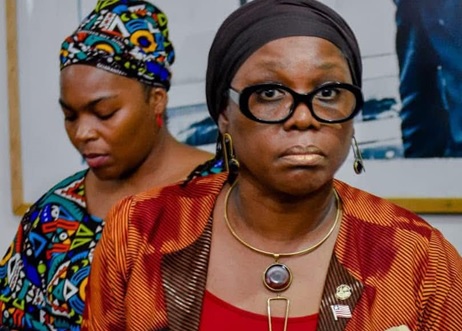
MONROVIA – Serious allegations of power concentration, fiscal excess, and institutional sidelining are emerging from within Liberia’s Ministry of Foreign Affairs, where multiple insiders accuse Minister Sara Beysolow Nyanti of operating a parallel power structure that undermines presidential authority and entrenches her loyalists.
Several officials, speaking on condition of anonymity, describe a ministry increasingly run by an inner circle rather than through constitutional governance. According to them, Nyanti has systematically marginalized presidential appointees, replacing their functional roles with consultants and personal aides who wield significant decision-making power without official mandates.
At the center of the controversy is what insiders have dubbed “a government within a government.” Consultants and personal staff reportedly perform duties meant for constitutionally appointed officials, while legitimate officeholders are left idle, sidelined, or pressured to resign. Sources allege that Nyanti has brought in at least 67 individuals, including a political advisor, communications officer, and dozens from her political base, many of whom now occupy ministry offices and draw premium salaries.
Senior staff say these hirings have significantly inflated the ministry’s budget without yielding visible diplomatic gains. “The offices of presidential appointees are dormant. Decisions are made elsewhere,” one senior official lamented. “She travels with personal security and domestic staff, and the ministry is bloated with people who owe loyalty to her, not the Republic.”
Among those reportedly targeted are Hon. Karishma Pelham-Raad, former Assistant Minister for International Cooperation, and Hon. Saywhar N. Gbaa, current Assistant Minister for Public Affairs, is an ally of the late Minister of State Sylvester Grigsby. Since Grigsby’s passing, sources say Nyanti has deliberately isolated his associates while consolidating her internal control over the ministry’s structure.
Concerns over her treatment of Assistant Minister Gbaa have been especially sharp. During a September 9 media briefing ahead of Liberia’s participation in the 80th United Nations General Assembly, Nyanti allegedly addressed Gbaa in a combative and undiplomatic tone before ten journalists. Although no formal complaints were filed, eyewitnesses described her remarks as openly hostile. Insiders later claimed she privately vowed that Gbaa “will be the next to leave government,” mirroring the pressure that led to Pelham-Raad’s resignation.
Minister Nyanti has also been heard telling colleagues that “the president favors every decision I make,” a statement that has triggered political and constitutional concerns about unchecked ministerial authority and the erosion of protections for presidential appointees.
These developments come at a pivotal time. Beginning January 2026, Liberia will assume a non-permanent seat on the United Nations Security Council, a role that demands institutional coherence, disciplined diplomacy, and credible leadership. Yet, the very ministry tasked with leading Liberia’s international engagements is now grappling with accusations of internal suppression and financial overreach.
The implications extend well beyond administrative politics. They touch on the autonomy of presidential appointees, the integrity of executive governance, and the credibility of Liberia’s foreign service at a moment of heightened global visibility.
While Nyanti has publicly portrayed herself as a reformer, insiders suggest a different reality, one marked by the centralization of power, the sidelining of official structures, and reliance on consultants to bypass governance systems.