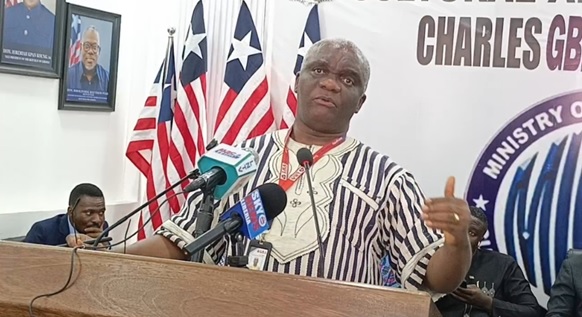
MONROVIA – The Ministry of Finance and Development Planning has unveiled a draft national budget for Fiscal Year 2026 that significantly increases funding for key security and accountability institutions, signaling a renewed focus on public safety and governance reforms. Minister Augustine Kpehe Ngafuan delivered the US$1.2 billion draft budget to House Speaker Richard Nagbe Koon on Friday, November 7, 2025, as lawmakers prepare to scrutinize allocations across critical sectors. Several security agencies are set to receive substantial funding increases, reflecting the government’s commitment to strengthening Liberia’s law enforcement and oversight mechanisms.
The Liberia National Police (LNP) is slated to see its budget rise from an estimated US$21.5 million in 2025 to US$25.7 million in the upcoming fiscal year. This increase is intended to enhance operational capacity, improve policing standards, and support ongoing efforts to curb crime nationwide. The boost also aligns with broader government initiatives aimed at modernizing the security sector and ensuring public safety in urban and rural communities.
The Liberia Immigration Service (LIS) is also projected to benefit, with funding climbing from US$7.4 million to US$10.7 million. The additional resources are expected to strengthen border management, enhance personnel training, and improve the administration of immigration services. The move underscores the government’s recognition of the importance of effective migration control and national security in maintaining Liberia’s stability.
The Liberia Drug Enforcement Agency (LDEA) stands out with a dramatic budgetary increase, more than doubling from US$3.1 million to US$7.6 million. This substantial rise is part of the government’s strategy to bolster anti-drug trafficking operations, expand investigative capacities, and enhance inter-agency coordination to combat organized crime and illegal substances. The allocation reflects the administration’s prioritization of tackling the growing challenges posed by narcotics and related criminal activity.
Funding for the National Fire Service remains unchanged at US$2.9 million, a figure consistent with the previous fiscal year. While the allocation shows no increase, the draft budget maintains the essential support needed to sustain emergency response operations, fire safety initiatives, and disaster preparedness programs across the country.
The Ministry of National Defense sees a modest adjustment, with the 2026 draft budget proposed at US$20.7 million compared to a 2025 approved budget of US$21.3 million and an estimated outturn of US$19.3 million. Similarly, the National Security Agency (NSA) is allocated US$22.1 million, up from an estimated US$13.8 million in 2025, reflecting efforts to enhance intelligence capabilities, cybersecurity infrastructure, and national security operations.
The budgetary shifts suggest a strategic emphasis on reinforcing institutions tasked with upholding law and order, public accountability, and governance oversight. Analysts note that increased funding for agencies such as the LDEA, LNP, and LIS is likely to improve operational efficiency, expand service delivery, and strengthen Liberia’s overall security architecture.
Public and legislative stakeholders are expected to closely examine the proposed figures, assessing whether the allocations are sufficient to meet operational demands while ensuring transparency and accountability. The FY2026 draft budget also highlights the government’s recognition of the need to modernize and professionalize security institutions to respond effectively to contemporary challenges.
Critics may question the absence of significant increases for the National Fire Service, which continues to operate with the same resources as in 2025, despite growing urbanization and disaster response needs. Nonetheless, the draft budget presents a clear message that security and anti-corruption initiatives remain central to the government’s priorities in the coming fiscal year.
As lawmakers prepare to debate and refine the budget, the increased allocations for Liberia’s core security and accountability agencies signal a renewed commitment to strengthening governance, protecting citizens, and tackling criminal and illicit activities. Observers expect that if implemented effectively, the proposed funding boosts could enhance national security, public confidence, and the overall rule of law in Liberia.