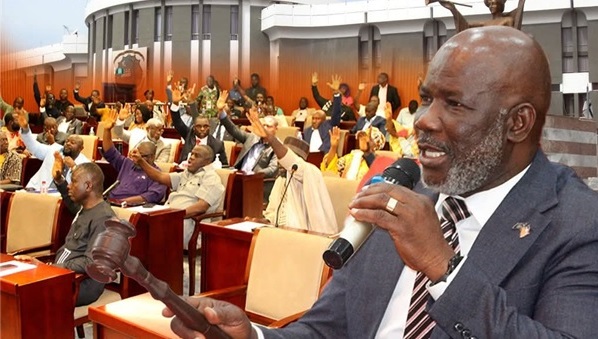
CAPITOL HILL, MONROVIA – In a landmark decision expected to reshape Liberia’s transport and mineral export landscape for decades, the House of Representatives on Thursday, December 11, 2025, voted to ratify the Concession and Access Agreement (CAA) involving the Government of Liberia, Société des Mines de Fer de Guinée (SMFG), and Ivanhoe Liberia Limited. The decisive vote followed hours of debate during the 17th Day Sitting of the House’s 3rd Quarter, marking a significant step toward opening Liberia’s rail and port systems to multi-user access under a modernized regional framework.
The ratification came after the Joint Committee on Investment & Concessions, Judiciary, Ways & Means, and Good Governance submitted a detailed report recommending full approval of the agreement. The Committee’s review drew from testimonies provided by the Inter-Ministerial Concessions Committee (IMCC), which led negotiations on behalf of the government. Lawmakers were informed that the CAA, dated July 5, 2025, represents the culmination of years of negotiations that began with Liberia’s 2021 grant of a conditional Right of Access for Guinean iron ore exportation.
According to the report, the agreement grants SMFG and Ivanhoe Liberia a 25-year right to transport iron ore from the Nimba region of Guinea through Liberia using the existing Yekepa–Buchanan railway corridor. The companies will be required to upgrade rail capacity and undertake major improvements at the Port of Buchanan to ensure the system becomes a safe, modern, and fully multi-user platform. These upgrades, the Committee emphasized, will transform the route into one of West Africa’s most important industrial corridors.
The arrangement positions Liberia as a key transit hub for industrial exports from Guinea, with revenue streams designed to directly benefit national coffers. Among these are a 1.5% customs user fee on imports, an annual transit fee of US$500,000, and significant upfront payments totaling more than US$30 million once the agreement reaches full implementation milestones. A non-refundable US$37 million previously advanced by the concessionaires remains secured unless access is denied.
Infrastructure development under the CAA is equally substantial. Phase 1 is expected to inject more than US$64 million into immediate rail and port improvements, while Phase 2 will bring an estimated US$888 million in further upgrades, a combined investment nearing US$1 billion. These enhancements are projected to vastly expand Liberia’s transport capacity and strengthen regional integration under the frameworks of the Mano River Union and ECOWAS.
In addition to infrastructure spending, the concessionaires have committed to staged payments that include US$1 million within 10 business days of signing, US$10 million after the Effective Date, and US$15 million when operations commence. Additional payments tied to regulatory milestones and operator appointments further increase Liberia’s fiscal gains, while rail access fees are projected to contribute more than US$1 billion in long-term revenue.
Communities along the rail corridor also stand to benefit significantly. The agreement establishes a structured Community Development Fund starting at US$1 million in Year 1, rising to US$5 million annually from Year 6 onward. Over the life of the agreement, this fund is expected to surpass US$110 million, earmarked for education, health, local infrastructure, and livelihood programs.
The CAA also embeds critical national obligations, including employment preference for Liberians, prioritization of Liberian-owned businesses in procurement, and strict adherence to environmental, social, and medical standards. Ivanhoe Atlantic has already submitted a comprehensive Environmental and Social Impact Assessment (ESIA) to the Environmental Protection Agency, following consultations with communities from Yekepa to Buchanan.
If both Houses of the Legislature approve the agreement, project development is expected to begin in 2026, with the first shipment of iron ore projected between 2–5 million tons annually in 2027. Following feasibility studies, Phase 2 targets an expansion to 30 million tons per year. ArcelorMittal Liberia will remain operator of the rail system until September 23, 2030, after which management will transition to a neutral Independent Operator under the National Rail Authority.
The IMCC assured lawmakers that all legal and procedural requirements were fulfilled before submission to the Legislature. Committee members emphasized the agreement’s potential to boost revenue, create thousands of direct and indirect jobs, and advance Liberia’s long-standing goal of establishing a competitive multi-user rail regime.
After deliberations, a motion by Montserrado County District #2 Representative Sekou Kanneh led to the agreement’s passage and referral to the Liberian Senate for concurrence. The vote has already triggered reactions from key stakeholders, including former Mines and Energy Minister Wilmot J.M. Paye, who played a central role in earlier negotiations.
In a statement, Paye hailed the House’s decision as “uplifting,” asserting that it reaffirms Liberia’s commitment to unlocking the vast mineral and infrastructural potential of the Yekepa–Buchanan corridor. He noted that the corridor’s iron ore reserves, estimated at 17 billion tons, position Liberia to become a global mining powerhouse if managed responsibly.
However, Paye warned that the Senate must act in Liberia’s interest, noting that some senators maintain business ties with ArcelorMittal, the current operator. He expressed concern that if the Senate concurs, ArcelorMittal may accelerate extraction to levels that could shorten the mine life, potentially undermining milestones set in its Mineral Development Agreement.
Paye further criticized what he described as misleading public claims by ArcelorMittal that its concentrator plant is ready for operation. He argued that the plant remains far from functional and that the company appears more interested in exploiting multiple high-grade ore deposits than fulfilling earlier commitments. This, he said, places Liberia at risk if regulators do not strengthen oversight.
Despite these concerns, Paye clarified that he remains supportive of ArcelorMittal’s investment in Liberia but rejected the notion that Liberia should operate from a position of desperation. “We are not desperate. We are a country,” he stated, underscoring the need for transparency in determining the concentrator’s production capacity and operational readiness.