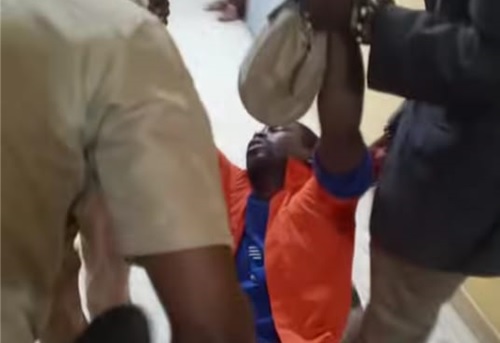
MONROVIA – Kivi Bah, a defendant in the high-profile Capitol Arson case, fainted in open court on Wednesday, September 24, 2025, during a hearing on a motion to suppress key evidence. The dramatic incident occurred at Criminal Court “A” in the Temple of Justice, leaving court officials and spectators startled.
The motion, filed by defense lawyers representing several defendants, seeks to exclude certain evidence they argue was obtained illegally or is irrelevant to the charges. Defense attorneys have now urgently requested Bah’s release, citing the need for immediate medical attention following the courtroom collapse.
Presiding over the case, Resident Circuit Judge Roosevelt Z. Willie is expected to issue a ruling on the 32-count motion that has become a central focus of the trial. The case involves more than a dozen defendants, including J. Fonati Kofa, Dixon W. Seboe, Jacob C. Debbie, Jerry Pokah (alias Tyrese), Stephen M. Broh, John Nyanti, Patience Bestman, Grace Johnson, Abu Kamara, Christian Kofa, Eric Susay, Thomas Isaac, and Etheridge, among others yet to be identified.
The defendants face serious charges, including attempted murder, criminal conspiracy, reckless burning and explosion, criminal solicitation, facilitation, and reckless endangerment. The trial has drawn significant public attention due to both the gravity of the accusations and the number of individuals implicated.
The motion to suppress evidence is being closely watched, as its outcome could significantly shape the course of the trial. Legal experts say the court’s decision will have important implications for how evidence is treated in Liberia’s criminal justice system, especially in cases of national significance.
The case stems from one of Liberia’s most devastating incidents in recent history. On December 18, 2024, a fire broke out at the Capitol Building at around 6:20 a.m., severely damaging the nation’s legislative headquarters. Although no casualties were reported, the blaze disrupted legislative activities and exposed critical vulnerabilities in the security of government facilities, raising questions about preparedness and oversight.
As the court proceedings continue, all eyes remain on Judge Willie to deliver a ruling that could either strengthen the prosecution’s case or provide relief for the defendants. Meanwhile, the dramatic courtroom incident involving Kivi Bah underscores the intense pressure and high stakes surrounding one of Liberia’s most closely followed criminal trials.