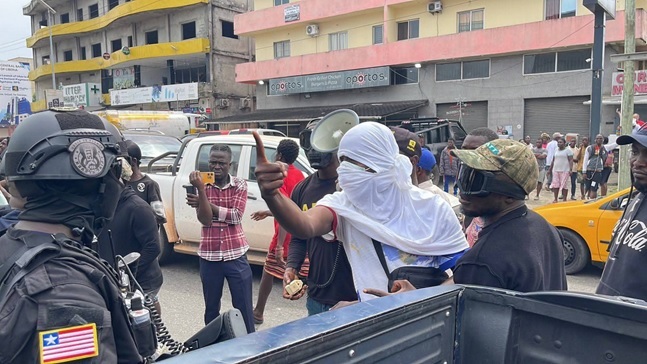
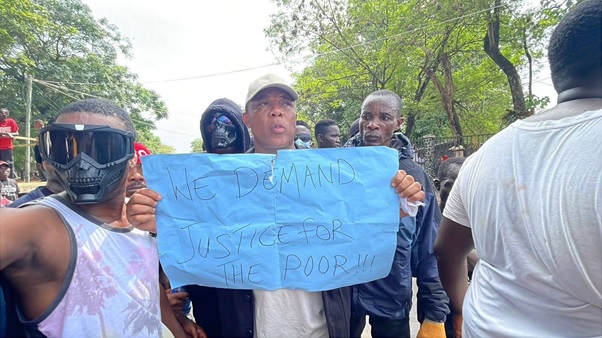
MONROVIA – The December 17 “Lead or Leave” protest was billed as a defining confrontation between citizens and power. Instead, it ended as a loud but hollow episode with no engagement, no petition delivered, and no accountability triggered. On Capitol Hill, where symbolism matters most, the protest collapsed into confusion and clashes, exposing not only the Boakai administration’s indifference to public pressure but also the protest organizers’ inability to convert anger into leverage. The result was a political stalemate that served neither governance nor dissent.
For President Joseph Nyuma Boakai’s executive branch, the central question is simple and unavoidable: why did a protest framed around corruption, drugs, prices, and public hardship meet a closed gate rather than a constitutional response? If the administration claims openness, why was there no clear protocol to receive grievances peacefully at the seat of power? And if security concerns were paramount, why was there no alternative channel announced in advance to accept the petition and defuse tensions before they escalated?
The protest’s failure to hand over documentation is not a footnote; it is the core indictment. A movement that threatens to “lead or leave” must first prove it can lead by presenting clear demands, timelines, and consequences. Without a petition delivered, the executive branch was spared the discomfort of responding in writing. Was that a failure of planning by STAND, or did the executive deliberately benefit from procedural opacity? Either way, the public lost.
Violence on Capitol Hill compounded the damage. Rock-throwing and tear gas replaced persuasion and pressure. The executive branch must answer why crowd control escalated to force rather than de-escalation, and whether its security posture treats protest as a nuisance to be suppressed instead of a democratic signal to be heard. If the administration believes force is the answer, what precedent does that set for future dissent?
Yet responsibility does not stop at the gates of the Executive Mansion. Mulbah K. Morlu and STAND framed December 17 as a national reckoning. Where was the operational discipline to match that rhetoric? If entry to the Mansion was the objective, what contingency plan existed when access was denied? Why was there no designated handover point, no legal team on standby, no marshals trained to restrain provocations? Leadership is measured not by slogans but by preparedness.
Morlu’s confrontation with media personnel followed by an apology underscored a deeper problem: message control. A protest that alienates journalists undermines its own oxygen. If the goal was to amplify grievances, why risk silencing the very channels that carry them? And when organizers left the site amid chaos, what signal did that send to participants who were told this was a decisive moment?
The executive branch, for its part, cannot hide behind disorder it helped to create or manage poorly. If the administration is confident in its anti-corruption posture and economic stewardship, why not receive the petition publicly and rebut it point by point? Why not demonstrate leadership by engagement rather than barricades? Silence and security lines are not substitutes for answers.
The issue of the Mano River Union Center for Peace and Development in Lofa County raised by protesters also demands clarity. If the project is sound, where is the transparent accounting? If it is flawed, where is the corrective action? The executive’s reluctance to address specific allegations fuels suspicion and hands protest leaders an open field one they failed to use effectively. Alvin Wesseh’s rejection of the House committee process adds another layer of contradiction. If institutions are distrusted, what is the alternative pathway for redress? Protests cannot reject every channel without building a credible one of their own. Otherwise, escalation becomes the only tactic left, and escalation without structure leads to collapse.
Both sides invoked constitutional rights. Rights, however, come with responsibilities. The executive must protect peaceful assembly and provide avenues for redress. Protest leaders must protect participants, present demands coherently, and avoid actions that invite repression or discredit their cause. December 17 showed neither side met that standard.
The promise to “continue protests” raises the final, hardest questions. Continue how, louder or smarter? With petitions delivered, legal strategies prepared, and nonviolent discipline enforced? Or with repeated confrontations that exhaust supporters and normalize force? And for the Boakai administration: will it continue to wait out public anger behind security cordons, or will it confront grievances with transparency and timelines?
December 17 should not be remembered as a protest that failed, but as a warning to both power and opposition. Leadership is proven by engagement, not avoidance. Resistance is proven by results, not noise. Until the executive answers the public and protest leaders answer for their preparation, Liberia’s politics will keep producing spectacles without consequences and citizens will keep paying the price.