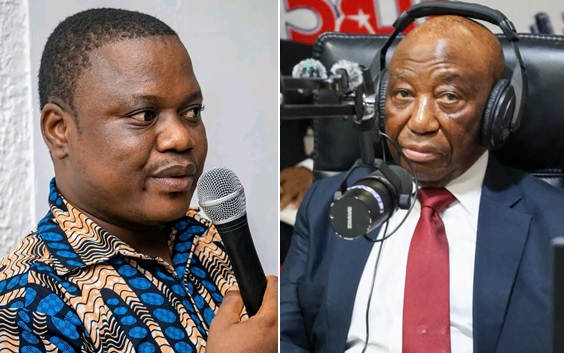
MONROVIA – President Joseph Nyuma Boakai’s recent remarks dismissing Liberia’s local radio stations have drawn sharp criticism, raising important questions about leadership engagement, media accountability, and democratic dialogue. Appearing on state radio ELBC on Friday, December 19, 2025, President Boakai stated bluntly: “I don’t listen to radio besides the BBC and ELWA. Too much rudeness on these radio stations.”
The President’s statement, delivered during a public address on local airwaves, immediately drew concern from media advocates and governance watchdogs, who view radio as Liberia’s most accessible and influential platform for public discourse. Among the strongest responses came from the Executive Director of the Center for Transparency and Accountability in Liberia (CENTAL), Mr. Anderson D. Miamen.
In a statement published on his official Facebook page the following day, Miamen challenged both the substance and implications of the President’s claim. Writing under the title “It is the President’s Right to Not Listen to Local Radio Stations, But He Cannot Use ‘Abuse’ as an Excuse,” Miamen made clear that his disagreement was not about Boakai’s personal media preferences, but about what he described as an unfair generalization of Liberia’s broadcast media.
“Today, while on ELBC and other local radio stations addressing the public, President Boakai… said he does not listen to local radio stations because they allow so much ‘abuses or foul languages,’” Miamen wrote. He added pointedly, “I strongly disagree, not with the president’s right to listen or not listen to radio, but the justification provided.”
Miamen argued that the President’s characterization wrongly undermines the work of responsible media managers and editors who, he said, actively police their platforms. According to him, many stations enforce standards that prevent insults and promptly rebuke or cut off callers who cross the line. “You cannot use few bad apples to characterize radio stations as such,” he stressed.
Questioning the consistency of the President’s claim, Miamen asked whether leading stations such as OK FM, Prime FM, and even ELBC itself suddenly became “abusive” only after the elections. He noted that these same platforms were heavily utilized by President Boakai and his allies in the past, including during the just-ended electoral campaign, without being described as rude or foul.
Miamen further pointed out the contradiction in criticizing local radio while simultaneously using it to convey official messages. “Were they abusive when he excellently used them today to communicate his messages to the public?” he asked, suggesting that the President’s remarks risk delegitimizing institutions that remain central to public communication.
Beyond the issue of fairness, Miamen warned of the governance implications of a president distancing himself from local radio. He described it as “problematic” that a national leader would choose not to monitor what he called the leading channel through which Liberians provide feedback, voice grievances, and engage with their government.
According to Miamen, disengagement is not a solution to challenges around offensive language. “Boycotting radio stations will not solve whatever problems that exist regarding the use of foul languages,” he wrote, arguing instead for collaboration and reform rather than withdrawal.
He concluded by calling for inclusive and practical measures, urging the government to work with the Press Union of Liberia, media owners, managers, and other stakeholders to address concerns about standards and professionalism. In Miamen’s view, constructive engagement rather than dismissal remains essential to safeguarding both free expression and responsible broadcasting in Liberia.