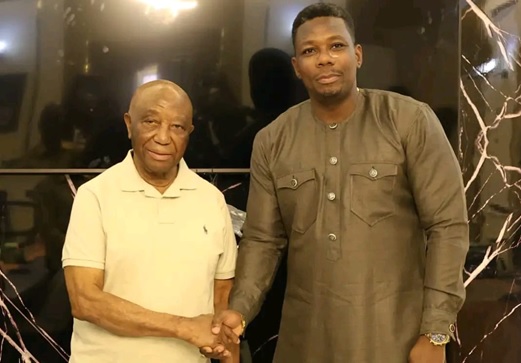
MONROVIA – One week after its high-profile launch drew thousands into the streets of Monrovia, the Liberia Political Centrism Movement (LPCM) has formally pledged its allegiance to President Joseph Nyuma Boakai, affirming that the Administration’s approach to governance aligns with the Movement’s vision for national unity, moderation, and developmental progress. The declaration was made on Saturday, November 29, 2025, when LPCM leaders, headed by Cllr. Kanio Bai Gbala, met with the President to express their commitment to collaborating with the government in support of its national agenda.
During the meeting, Cllr. Gbala told President Boakai that the LPCM’s endorsement was rooted in long-term observation of the President’s leadership style, which he described as focused on healing longstanding divisions, fostering cohesion, and steering Liberia toward sustainable development. He noted that while Liberia’s political discourse often leans toward extremes, the President had demonstrated a consistent effort to build a governance culture grounded in calm, reason, and shared national priorities.
Gbala emphasized that the LPCM is composed of professionals from diverse backgrounds, including a large number of members who previously aligned with the Congress for Democratic Change (CDC). According to him, the Movement was intentionally structured to serve as a bridge across political divides, incorporating Liberians who have no formal political affiliation but are united by a desire for mature political engagement and patriotic responsibility.
He stressed that the Movement was not created to serve as another partisan vehicle but as a platform to promote evidence-based dialogue and cooperation. Politics, he said, must evolve beyond hostility and entrenched animosity, noting that opposition is most effective when anchored in constructive criticism and national interest rather than divisive rhetoric. He argued that Liberia’s political culture must shift toward tolerance, balance, and practical solutions if the country is to overcome decades of stagnation.
Members of the delegation echoed their chairman’s remarks, underscoring their shared concern about Liberia’s future and the need for a new approach to political practice. Several speakers expressed frustration with the prevailing tone of national politics, which they said prioritizes personal and partisan battles over the fundamental needs of the population. They maintained that the LPCM is prepared to help change that dynamic by supporting policies and programs that move the country forward.
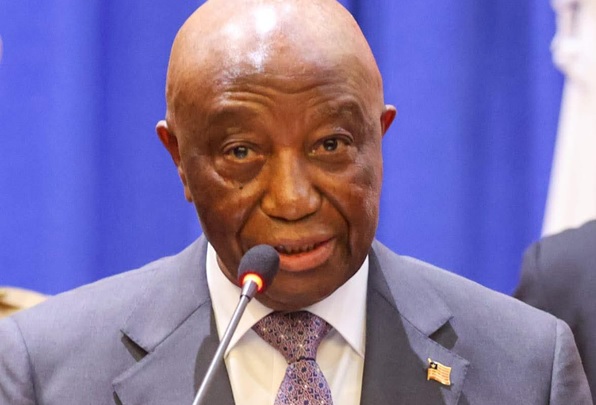
President Boakai welcomed the endorsement, thanking the LPCM for what he described as a timely demonstration of civic responsibility. He told the delegation that his administration is not driven by partisan calculations but by a commitment to improving the welfare of Liberians across all political, ethnic, and economic backgrounds. The President also reminded the group that Liberia’s development depends on collective action, not isolated political agendas.
In remarks that blended reflection and mentorship, President Boakai shared insights from his decades of public service, emphasizing that the real test of leadership lies in one’s ability to unite people of different viewpoints for a shared purpose. He said his administration remains open to all Liberians willing to contribute to national recovery, noting that progress is always stronger when built on broad collaboration.
The meeting concluded with a symbolic gesture from the Movement as its leadership presented the President with an LPCM-branded T-shirt and cap. The gesture, according to Movement officials, represented a formal welcome and a public expression of readiness to stand with the administration in advancing national reforms. President Boakai received the items with gratitude and praised the spirit of unity reflected in the presentation.
The LPCM, which only became a national talking point days ago, has quickly built momentum. On November 22, thousands filled central Monrovia to witness its launch, marking one of the largest civic mobilizations seen in recent years outside of electoral periods. The event was characterized by calls for responsible leadership, national reconciliation, and a rejection of politics driven by extremes.
Cllr. Gbala, an associate professor of law at the Louis Arthur Grimes School of Law at the University of Liberia, has emerged as the face of the movement. His academic background, including a Master of Laws from Ohio Northern University’s Center for Democratic Governance, has shaped the LPCM’s emphasis on constitutionalism, institutional strengthening, and evidence-based policymaking as core strategies for nation-building.
At the launch, Gbala delivered a speech that resonated widely, invoking the words of former U.S. President Barack Obama to reinforce the Movement’s call for unity. He reminded Liberians that progress is impossible when citizens are divided into rigid political camps, urging the country to rediscover the shared values that bind it together. “There is not a liberal America and a conservative America. There is the United States of America,” he said, adapting the message to Liberia’s context and emphasizing that the nation must reject division to achieve lasting development.
Gbala warned that Liberia’s future is endangered by entrenched partisanship, political extremism, and a public discourse that often prioritizes confrontation over constructive engagement. He argued that Liberia must embrace balance, justice, and practical leadership if it hopes to confront corruption, expand economic opportunities, strengthen institutions, and secure a more stable democracy.
As the LPCM transitions from its launch phase into active engagement with national leaders, its endorsement of President Boakai is likely to energize public debate about the country’s political direction. Whether the Movement becomes a lasting force for moderation or another short-lived political experiment will depend largely on its ability to maintain independence, uphold its principles, and influence Liberia’s governance landscape in meaningful ways.