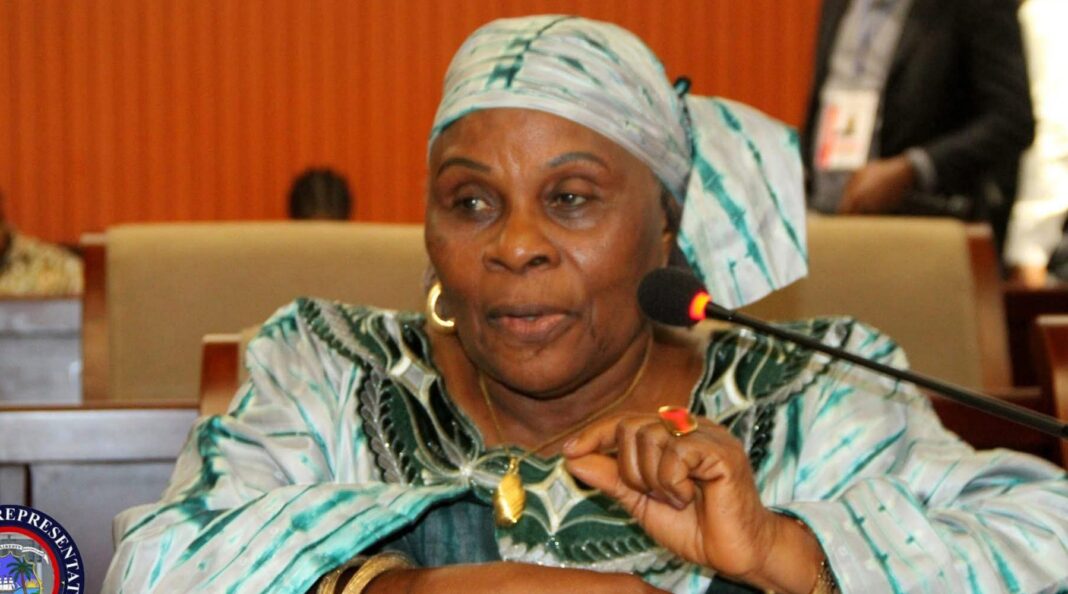
MONROVIA – Grand Gedeh County District #2 Representative Marie G. Johnson has called for a comprehensive investigation into the financial source and legitimacy of the US$6.1 million Mano River Union Center for Regional Peace and Development project in Foya, Lofa County, intensifying public debate already inflamed by controversy over a separate multi‑million‑dollar construction in the same area allegedly tied to President Joseph Nyuma Boakai.
In a formal letter to the House of Representatives on Tuesday, February 10, 2026, Rep. Johnson questioned the establishment, purpose, and legal framework of the MRU Center project, asserting that its scale and significance demand legislative scrutiny, particularly in line with constitutional budgetary oversight and public transparency.
“Transparency and accountability are critical for projects of regional significance, particularly those involving international or sub-regional bodies such as the MRU,” Johnson told lawmakers, underscoring the House’s constitutional responsibility to ensure proper scrutiny of project financing and legislative approval.
Her demand comes against a backdrop of persistent controversy surrounding the so‑called “Foya villa” construction, a multi‑million‑dollar project in President Boakai’s hometown that has sparked public questions about ownership, funding sources, and procurement compliance.
The controversy surrounding the reported US$10 million construction project in President Joseph Nyuma Boakai’s hometown of Foya, Lofa County, has refused to subside, despite repeated assurances from the Executive that the initiative is not for his personal benefit.
Instead of easing public concern, the President’s explanations and the government’s shifting narrative have deepened questions about transparency, accountability, and governance under his administration.
Appearing on state radio ELBC on Friday, December 19, 2025, President Boakai categorically denied that the project was intended as a retirement home or private residence. “I don’t need a retirement home built for me with public funds,” the President said. “God willing, I intend to retire in Foya. I already have a house there, which Samaritan’s Purse used for years, and I plan to rebuild that house for my retirement.”
The President stressed that the development currently underway in Foya has no connection to his personal residence or private interests. “I have never taken government money for any personal use,” Boakai insisted. “The project in Foya is for peacebuilding in the sub-region. It is an international project intended to prepare Foya as a place where crises can be resolved and where international meetings can also take place.”
Boakai further distanced himself from the initiative, claiming it neither originated from him nor bears his name. “It is not a Joseph Boakai project. In fact, it started without my knowledge. You can go there; there is nothing in my name,” he said, adding that funding would come through regional cooperation. “The project will be funded under the Mano River Union,” the President stated.
Pressed on why the project initially proceeded without public disclosure, Boakai acknowledged that the lack of transparency was deliberate. “They knew very well that I would have resisted it at the beginning because I did not want anything done in Foya that could be interpreted as being for me,” he explained, while reiterating that the initiative was not private. He concluded by stating that funding would be shared collectively among Mano River Union member states.
However, months after public exposure of the project, the President has continued to defend it amid mounting contradictions. On Tuesday, December 16, 2025, Information Minister Jerolinmek Matthew Piah rebranded the initiative as the “Mano River Union Presidential Center for Regional Peace and Development,” describing it as a strategic national asset to enhance Liberia’s regional leadership role.
According to Minister Piah, the proposed facility will include a 500-seat conference hall and nine secure residential units on seven acres of land in Foya, designed to host high-level sub-regional, regional, and international meetings. He argued that the center would advance peace, security, and economic integration across the Mano River Basin.
Information Minister Jerolinmek Matthew Piah defended the project on Tuesday, December 16, 2025, describing it as the “Mano River Union (MRU) Presidential Center for Regional Peace and Development,” a strategic national asset aimed at enhancing Liberia’s regional leadership role. Piah emphasized that the center will host high-level sub-regional, regional, and international meetings, with a 500-seat conference hall and nine secure residential units on seven acres in Foya. According to him, the facility is designed to advance peace, security, and economic integration across the Mano River Basin.
Deputy Information Minister Daniel Sando’s earlier remarks linking the project to the MRU only amplified public distrust. His claims, aired on Punch FM on September 29, 2025, were swiftly contradicted by the MRU Secretariat, which confirmed no involvement in constructing presidential villas.
Ambassador Simeon Moribah, MRU Secretary General, reaffirmed that the organization’s mandate focuses on trade, security, and human development, not personal presidential estates.
Deputy Information Minister Daniel Sando’s comments on Monday, September 29, 2025, on the controversial US$10 million Presidential Villa project in Foya District, Lofa County, have exposed more than just a communication misstep. They have deepened public distrust in President Joseph Boakai’s administration.
By suggesting on Punch FM that the construction was part of a broader Mano River Union (MRU) project, Sando not only embarrassed the government but also drew the MRU into a national scandal it clearly wants no part of.
The MRU Secretariat’s swift and cautious statement speaks volumes. It did not confirm Sando’s claims, nor did it endorse the government’s position. Instead, the Secretariat distanced itself, noting it was “not prepared to engage on issues related to allegations or rumors.”
That careful phrasing is diplomatic language for ‘don’t drag us into your mess without evidence. In governance, perception often matters as much as reality. When a regional body declines to backstop your spokesperson, it reflects poorly on the administration’s credibility.
This entire saga began when Eddie D. Jarwolo, Executive Director of NAYTOME-Liberia, publicly questioned the rationale behind constructing a multimillion-dollar villa in the President’s hometown, a place where residents remain deprived of basic services like health care, education, and jobs.
Jarwolo’s criticism struck a nerve, and rather than calmly providing facts, the government’s deputy spokesman dismissed it as “politically motivated.” Such deflections are not governance; they are political spin.
The villa, constructed by MUSNS Groups Incorporated and led by Joe Mulbah, a known associate of President Boakai, with Edward Yamba as chief engineer, raises red flags about conflicts of interest. Liberia has seen this playbook before, with leaders cloaking personal luxuries as public interest projects, with little transparency about financing. It is repeat of the worst kind.
However, in response to these concerns, the House leadership has scheduled a closed‑door hearing on February 16, 2026, inviting officials from the Ministry of Finance and Development Planning, the Public Procurement and Concessions Commission, and the Ministry of Public Works to clarify the MRU Center project’s funding, legal authority, and procurement framework.