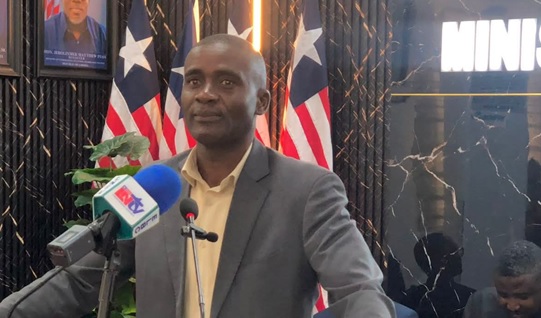
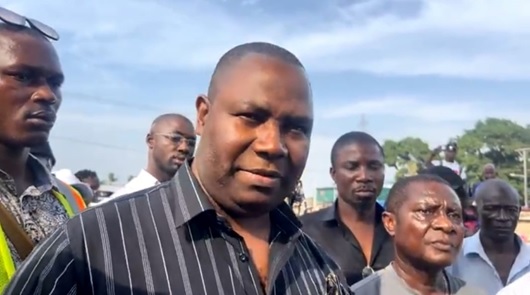
MONROVIA – The brutal demolition of homes in Saye Town has erupted into a full-blown political and moral confrontation, pitting Unity Party Chairman Rev. Luther Tarpeh against the activist movement STAND, led by its outspoken national chairman Mulbah Morlu, over who is genuinely defending displaced residents and who is, in Morlu’s words, “an agent of the perpetrators.”
At the heart of the controversy is the demolition exercise that left dozens of families homeless after armed police officers moved in under what critics describe as a corrupt and weaponized court order. For the victims, the destruction was not only physical but symbolic of a state increasingly accused of siding with power over people.
It was against this backdrop that Rev. Luther Tarpeh visited Saye Town on Thursday, February 5, 2026. During the visit, the Unity Party chairman pledged to mobilize a team of lawyers to represent the affected residents, many of whom insist they legally own the land on which their homes once stood.
Tarpeh also presented L$800,000 to the displaced families, saying the money was meant to help them address immediate needs such as food, shelter, and basic survival while legal proceedings are pursued. He assured residents that the Unity Party would not abandon them in their search for justice.
However, Tarpeh’s intervention was swiftly and aggressively rejected by Mulbah Morlu, national chairman of Solidarity and Trust for a New Day (STAND). Morlu accused the Unity Party chairman of hypocrisy and complicity, arguing that Tarpeh’s gesture amounts to political theater rather than genuine solidarity.
“Government agents who branded our defense of the Saye Town victims as ‘political’ are now cheering UP’s Luther Tarpeh for handing out L$800,000 and promising lawyers,” Morlu charged. “The same agents of the perpetrators who bulldozed people’s homes now claim they want to help them in court.”
Morlu went further, warning residents that Tarpeh is not a savior but “another messenger of the destroyers,” likening him to other political figures he accuses of masking injustice with sympathy. He alleged that the courts where Tarpeh’s lawyers would operate are already controlled by the same system that authorized the demolitions.
Addressing the victims directly, Morlu urged them to reject what he called “bite and blow” politics, first destroying communities and then offering money and promises. “Land is life,” he declared, insisting that no amount of money or legal maneuvering should distract residents from resisting dispossession.
STAND’s position is rooted in its earlier press statement issued before Tarpeh’s visit, in which the movement strongly condemned the Saye Town demolition as an illegal, state-backed operation carried out by armed police officers acting on a corrupted court order. The group described the action as heartless and unconstitutional.
According to STAND, Saye Town is only one chapter in a wider land-grab crisis that has already displaced tens of thousands of citizens across Montserrado County. Communities including Stockton Creek, Sinkor–Old Road, New Port Street, Bushrod Island, Brewerville, and Congo Town have all faced similar demolitions, triggering repeated humanitarian emergencies.
STAND further warned that credible information from community-based investigators suggests the so-called “bloody bulldozer” campaign could soon expand to Wroto Town and parts of Paynesville. The movement accused the state of using courts and security forces to advance elite interests at the expense of poor but legitimate landowners.
In a direct indictment of the Boakai administration, STAND accused President Joseph Boakai of silent tolerance. The group argued that the President’s failure to intervene signals acceptance of abuses committed against vulnerable communities, pushing families into homelessness, hunger, and despair.
The movement also criticized former President Ellen Johnson-Sirleaf, saying her endorsement of the demolition campaign reflects a continuation of a Sirleaf–Boakai legacy that displaced thousands during their combined years in power. STAND maintained that respect for the rule of law does not mean accepting its manipulation by judges, officials, and elites.
Legally, STAND insists that the Saye Town demolition violates Articles 20(a) and 22(a) of Liberia’s Constitution, the Land Rights Act of 2018, and other tenure laws. It further argues that the action breaches Liberia’s international obligations under the International Covenant on Economic, Social and Cultural Rights, the African Charter on Human and Peoples’ Rights, and UN guidelines on forced evictions.
In response, STAND has pledged to deploy civil rights advocates, community organizers, and additional lawyers to stand with Saye Town residents. Morlu vowed that STAND leaders would remain on the ground, even sleeping under tents if necessary, until the victims’ lands and rights are restored.